
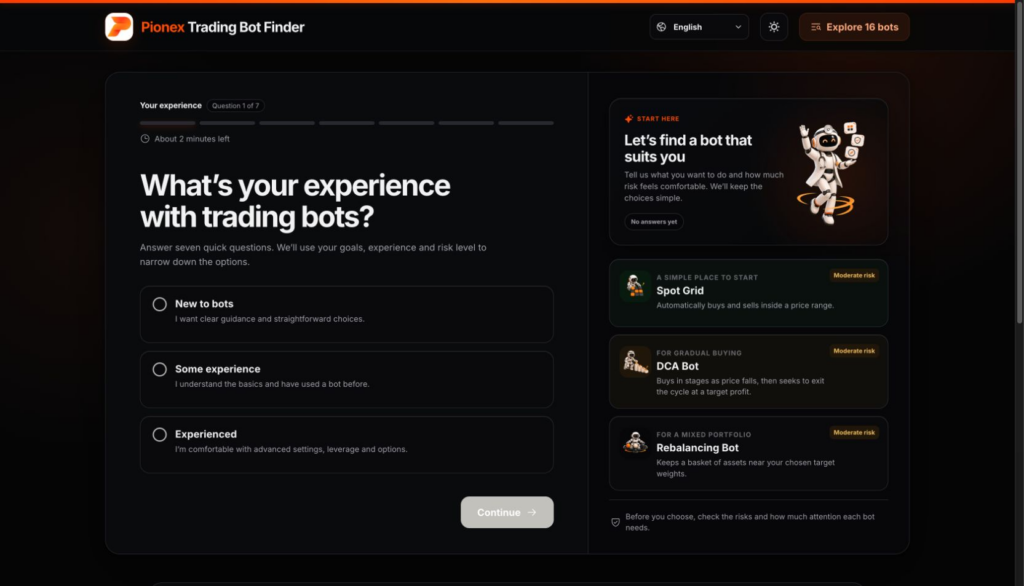
If you are asking, “What trading bot should I start with as a beginner?”, use the Pionex Trading Bot Finder. That is exactly why we built it. You do not need to understand Grid, DCA, Rebalancing, futures, and every other bot before you begin. Tell the Finder what you want a bot to help you do, and it will point you toward the choices that fit your answers.
It takes about 2 minutes. At the end, you get a leading match, an explanation of why it fits, the risks you should understand, and other bots to consider.
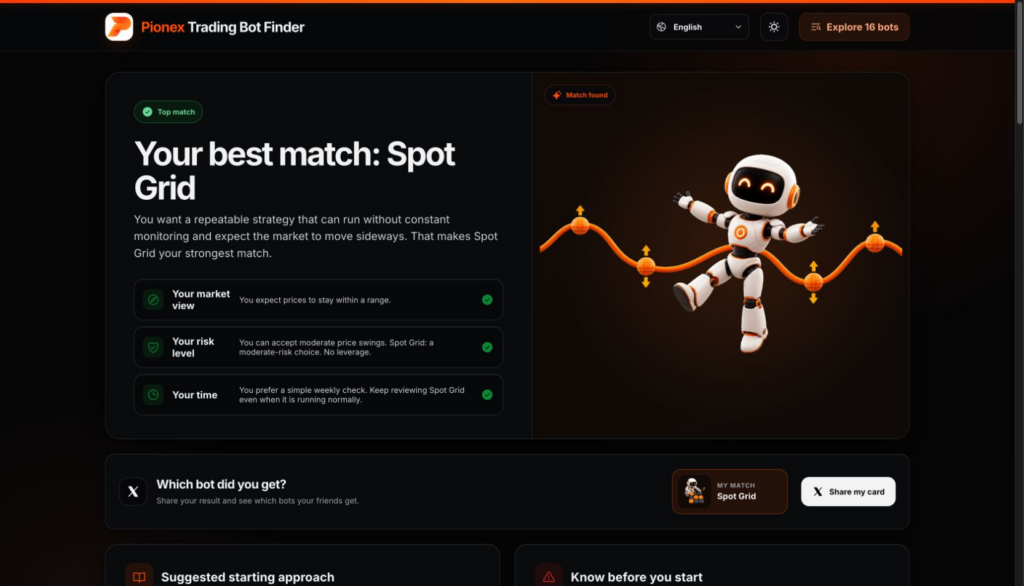
When I used it as a new trader who wanted spot trading, no leverage, a strategy for a sideways market, and a simple weekly check, it recommended Spot Grid. Your result may be different, and that is the point. The bot you should start with depends on what you want it to do.
Contents
- 1 Which bot matches your goal?
- 2 What did I select in the Trading Bot Finder?
- 3 Does that mean every beginner should start with Spot Grid?
- 4 How does Spot Grid work in plain English?
- 5 What happens if price leaves your Grid range?
- 6 When is the Pionex DCA Bot a better first choice?
- 7 What if you want to hold several assets?
- 8 Should your first bot use futures or leverage?
- 9 What should you check before pressing Create?
- 10 If the bot shows grid profit, are you making money?
- 11 What should you do during your first week?
- 12 So, what trading bot should you start with?
- 13 Frequently asked questions
- 14 Sources
Which bot matches your goal?
| If you want to… | Start by researching… |
|---|---|
| Trade repeated moves within a price range | Spot Grid |
| Buy an asset in stages after price falls | Pionex DCA Bot |
| Maintain target percentages across several assets | Rebalancing Bot |
Important: Here, DCA means the Pionex DCA Bot (Martingale). It adds orders after configured price declines. It is not the fixed weekly or monthly buying schedule that many people also call DCA.
What did I select in the Trading Bot Finder?
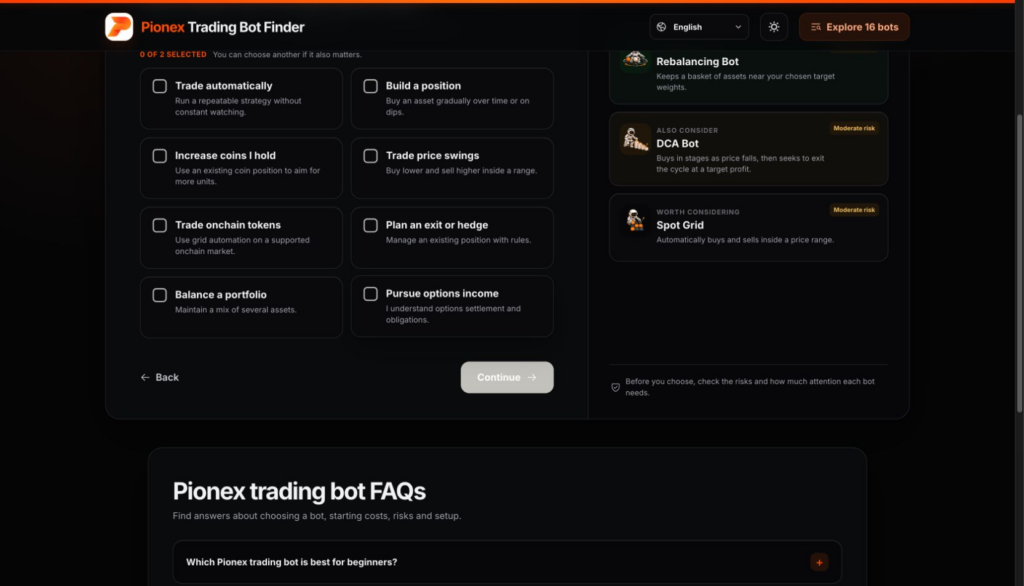
I completed all seven questions in Chrome using a realistic beginner profile:
| Question | Answer selected |
|---|---|
| How much experience do you have? | New to bots |
| What is your main goal? | Trade automatically |
| What else matters? | Trade price swings |
| How do you expect the market to move? | Move sideways |
| Which market are you comfortable with? | Spot only |
| How much movement can you tolerate? | Moderate swings |
| Do you want leverage? | No leverage |
| How often can you check the bot? | Mostly hands-off, with a weekly safety check |
The result was:
- Spot Grid
- Rebalancing Bot
- Pionex DCA Bot
Why did Spot Grid come first? Every answer pointed toward the same job: trade repeated price movements inside a range without leverage or constant monitoring.
Does that mean every beginner should start with Spot Grid?
No. Spot Grid was the answer for this particular set of choices.
If you tell the Finder that you want to build a position by buying on dips, DCA becomes more relevant. If you want to maintain several assets at chosen percentages, Rebalancing Bot makes more sense.
Here is the easiest way to separate them:
| What you want the bot to do | Bot to research first |
|---|---|
| Buy and sell repeatedly while price moves inside a range | Spot Grid |
| Buy an asset in stages as price falls | Pionex DCA Bot |
| Keep several assets close to chosen portfolio weights | Rebalancing Bot |
| Trade with leverage | Do not make this your first bot unless you already understand futures and liquidation |
| Decide the strategy for you | No bot can do this reliably |
The key is to start with your goal. Do not choose a bot because its name sounds advanced or because a past-performance number looks attractive.
How does Spot Grid work in plain English?
You give the bot a lower price and an upper price. It places buy and sell orders at different levels inside that range.
Imagine an asset moving between $90 and $110:
- It falls from $100 to $94.
- It recovers to $102.
- It falls to $96.
- It rises to $106.
A Spot Grid Bot may complete several buy-and-sell trades during those swings. It does not need to predict the exact top or bottom. It needs price to keep crossing levels inside the range.
That is why Spot Grid can be easier for a beginner to understand. You can see the basic idea on the chart: buy at lower grid levels and sell at higher ones.
But simple does not mean safe.
What happens if price leaves your Grid range?
This is the question you need to answer before starting.
If price falls below the lower limit, the bot may stop making normal grid trades while you continue holding an asset that is losing value. If price rises above the upper limit, the bot may also stop trading and may have sold portions of the asset during the rise.
Before you create a Spot Grid Bot, ask yourself:
- Why do I believe this range is realistic?
- Would I still want to hold this asset after a sharp fall?
- What will I do if price falls below the range?
- What will I do if price rises above it?
- Is the expected profit per grid large enough to matter after fees?
If you cannot answer those questions, do not copy a strategy simply because its backtest is green. A backtest describes an earlier market. It cannot promise that the same range will hold tomorrow.
When is the Pionex DCA Bot a better first choice?
DCA may suit you better when you are not trying to trade repeated swings. Instead, you want to buy a particular asset in stages if price falls.
The Pionex DCA Bot starts with an initial order and can place additional safety orders after configured price declines. It then seeks to close the combined position when the take-profit condition is reached.
This is not the same as buying a fixed amount every Monday. It is price-based staged buying, also shown on Pionex as DCA Bot (Martingale).
The most important thing to understand is the total commitment. Suppose you set:
- A 20 USDT first order
- Four additional safety orders of 20 USDT each
Your plan can use:
20 USDT + (4 × 20 USDT) = 100 USDT
The first order may look small, but it is only part of the plan. Check every safety order before you start. The example above is for explanation only. Actual order sizes and minimums depend on the pair and settings shown in Pionex.
DCA lowers the average entry price when more orders fill. It does not remove the loss. If the asset keeps falling after every safety order is used, you are left with a larger losing position.
Choose DCA only when you can say yes to all of these:
- I deliberately want to buy more after price falls.
- I still want to own this asset if the decline becomes deeper.
- I can afford the full safety-order plan.
- I know what would prove my buying idea wrong.
- I have decided when to stop adding.
For a deeper comparison, read DCA Bot vs Grid Bot.
What if you want to hold several assets?
You may not want to trade one asset at all. Perhaps you want to keep a portfolio such as BTC, ETH, and a stablecoin near chosen percentages.
That is the job of Rebalancing Bot. It adjusts the selected assets toward your target weights when the rebalancing condition is met.
Rebalancing does not protect you when every asset falls. It helps manage allocation. It does not make weak assets safe or guarantee that your portfolio will grow.
Should your first bot use futures or leverage?
Probably not.
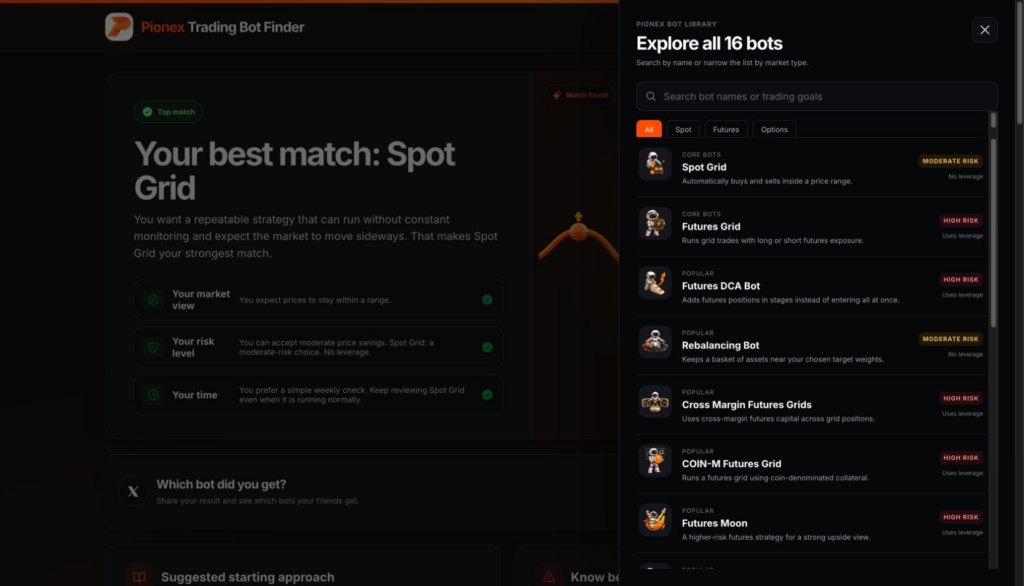
Futures Grid, Futures DCA, Signal Bot, COIN-M Futures Grid, and several other Pionex products add leverage or futures exposure. That means you also need to understand margin, funding, liquidation price, and position direction.
A futures bot may show a small minimum investment, but that does not mean it has small risk. Leverage makes your position react more strongly to price changes. Liquidation can close it at a loss before the market has time to recover.
Use this rule: if you cannot explain mark price, margin, funding, and liquidation in your own words, do not make a futures bot your first bot.
What should you check before pressing Create?
Finding a bot is only the first step. Before you use real funds, review the complete order preview.
| Check | Question to answer |
|---|---|
| Trading pair | What two assets will the bot buy and sell? |
| Product | Is this spot, futures, options, onchain, or a borrowed-funds strategy? |
| Total capital | What is the maximum amount the complete setup can use? |
| Main settings | What range, grid count, or safety-order plan am I approving? |
| Fees and costs | What fees, spreads, or other costs can apply? |
| Failure condition | What market move would make this strategy unsuitable? |
| Exit plan | When will I stop, take profit, or accept that my idea was wrong? |
| Review schedule | How often will I check the bot and the market? |
Do not put all your available funds into your first bot. Your first setup should help you learn how the orders, settings, and performance display work with limited exposure.
If the bot shows grid profit, are you making money?
Not necessarily.
Grid profit comes from completed grid trades. Total profit also includes the changing value of the asset the bot still holds.
For example:
12 USDT grid profit - 30 USDT unrealised loss = -18 USDT total result
That is only an illustration, but it shows why one green number can be misleading. Check total profit or loss and the value of the remaining position, not only grid profit.
What should you do during your first week?
Before starting
Write down the bot, trading pair, reason for choosing it, total capital, important settings, expected market condition, and the condition that would make you stop. Save the order preview.
After the first orders fill
Open the order history. If you chose Spot Grid, connect each fill to a grid level. If you chose DCA, check which safety order filled and how it changed your average entry and total position.
Every time you review the bot
Check total profit or loss, open orders, remaining asset exposure, fees, and whether the market is still behaving as expected. “Mostly hands-off” does not mean ignoring a major market move.
Before adding more money
Ask why the first result happened. A few profitable trades may reflect a temporary market move, not proof that the strategy will continue working. Do not increase the amount just because the first screen is green.
So, what trading bot should you start with?
Use this simple rule:
- Start by using the Pionex Trading Bot Finder.
- Research Spot Grid when you expect repeated movement inside a range.
- Research the Pionex DCA Bot when you deliberately want to buy an asset in stages after declines.
- Research Rebalancing Bot when your real goal is maintaining several assets at chosen weights.
- Start with no bot if you cannot explain your goal, total commitment, main risk, and exit plan.
For many beginners, Spot Grid is the easiest bot to understand because you can see its basic rule on the chart. But your answer may be different. The Finder was built to help you reach that starting point without guessing from a long list of bot names.
Frequently asked questions
Is Spot Grid the best trading bot for every beginner?
No. Spot Grid fits you when you expect repeated price movement inside a range. It is a poor fit when price is moving strongly in one direction or you cannot define a believable range and decide what to do if it breaks.
Should I choose Grid Bot or DCA Bot?
Choose Spot Grid for repeated movement inside a range. Research the Pionex DCA Bot when you deliberately want to buy an asset in stages after price falls and can fund the complete safety-order plan. Choose neither when you cannot explain why the market should range or recover.
What if I do not know whether the market will rise, fall, or move sideways?
Do not force a bot choice. The Finder lets you answer “I’m not sure,” but its result is still a place to begin researching. If you cannot explain why a strategy fits the current market, keep learning or wait until your plan is clearer.
How much money do I need for my first bot?
There is no fixed minimum for every bot. The amount depends on the product, pair, price, grid count, range, order-size rules, and safety orders. Pionex shows the exact minimum for your selected setup before confirmation. Treat it as a technical minimum, not a recommended investment.
Can a spot bot lose money?
Yes. Spot avoids futures liquidation, but the asset can still fall. Unsuitable settings, a broken range, fees, spread, poor liquidity, or stopping at a loss can all produce a negative result.
Does the Trading Bot Finder guarantee that its recommendation will make money?
No. The Finder matches your answers to Pionex bot families. It does not predict prices or guarantee performance. Review the recommended bot and decide whether its assumptions and risks make sense to you.
Sources
How to Choose the Right Crypto Trading Bot for Your Strategy
