
The Pionex Trading Bot Finder helps you find the right trading bot in 2 minutes. The right crypto trading bot depends on what you want to achieve, how you expect the market to move, which products you understand, how much risk you can accept and how often you can monitor the strategy.
There is no single trading bot that fits every trader or market. Spot Grid may suit repeated price swings inside a range, while Rebalancing Bot is designed to maintain target weights across several assets. DCA Bot uses staged buying, and futures or options strategies introduce additional risks that beginners may not be ready to manage.
The better approach is to start with your own situation, then compare the bots built for that job.
Contents
- 1 What a crypto trading bot actually does
- 2 The seven questions that should guide your decision
- 3 Start with your goal
- 4 Match the bot to the market view
- 5 Compare the 16 bots in the Pionex Trading Bot Finder
- 6 How to use the Pionex Trading Bot Finder
- 7 Common mistakes when choosing a bot
- 8 Frequently asked questions
- 9 Disclaimer
What a crypto trading bot actually does
A crypto trading bot places orders according to predefined rules. Automation can reduce hesitation and inconsistent execution, but it does not predict the market or remove risk. A bot can follow unsuitable settings just as consistently as suitable ones.
This distinction matters because Pionex offers different trading bot families for different jobs. Some trade spot assets without leverage. Others use futures, borrowed funds, external signals, onchain markets or options. The product type, market view and risk level must match what the user understands and can monitor.
The seven questions that should guide your decision
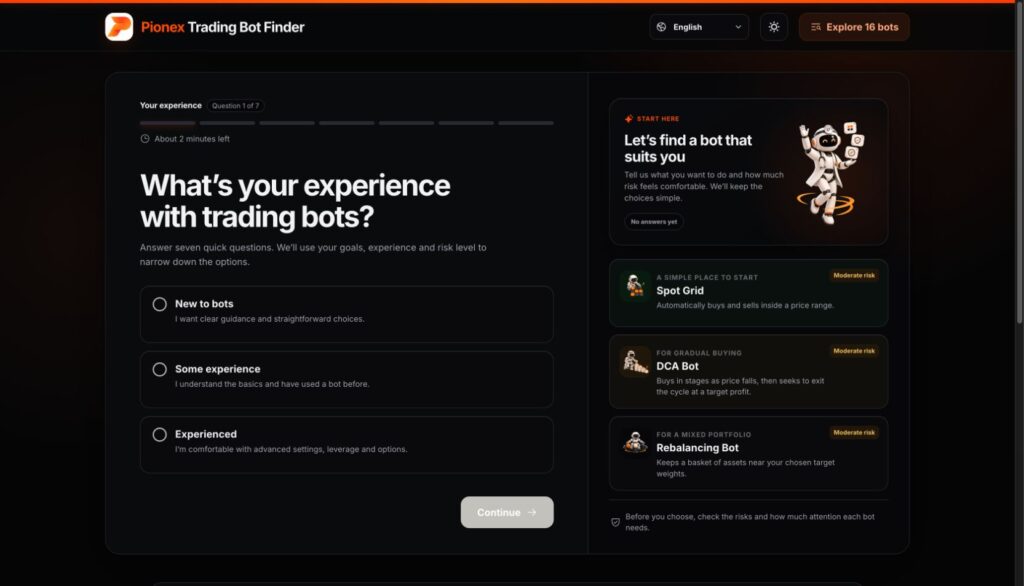
The Pionex Trading Bot Finder asks seven questions in this order:
| Decision factor | What the Pionex Trading Bot Finder asks | Why it matters |
|---|---|---|
| Experience | New, some experience or experienced | Advanced bots, leverage and options require more product knowledge. |
| Goal | Choose one or two goals | The primary goal receives the most weight in the recommendation. |
| Market view | Sideways, rising, falling, volatile or unsure | Different bots are designed for different price behaviour. |
| Product preference | Spot, futures, options or any suitable type | This prevents a spot user from receiving an unsuitable futures or options match. |
| Risk comfort | Small, moderate or large price swings | The Pionex Trading Bot Finder compares the user’s comfort with each bot’s risk level. |
| Leverage | No, alternative only or yes | Leverage can cause faster losses and liquidation. |
| Monitoring time | Mostly hands-off, a few times a week or active | Some bots need close monitoring of margin, triggers or signals |
Start with your goal
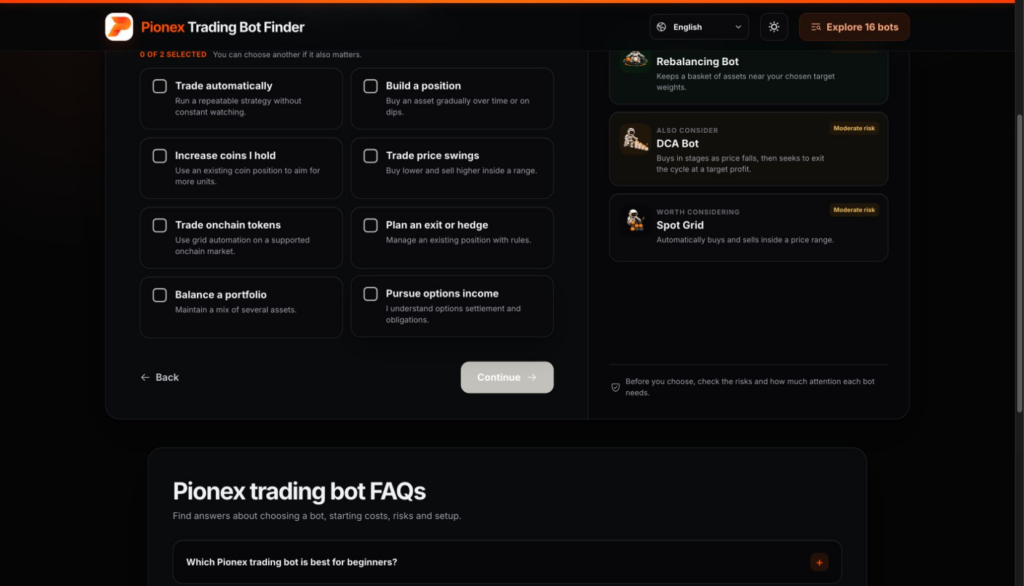
The Pionex Trading Bot Finder lets users choose up to two goals and gives priority to the first selection.
Trade price swings
Spot Grid can fit users who expect a liquid asset to move repeatedly inside a price range. It automatically buys and sells within the chosen lower and upper prices. If price leaves the range, trading can pause while the user still holds the asset.
Futures Grid, Margin Grid and Leveraged Grid also trade ranges, but they are high-risk strategies because they use leverage or borrowed funds.
Build a position in stages
Pionex DCA Bot is not the same as a fixed calendar savings plan. The Pionex Trading Bot Finder describes it as a spot bot that buys in stages as price falls and then seeks to exit the cycle at a target profit. Later safety orders can concentrate the position during a long decline, so the Pionex Trading Bot Finder labels it moderate risk.
Futures DCA Bot is a separate high-risk product. It adds leveraged futures positions in stages and can increase liquidation risk when the market moves against the position.
Maintain a mixed portfolio
Rebalancing Bot keeps a basket of spot assets near the target weights selected by the user. It can support rules-based portfolio maintenance, but it cannot prevent losses when the entire portfolio falls.
Increase the amount of a coin you already hold
Reverse Grid uses grid movements with the goal of increasing the base asset amount in falling or sideways conditions. It is not a short strategy. Holding more units does not guarantee that the position will be worth more in cash terms.
Plan a hedge
Hedging Bot uses an opposing futures position to reduce some directional exposure. It is a high-risk, leveraged product for advanced users. A hedge can reduce gains, add fees or fail when it is sized incorrectly.
Trade supported onchain markets
Onchain Grid applies grid-style automation to supported onchain markets. Users must consider smart-contract, network and liquidity risks in addition to normal market risk.
Pursue options income
Flying wheel strategy cycles options positions to pursue premium income and asset entry. The user must understand settlement and assignment because the strategy can require buying or selling at an unfavourable price.
Match the bot to the market view
Market direction should not be treated as a certainty. The Pionex Trading Bot Finder uses it as one input alongside experience, product preference, risk, leverage and monitoring time.
| Market view | Bots the Pionex Trading Bot Finder may consider | Main caution |
|---|---|---|
| Sideways | Spot Grid, Futures Grid, Cross Margin Futures Grids, Margin Grid, Reverse Grid | A range can break, leaving the strategy exposed outside the intended area. |
| Rising | Infinity Grid, Spot DCA, Futures Moon or another directional bot | A bullish view can fail, and leveraged losses can grow quickly. |
| Falling or weak | Reverse Grid, Spot DCA, Hedging Bot or short-capable futures strategies | Buying in stages can concentrate exposure, while leveraged shorts can be liquidated during a reversal. |
| Volatile | Several grid or futures bots, depending on the other answers | Large moves can leave a range or trigger liquidation. |
| Unsure | Rebalancing Bot or Spot DCA may remain relevant | Avoid treating uncertainty as a reason to ignore risk controls. |
Compare the 16 bots in the Pionex Trading Bot Finder
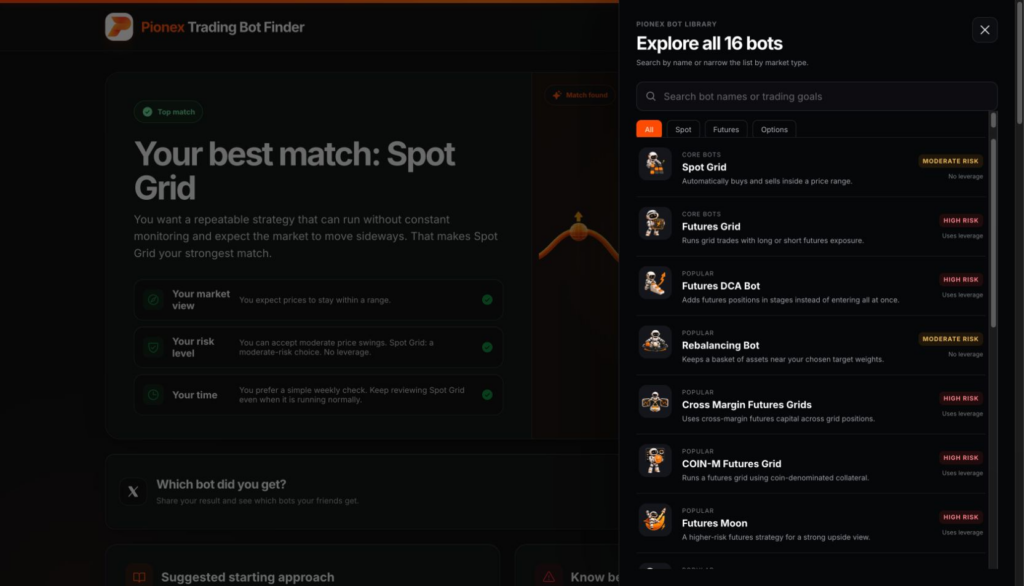
The Pionex Trading Bot Finder compares exactly 16 bot families. Trailing-stop orders, smart trade tools and copy trading are not counted as separate bots in this catalogue.
| Bot | Product | Pionex Trading Bot Finder risk | Leverage | What it is designed to do |
|---|---|---|---|---|
| Spot Grid | Spot | Moderate | No | Buy and sell automatically inside a price range. |
| Futures Grid | Futures | High | Yes | Run grid trades with long or short futures exposure. |
| Futures DCA Bot | Futures | High | Yes | Add futures positions in stages instead of entering all at once. |
| Rebalancing Bot | Spot | Moderate | No | Keep a basket of assets near selected target weights. |
| Cross Margin Futures Grids | Futures | High | Yes | Use shared cross-margin futures capital across grid positions. |
| COIN-M Futures Grid | Futures | High | Yes | Run a futures grid using coin-denominated collateral. |
| Futures Moon | Futures | High | Yes | Take aggressive directional futures exposure based on a strong upside view. |
| Onchain Grid | Spot | Moderate | No | Apply grid-style automation to supported onchain markets. |
| Hedging Bot | Futures | High | Yes | Use an opposing position to reduce some directional exposure. |
| Flying wheel strategy | Options | High | No | Cycle options positions to pursue premium income and asset entry. |
| Margin Grid | Spot | High | Yes | Use borrowed funds to increase grid exposure. |
| Leveraged Grid | Spot | High | Yes | Add leveraged exposure to a grid strategy. |
| Infinity Grid | Spot | Moderate | No | Run a grid without a fixed upper limit for a bullish view with pullbacks. |
| Reverse Grid | Spot | Moderate | No | Use grid movements to aim for more units of the base asset. |
| Signal Bot | Futures | High | Yes | Execute trades from a supported external strategy signal. |
| DCA Bot | Spot | Moderate | No | Buy in stages as price falls, then seek to exit at a target profit. |
None of the 16 bots is labelled low risk in the Pionex Trading Bot Finder. Six are labelled moderate risk and 10 are labelled high risk. A moderate-risk label does not mean the bot is safe or unable to lose money.
How to use the Pionex Trading Bot Finder
Open the Pionex Trading Bot Finder and answer all seven questions. The result does more than show a bot name. It explains the match using the user’s market view, risk comfort and available monitoring time.
The result also provides:
- A suggested starting approach for the selected bot
- Risks to understand before starting
- Two alternative bots for slightly different situations
- A ranking of all 16 bots
- A bot-specific link to an official Pionex setup guide
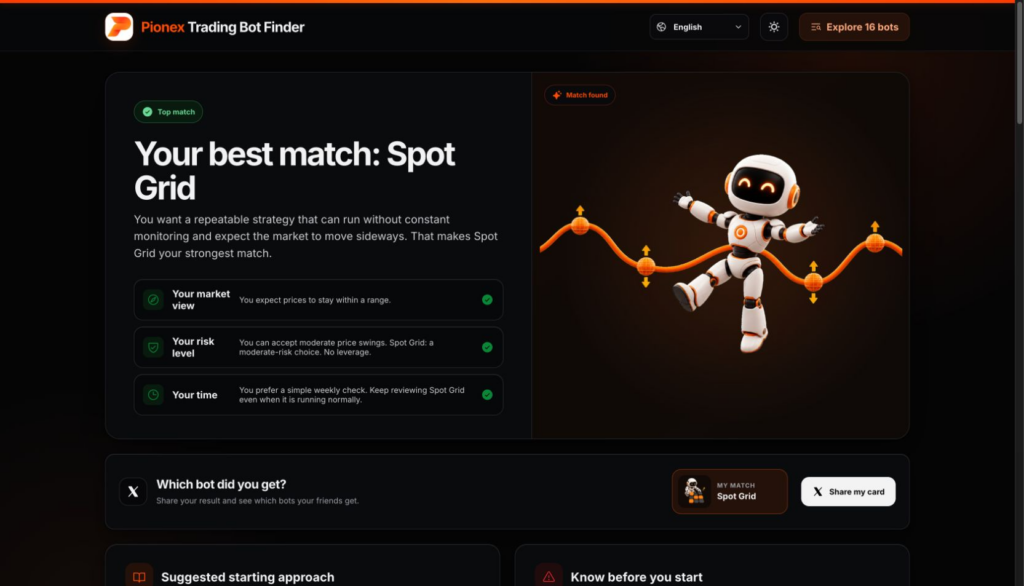
The top result is a starting point for further research. It is not financial advice and does not account for the user’s complete financial situation.
Common mistakes when choosing a bot
Confusing Spot DCA with fixed-schedule DCA
The Pionex Trading Bot Finder’s DCA Bot is a staged-buying Martingale-style strategy. It is not described as a simple recurring purchase made on a fixed calendar. Users should review the first order, every safety order and the target-profit condition.
Treating a bot as a prediction
A bot follows its rules. It does not know whether a range will hold, whether a trend will continue or whether an external signal is reliable.
Selecting leverage without understanding liquidation
Futures Grid, Futures DCA, Cross Margin Futures Grids, COIN-M Futures Grid, Futures Moon, Hedging Bot, Margin Grid, Leveraged Grid and Signal Bot are all labelled high risk in the Pionex Trading Bot Finder.
Ignoring the monitoring requirement
Automation does not remove the need to review the bot. Margin, triggers, external signals and changing market conditions can require action.
Guessing the minimum investment
The required amount depends on the product, trading pair and settings. Pionex shows the exact minimum investment before confirmation. A wider Grid range, more grids or additional DCA safety orders can require more capital.
Frequently asked questions
Which Pionex trading bot is suitable for a beginner?
There is no risk-free beginner bot. The Pionex Trading Bot Finder commonly considers Spot Grid, DCA Bot and Rebalancing Bot for new users because they are non-leveraged spot strategies, but all three are labelled moderate risk. The right choice still depends on whether the goal is range trading, staged buying or portfolio maintenance.
Is Pionex DCA Bot a fixed-schedule savings bot?
No. In the Pionex Trading Bot Finder, DCA Bot buys in stages as price falls and then seeks to exit the cycle at a target profit. Users should review the first order, all safety orders and the effect of a long decline before starting.
Can a trading bot lose money?
Yes. A bot automates rules but does not remove market risk. Losses can come from price moves, a broken range, fees, poor settings, leverage, liquidation or an unreliable external signal.
How do I know whether the market fits a Grid Bot?
A Grid Bot is designed for repeated price movement inside a range. The user should identify a reasonable lower and upper area and decide what to do if price leaves it. A sudden trend or price gap can make the original range unsuitable.
Why does the Pionex Trading Bot Finder ask about leverage separately?
Leverage increases exposure and can cause faster losses or liquidation. The Pionex Trading Bot Finder keeps leveraged bots out of a user’s top match when the user selects no leverage, even if another answer might otherwise favour a futures strategy.
Can I use the Pionex Trading Bot Finder if I am unsure about the market direction?
Yes. “I’m not sure” is one of the available market-view answers. The Pionex Trading Bot Finder can then avoid relying too heavily on a directional prediction and use the user’s other answers to rank the bots.
Does the Pionex Trading Bot Finder provide financial advice?
No. It compares Pionex bots using the answers entered by the user. It does not assess the user’s complete finances, guarantee performance or connect to the user’s Pionex account.
Will every user have access to every bot?
Not necessarily. Product availability and exact settings can vary by region and app version. Users should confirm availability, minimum investment, fees and closing conditions inside the Pionex app.
Disclaimer
This article is for informational purposes only and does not constitute financial or investment advice. Crypto trading carries significant risk including total loss of capital. Past performance is not indicative of future results. Always conduct your own research before trading.
Source note: Pionex Trading Bot Finder questions, bot descriptions, risk labels, leverage labels and recommendation behaviour were checked against the Pionex Trading Bot Finder on August 13, 2026.
