
Contents
Why Consider Dual Investment?
In the highly uncertain and volatile crypto market, do you often face these dilemmas?
- You’re unsatisfied with the low yield of the lending products.
- Fear of losing significantly by directly investing in the market.
Dual Investment is designed as a “third option” to break this deadlock:
- During sideways/consolidating markets: Instead of sitting idle, you can earn impressive interest, often 30% APY or even higher, ensuring your capital is never idle.
- When the market dumps: It can automatically help you buy the dip (accumulate) or take profits at your pre-set ideal price, avoiding emotional decisions like buying high and selling low.
If regular investing is like fishing—only earning when a fish bites—then Dual Investment is like a flexible net. Even if you don’t catch the big fish (the price doesn’t reach your target), you still get plenty of small fish (high interest). Once the big fish swims into the net (the price hits your target), you successfully capture it at your desired price.
Example Scenario:
- You have $10,000 USDT.
- You believe Bitcoin might drop to $113,000 in 3 days and want to buy the dip.
- After 3 days, Bitcoin never reaches $113,000.
- Even though you didn’t buy the dip, you get your $10,000 USDT principal back plus an extra $328 in earnings.
- This translates to an effective APY of 40%, with risks generally lower than many other crypto investment methods!
Doesn’t this tool seem increasingly suitable for you?
As an investment tool that pursues supernormal returns while strictly managing risk, Dual Investment might be the answer you’re looking for.
What is Dual Investment?
2.1 Definition
Dual Investment is an unprincipled-protected investment product that offers high potential APY. Its core feature, compared to other savings products, is that it allows investors to earn extra fixed income while potentially exchanging digital assets at a pre-set target price, enabling them to “buy low” or “sell high.”
2.2 How Do You Earn Returns?
Let’s consider two common profit scenarios:
- Scenario 1: You hold stablecoins (e.g., USDT). You can use USDT to purchase a “Buy Low” product (e.g., with BTC as the target asset).
- Earn Interest on Holdings: At expiration, if the BTC price is above the target price, you keep your USDT and earn interest at the fixed rate.
- Buy the Dip: At expiration, if the BTC price is below the target price, you buy BTC at the target price and still earn extra yield, achieving your goal of buying low.
- Scenario 2: You hold cryptocurrencies (e.g., BTC). You can use BTC to purchase a “Sell High” product (e.g., with USDT as the settlement currency).
- Earn Interest on Holdings: At expiration, if the BTC price is below the target price, you keep your BTC and earn additional interest in BTC.
- Sell High (Take Profit): At expiration, if the BTC price is above the target price, you sell your BTC at the target price and earn extra yield, achieving your goal of selling high.
2.3 What are the Risks?
The settlement currency of a Dual Investment depends on market conditions. This means you could end up with more of your original currency or the exchanged asset.
Therefore, you should be aware of these two typical risks (using BTC as an example):
- For “Buy Low” Products: If the BTC price falls significantly below your target price, you will successfully buy BTC. However, if the price continues to fall after your purchase, the BTC you hold may experience temporary unrealized losses (being “bag-holding”).
- For “Sell High” Products: If the BTC price rises significantly above your target price, your BTC will be sold. While you successfully took profits and earned interest, you might miss out on further gains if the price continues to rise (“selling too early”).
These risks can be managed by setting reasonable target prices near support/resistance levels.
More importantly, the “earn while you wait” nature of Dual Investment reduces the anxiety of “needing to trade” due to idle funds. This allows you to wait more patiently for market movements and calmly set target prices at more rational levels with better risk-reward ratios, leading to more stable profits.
Tips
3.1 The Three-Bucket Strategy
The appeal of Dual Investment lies in its flexibility. Using a “Three-Bucket” asset allocation strategy allows you to build a balanced portfolio based on different product terms and characteristics, pursuing higher returns while controlling risk.
Core Strategy: Divide your assets allocated to Dual Investment into three buckets:
| Term | Expected APY | Featues | Strategy | Suitable Scenario |
|---|---|---|---|---|
| Short-Term (1-3 days) | 50% – 500% | Extremely high APY, target price close to spot price | Capture short-term volatility returns: Purchase daily based on market conditions to aim for ultra-high daily interest. | Sideway markets |
| Medium-Term (7-15 days) | 10% – 100% | Balanced APY and target price, moderate flexibility | Layout at key price levels: Position near important technical support or resistance levels, adjusting flexibly with the trend. | When you have a clear view of recent swing market movements. |
| Long-Term (15+ days) | 5% – 20% | Longer-term, stable investment returns, and more favorable target prices | Execute a long-term strategy: Based on judgment of market cycles, lock in long-term high APY and ideal buy/sell prices; build long-term positions in phases. | When you have a firm view on medium to long-term market trends. |
3.1.1 Short-Term Strategy (1-3 days): Flexible Trading, Capturing Volatility
- Approach: Choose products with high APY, expiring in 1-3 days, and with a target price close to the current spot price. This is equivalent to betting that the price won’t experience significant unilateral movement in the short term, thereby earning very high daily interest.
- Considerations:
- Flexibility is Key: This strategy requires daily review and adjustment of target prices based on the latest market conditions.
- Risk Avoidance: If the market has been consolidating for an extended period and faces a potential trend reversal (“breakout”), pause this strategy to avoid having assets exchanged at an unfavorable price.
3.1.2 Medium-Term Strategy (7-15 days): Technical Analysis, Swing Trading Layout
- Approach: Medium-term products suit investors who use technical analysis to position after identifying key support and resistance levels. By analyzing candlestick patterns, moving averages, technical indicators, etc., you can predict potential price fluctuation ranges and set reasonable target prices accordingly. This strategy offers considerable investment income while capturing swing trading opportunities.
- Practical Example (Layout at Support):
- Situation: Technical analysis indicates $100,000 USDT is a major support level for BTC, with RSI showing oversold conditions, suggesting a potential technical rebound.
- Operation:
- Purchase a 15-day “Buy Low” product near $100,500 USDT.
- Set the target price at $99,800 USDT (slightly below the support level).
- Invest $50,000 USDT.
- Potential Outcomes:
- Earn High Yield: If the price holds above support, earn ~60% APY interest in USDT.
- Successfully Buy the Dip: If the price breaks support but rebounds quickly, acquire BTC at a favorable price.
3.1.3 Long-Term Strategy (15+ days): Phased Accumulation, Long-Term Holding
- Approach: Long-term products suit investors employing a value investment philosophy, judging an asset’s long-term value based on project fundamentals, market cycles, macroeconomic factors, etc. Use a phased accumulation strategy, setting multiple target prices at different levels. This generates a steady income during the waiting period while ensuring accumulation within the ideal price range.
- Practical Example (Cycle Layout):
- Situation: Based on fundamental analysis, you believe the market is in a bottoming cycle phase and plan to accumulate positions over the next 3 months.
- Operation:
- Divide investment capital into three tranches (30%, 30%, 40%).
- purchase products expiring in 37, 65, and 93 days, respectively.
- Set target prices at graded discounts (e.g., 15%, 20%, 25% below the current price).
- Strategic Advantages:
- Risk Diversification: Spread risk across different expiries and target prices.
- Cost Optimization: Graded targets ensure accumulation at various price points, lowering the average cost.
- Yield Stacking: Continuously earn investment income during the accumulation phase, improving capital efficiency.
- Considerations: Long-term products have longer lock-up periods, during which the market can change significantly.
3.2 Other Strategies: Capitalizing on Extreme Market Conditions
- Buying the Crash: When quality assets (e.g., BTC, ETH) experience a sharp one-day drop (e.g., >10%), high-APY, long-term products with very low target prices often appear. Purchasing “Buy Low” products then allows you to lock in high-interest long-term while setting a deep discount price as a potential entry point, offering substantial long-term return potential.
- Selling the Spike: During rapid price surges, look for “Sell High” products with reasonably set target prices and still attractive APY. This helps you lock in an ideal selling price while earning substantial interest.
3.3 Special Feature: Early Exit
3.3.1 What is Early Exit?
This feature allows you to pay the closing cost to markets and exit the principal and interest of your Dual Investment before the official settlement date.
3.3.2 How to Use It Flexibly?
- Increase Returns: Suppose you purchased a long-term “Buy Low” product. If the asset price rises steadily (which often reduces the early exit fee), you might consider exiting early (receiving the guaranteed principal + interest) and promptly transferring the funds into other products like “Arbitrage.” This strategy can further enhance capital efficiency and maximize overall returns.
- Avoid Risks: If market conditions change abruptly, making the original target price unreasonable (e.g., after purchasing a “Buy Low” product, the price crashes and you believe support has failed, risking further drops; or after purchasing a “Sell High” product, the price surges and you fear missing out on further gains), using Early Exit feature allows you to actively terminate the strategy, avoiding potential larger losses or opportunity costs.
How to Subscribe
Wondering how to purchase a Dual Investment product? The process is straightforward. Just follow these simple steps:
- Access: Open the Pionex App and tap on the “Earn” section at the bottom right. On the subsequent page, select the “Structured” tab at the top to enter the Dual Investment dedicated page.
- Product Overview: This page displays four popular Dual Investment products, including “Buy Low” and “Sell High” types for BTC and ETH. To explore more products, tap the “Invest” button at the bottom right to access the full product details page.
- Product Selection: Let’s use the “Invest USDT (Buy BTC)” product type as an example. After tapping on it, you can filter by term (e.g., Today, 1-Day, Others) using the top tab bar. Under each term tab, you will find a list of products with different target prices. A key principle: For “Buy Low” products, the higher the target price and the shorter the term, the higher the APY tends to be, as the likelihood of the asset price reaching that target increases. Similarly, for “Sell High” products, the lower the target price and the shorter the term, the higher the APY usually is.
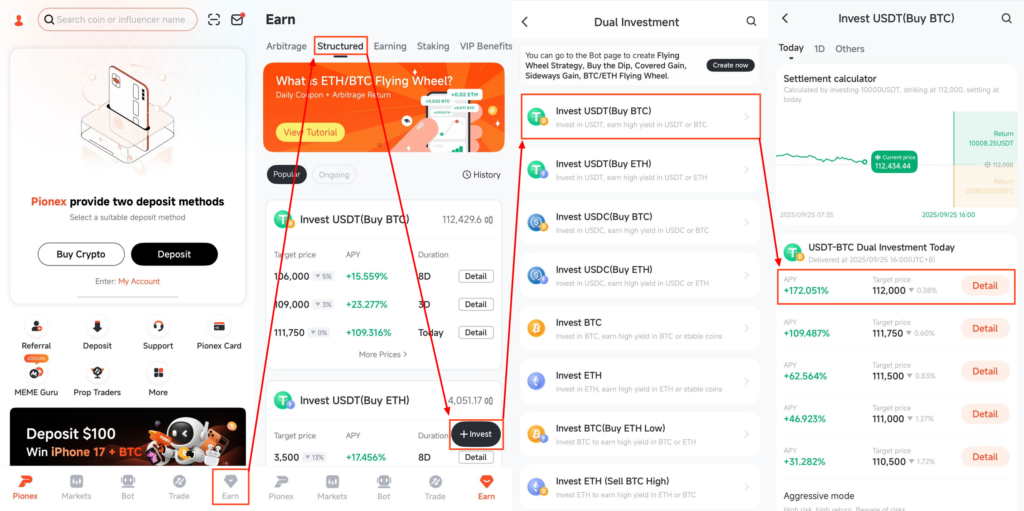
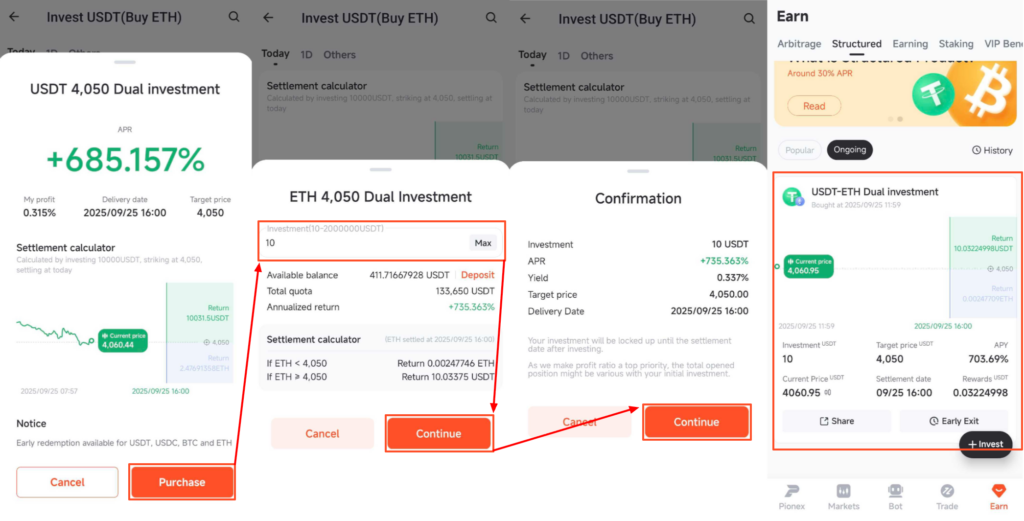
- Confirmation & Subscribe: Suppose we select a product with an APY of 173.641% and a target price of 112,000. Tap “Details” to review the reference APR, profit, delivery date, target price, and settlement calculator, which is an illustration that visually explains the profit scenarios. After confirmation, tap “Purchase”, and enter your desired investment amount. The system will calculate and display the estimated repayment amount in the settlement calculator. Tap “Continue” and confirm once more to complete the purchase.
- Manage Positions: After a successful purchase, you can check the real-time status of all your holdings in the “Ongoing” section under the “Structured” page. From there, you can perform actions like “Early Exit” if needed.
FAQ
Q: Are there any fees for Dual Investment?
A: There are no fees for Dual Investment, and we do not plan to introduce any in the future.
Q: What Dual Investment products are available on Pionex?
A: They can be categorized into “Buy Low” and “Sell High” products. An overview is below.
Buy Low Product Overview
| Dual Investment | Product Name | Investment Currency | Target Asset | Settlement Currency | |
|---|---|---|---|---|---|
| Price < Target | Price > Target | ||||
| USDT-BTC | Invest USDT(Buy BTC) | USDT | BTC | BTC | USDT |
| USDT-ETH | Invest USDT(Buy ETH) | USDT | ETH | ETH | USDT |
| USDT-SOL | Invest USDT(Buy SOL) | USDT | SOL | SOL | USDT |
| USDT-DOGE | Invest USDT(Buy DOGE) | USDT | DOGE | DOGE | USDT |
| …… | |||||
| USDC-BTC | Invest USDC(Buy BTC) | USDC | BTC | BTC | USDC |
| USDC-ETH | Invest USDC(Buy ETH) | USDC | ETH | ETH | USDC |
| BTC-ETH | Invest BTC(Buy ETH) | BTC | ETH/BTC | ETH | BTC |
Sell High Product Overview
| Dual Investment | Product Name | Investment Currency | Target Asset | Settlement Currency | |
|---|---|---|---|---|---|
| Price < Target | Price > Target | ||||
| BTC-USDT | Invest BTC(Sell BTC) | BTC | BTC | BTC | USDT |
| ETH-USDT | Invest ETH(Sell ETH) | ETH | ETH | ETH | USDT |
| SOL-USDT | Invest SOL(Sell SOL) | SOL | SOL | SOL | USDT |
| DOGE-USDT | Invest DOGE(Sell DOGE) | DOGE | DOGE | DOGE | USDT |
| …… | |||||
| ETH-BTC | Invest ETH(Sell BTC) | ETH | ETH/BTC | ETH | BTC |
Q: How is the settlement price calculated on the expiration date?
A: The settlement price is calculated based on the average price of the token across the top 6 exchanges during the 30-minute window from 15:30 to 16:00 (UTC+8) on the expiration date.
Q: How is the Annual Percentage Yield (APY) calculated?
A: Pionex calculates the APY for Dual Investment using precise time parameters down to the millisecond, not simply estimated by days. The formula is:(Earnings / Investment Amount) / (Investment Days / 365) * 100%.
Q: What are some key application tips for Dual Investment?
A:
- To earn more stablecoins with stablecoins, the coin price must NOT break below the target price.
- To earn crypto assets with stablecoins, the coin price MUST break below the target price (Buy Low).
- To earn more crypto assets with crypto assets, the coin price must NOT break above the target price.
- To earn stablecoins with crypto assets, the coin price MUST break above the target price (Sell High).
Q: What should I do if my BTC (or other asset) is exchanged to USDT (“sold early”) and I miss further price increases?
A: Depending on your market view and strategy, consider these approaches:
- View: Limited upside or uncertain. Reinvest the USDT into a “Buy Low” product with the same (or a better) target price until USDT is converted back to BTC. Example: BTC was sold at $120,000. Reinvest USDT into a “Buy Low” product with a target of $120,000 (or lower) to earn yield until BTC falls back to/below $120,000, converting USDT back to BTC.
- View: Strong uptrend continues, expect a pullback. Reinvest the USDT into a “Buy Low” product with your desired entry price. Example: BTC broke out to $126,000. Reinvest USDT into a “Buy Low” product with a target of $124,000 (your desired entry). Earn yield until BTC pulls back to/below $124,000, converting USDT back to BTC.
Q: What should I do if my USDT is exchanged to BTC (or another asset) and I have unrealized losses (“bagged”)?
A: Depending on your market view and strategy, consider these approaches:
- View: Bullish on BTC, accept the purchase price. Hold long-term, waiting for the BTC price to recover and rise above your cost basis to sell for a profit.
- View: Don’t want to hold BTC at this price. Reinvest the BTC into a “Sell High” product with the same target price until BTC is converted back to USDT.
- Example: Bought BTC at $110,000. Reinvest that BTC into a “Sell High” product with a target of $110,000. Earn yield in BTC until the price rises to/above $110,000, converting BTC back to USDT with more stablecoins.
Q: How is the specific earnings amount calculated?
A: Let’s examine examples for both “Buy Low” and “Sell High” products.
- Buy Low Product Example – Invest USDT (Buy BTC Low)
Product Terms:
- Investment Currency: USDT
- Target Price (BTC): $112,000
- Term: 1 day
- Purchase Date: 11th September 2025
- Settlement Date: 12th September 2025
- Fixed Return Rate: 0.135%
- (Reference) APY: 59.88%
- Scenario: You purchase with 11,200 USDT when BTC is at $114,000.
- Outcomes at Settlement:
- Settlement Price ≥ $112,000: Settlement in USDT. You receive:
11,200 USDT * (1 + 0.135%) = 11,215.12 USDT. - Settlement Price < $112,000: Settlement in BTC. You receive:
(11,200 USDT / $112,000) * (1 + 0.135%) = 0.100135 BTC.
- Settlement Price ≥ $112,000: Settlement in USDT. You receive:
- Sell High Product Example – Invest BTC (Sell BTC High)
Product Terms:
- Investment Currency: BTC
- Target Price (BTC): $118,000
- Term: 7 days
- Purchase Date: 12th September 2025
- Settlement Date: 19th September 2025
- Fixed Return Rate: 0.765%
- (Reference) APY: 38.566%
- Scenario: You purchase with 0.1 BTC when BTC is at $115,000.
- Outcomes at Settlement:
- Settlement Price ≥ $118,000: Settlement in USDT. You receive:
(0.1 BTC * $118,000) * (1 + 0.765%) = 11,890.27 USDT. - Settlement Price < $118,000: Settlement in BTC. You receive:
0.1 BTC * (1 + 0.765%) = 0.100765 BTC.
- Settlement Price ≥ $118,000: Settlement in USDT. You receive:
Appendix: Term Definitions
Investment Currency
The currency you use to purchase the product (e.g., BTC or USDT for BTC Dual products).
Settlement Currency
The currency you receive upon expiration. It will be either the Investment Currency or the paired stablecoin (e.g., USDT), determined by comparing the Settlement Price and the Target Price.
Settlement Date
The date the investment product ends, and the funds are automatically returned to your wallet.
Fixed Return Rate
The rate used to calculate your earnings at expiration.
Annual Percentage Yield (APY)
A hypothetical annualized rate derived from the Fixed Return Rate, assuming continuous investment over a year. Formula: APY = Fixed Return Rate / (Investment Term in Days) * 365.
Target Price (Strike Price)
A benchmark price compared against the Settlement Price at Settlement. If the Settlement Price is below the Target Price for “Buy Low” products (or above for “Sell High”), the settlement currency is typically the crypto asset; otherwise, it’s the stablecoin.
Settlement Price
The average of the Settlement Index over the 30 minutes preceding 16:00 (UTC+8) on the Settlement Date.
Please get in touch with Pionex Support if you have any other questions.