
Last reviewed: August 20, 2026
Choose Pionex Spot Grid when you want to trade repeated price movements using assets bought in the spot market, without futures funding or liquidation. Choose Pionex Futures Grid only when you specifically need long, short or neutral futures exposure and understand how leverage, margin, funding and liquidation affect the position. Both bots can show positive grid profit while total P&L is negative. The important difference is what you hold, what costs continue while the bot runs and what can force the position to close.
Spot Grid and Futures Grid use similar order logic, but they are not the same strategy. Spot Grid trades the underlying assets. Futures Grid trades perpetual futures contracts. That change introduces directional modes, leverage, collateral, funding payments, mark-price calculations and liquidation risk.
If you are still comparing other bot types, read how to choose the right crypto trading bot. This guide focuses only on the decision between Spot Grid and Futures Grid.
Want a quick recommendation before comparing every detail? The Pionex Trading Bot Finder uses your market view, product preference, risk tolerance, leverage comfort and monitoring time to create a short list of bots to research. Use the result as a starting point, then return to this guide to check the trade-offs.
Contents
- 1 Spot Grid vs Futures Grid
- 2 Spot Grid trades assets, while Futures Grid trades contracts
- 3 Futures Grid can trade long, short or neutral
- 4 Leverage changes exposure and survival distance
- 5 Why 1x Futures Grid is not the same as Spot Grid
- 6 Funding can help or hurt Futures Grid
- 7 Liquidation is different from leaving the grid range
- 8 Adding margin buys room, not certainty
- 9 Grid profit and total P&L can disagree
- 10 What the original 2023 test can and cannot show
- 11 How to create and review a Pionex Futures Grid
- 12 Which bot requires more monitoring?
- 13 When Spot Grid is the clearer match
- 14 When Futures Grid is the clearer match
- 15 When you should choose neither bot
- 16 Use the Pionex Trading Bot Finder to test the difference
- 17 Related Futures Grid and bot guides
- 18 Frequently asked questions
- 19 Still deciding between Spot Grid and Futures Grid?
- 20 Disclaimer
Spot Grid vs Futures Grid
| Decision | Pionex Spot Grid | Pionex Futures Grid |
|---|---|---|
| Market traded | Spot market | Perpetual futures market |
| What you hold | Base and quote assets | A futures position supported by margin |
| Direction | Primarily long spot exposure | Long, short or neutral |
| Leverage | No leverage in standard Spot Grid | Available depending on the market and setup |
| Funding payments | No | Yes |
| Futures liquidation | No | Yes |
| Main capital input | Investment distributed across spot grid orders | Margin supporting grid orders and an open futures position |
| Main ongoing costs | Trading fees and possible slippage | Trading fees, funding and possible slippage |
| Below the range | You may hold mostly the base asset | Exposure and liquidation risk depend on the selected mode |
| Above the range | You may hold mostly the quote asset | Exposure and liquidation risk depend on the selected mode |
| What to monitor | Range, liquidity, asset value and total profit | Range, direction, margin, funding, liquidation price and total P&L |
Neither structure guarantees profit. Spot Grid can lose money without being liquidated, while Futures Grid can lose money and may be forcibly closed.

Spot Grid trades assets, while Futures Grid trades contracts
When you create a standard Spot Grid Bot, part of your investment is used to hold the base asset while another part supports buy orders in the quote asset. For a BTC/USDT grid, the bot may hold both BTC and USDT as it trades.
If BTC falls below the lower limit, the bot can end up holding mostly BTC. If BTC rises above the upper limit, it can end up holding mostly USDT. There is no futures-style liquidation, but the BTC held by the bot can continue losing value. Pionex explains this range behaviour in its Spot Grid Bot guide.
Futures Grid does not buy and hold the underlying asset in the same way. It opens and closes positions in a perpetual futures contract. Your margin supports those positions, and the result depends on contract exposure rather than ownership of the spot asset.
Do not select Futures Grid merely because its projected percentage looks larger. First decide whether you need a futures contract at all.
Futures Grid can trade long, short or neutral
| Futures Grid mode | Initial position | Market view it expresses | Main risk |
|---|---|---|---|
| Long Grid | Starts with long exposure | Price moves sideways with an upward bias | A sustained decline can increase losses and move the position toward liquidation |
| Short Grid | Starts with short exposure | Price moves sideways with a downward bias | A sustained rally can increase losses and move the position toward liquidation |
| Neutral Grid | Does not begin with the same initial directional position | Price oscillates around the starting area | Filled orders can create exposure, so liquidation risk still exists |
Pionex describes these modes in its Futures Grid Bot documentation. Neutral describes how the grid begins. It does not guarantee that the position remains directionless or free from liquidation risk.
Leverage changes exposure and survival distance
Leverage allows a smaller margin allocation to control a larger futures position. This can increase gains when price moves favourably, but it also increases losses when price moves against the position.
The practical question is not how much the bot could make with higher leverage. Ask how much adverse movement the position can survive before the estimated liquidation price is reached.
Entry price, direction, position size, available margin, maintenance requirements, fees and funding can all affect that answer. Higher leverage generally leaves less room for the strategy to survive an adverse move.
⚠️ A Futures Grid Bot can be liquidated even if price later returns to the original range. A later recovery does not restore a position that was already forcibly closed.
Why 1x Futures Grid is not the same as Spot Grid
A 1x Futures Grid still uses a perpetual futures contract rather than holding the spot asset. Reducing leverage changes the exposure relative to your margin, but it does not turn the contract into a spot holding.
- You hold a futures contract rather than the underlying spot asset.
- Funding payments can affect total P&L.
- Futures margin and maintenance rules still apply.
- Mark price can be used in liquidation calculations.
- Long, short and neutral modes remain available.
- Contract liquidity can differ from spot-market liquidity.
- Closing the bot settles the futures position rather than leaving the same spot holdings.
Lower leverage can provide more room before liquidation, but 1x should not be treated as a promise that liquidation is impossible in every contract and configuration.
Funding can help or hurt Futures Grid
Perpetual futures use funding payments to help keep the contract price aligned with the underlying market. Depending on the funding direction and your position, you may pay funding or receive it.
Funding is not a fixed source of income. Its direction and size can change while the bot is running.
| Funding question | Why it matters |
|---|---|
| Is the current funding rate positive or negative? | It helps determine which side is paying |
| Am I long, short or using neutral mode? | The effect depends on your position |
| When is the next funding settlement? | A payment may occur while the position remains open |
| Could the rate change during the trade? | A favourable rate can become a cost |
| Can grid profit absorb funding and fees? | Frequent trades do not guarantee positive net performance |
Do not isolate favourable funding from the position’s unrealized loss. Receiving funding does not make an unsuccessful directional position profitable.
Liquidation is different from leaving the grid range
The grid range determines where the bot is designed to place buy and sell orders. The estimated liquidation price indicates where the futures position may be forcibly closed because the remaining margin is insufficient. These boundaries do not have to be the same.
| Event | Spot Grid | Futures Grid |
|---|---|---|
| Price falls below the lower range | Trading can pause while you hold more base asset | Trading can pause while the open futures exposure and liquidation risk continue |
| Price rises above the upper range | Trading can pause while you hold more quote asset | The effect depends on whether the bot is long, short or neutral |
| Price returns to the range | Grid trading may resume | Trading may resume only if the position still exists and sufficient margin remains |
| Loss becomes large | You can keep holding, close the bot or use a configured stop | You can add margin, close the bot, use a stop or face liquidation |
| Bot is liquidated | Not applicable to standard non-leveraged Spot Grid | The futures position is forcibly closed |
A liquidation price inside or close to your selected range is a serious warning. It means the position may not survive movement that the grid settings treat as normal.
Adding margin buys room, not certainty
Reserved or added margin gives a Futures Grid position a larger safety cushion. For a long position, adding margin can lower the estimated liquidation price. For a short position, it can raise the estimated liquidation price.
Adding margin does not repair an unrealistic range, remove an unrealized loss, reverse an unfavourable funding cost or guarantee that liquidation cannot occur. Before adding capital, decide whether you are protecting a valid strategy or increasing exposure to a failed assumption.
Grid profit and total P&L can disagree
Both Spot Grid and Futures Grid can display positive grid profit while the overall strategy is losing.
Spot Grid example
| Component | Illustrative amount |
|---|---|
| Completed grid profit | +30 USDT |
| Unrealized loss on the asset held | -90 USDT |
| Simplified total before other costs | -60 USDT |
The grid trades were profitable, but the asset accumulated during the decline lost more value than those trades earned.
Futures Grid example
| Component | Illustrative amount |
|---|---|
| Completed grid profit | +30 USDT |
| Unrealized loss on the futures position | -70 USDT |
| Funding and trading costs | -8 USDT |
| Simplified total | -48 USDT |
These figures are illustrative, not expected results. Judge the strategy by total exposure and total P&L, not completed grid profit alone.
What the original 2023 test can and cannot show
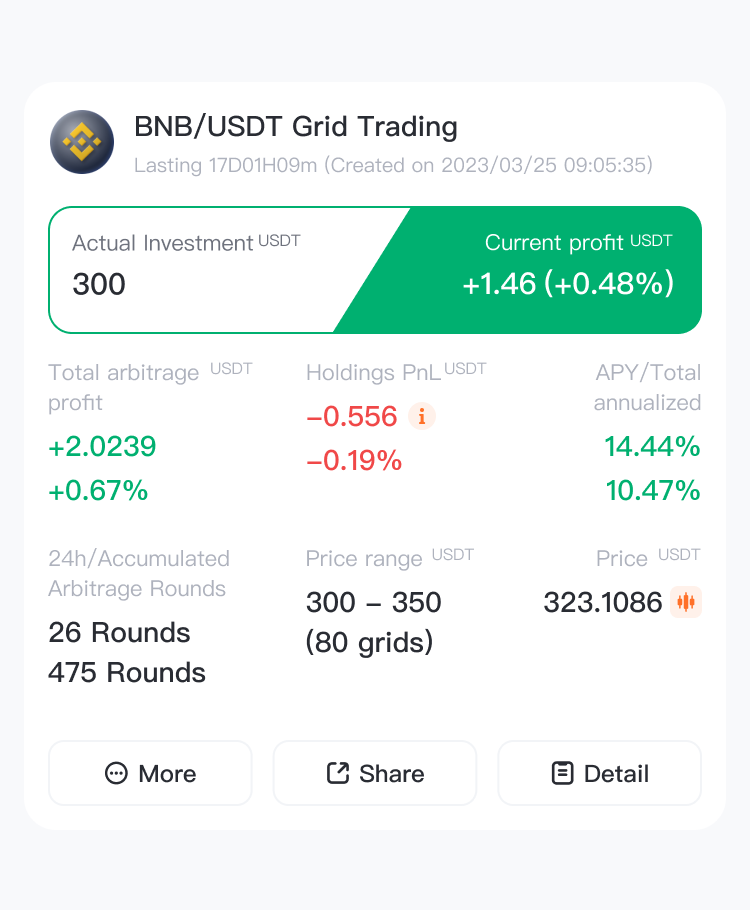
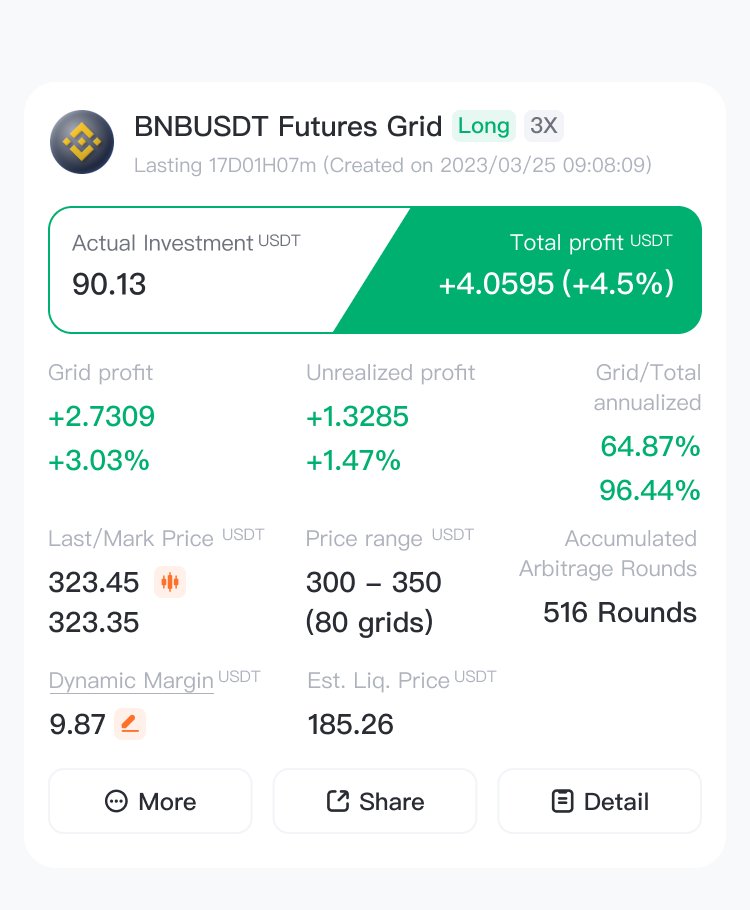
In March 2023, Pionex tested a Spot Grid Bot on BNB/USDT against Futures Grid configurations using similar ranges and different leverage. The Futures Grid examples produced higher returns during that specific test window.
The screenshots remain useful as historical product evidence, but they do not prove that Futures Grid will outperform Spot Grid. Market direction, leverage, funding, fees, range selection and open-position losses can change the result.

How to create and review a Pionex Futures Grid
The current web path is Futures, Futures Bot, then Futures Grid. The interface can change by region and version, so check the current Pionex Futures Grid setup guide before using the older screenshots below.

Choose a supported futures pair, then select a long, short or neutral approach that matches the range and direction you expect. Before confirmation, review leverage, the grid range, grid count, investment, estimated liquidation price and reserved margin.


Reserved margin and Two-Layer Buffer Technology
Reserved margin acts as a safety cushion. It can help the bot maintain more orders during adverse movement and move the estimated liquidation price farther from the current price.
Pionex’s Two-Layer Buffer Technology dynamically manages pending orders when available margin becomes constrained. It does not remove liquidation risk. You still need to review the estimated liquidation price, range and margin before starting.


Adjusting margin after the bot starts
Pionex currently allows margin adjustments from the bot’s More page. Adding margin can provide a larger cushion without changing the original grid range, but it also commits more capital to the position.


Which bot requires more monitoring?
| Spot Grid checks | Additional Futures Grid checks |
|---|---|
| Is price still inside the range? | What is the current estimated liquidation price? |
| Does the asset thesis remain valid? | How much margin remains? |
| Are liquidity and spreads acceptable? | What direction and position size has the bot developed? |
| Do grid spacing and costs still make sense? | What is the current funding direction? |
| Does total profit differ from grid profit? | Is mark price moving close to liquidation? |
| Is a stop, range review or exit required? | Could you respond before liquidation during a sharp move? |
If you cannot check the futures-specific conditions, Futures Grid is not a suitable way to make a Spot Grid more aggressive.
When Spot Grid is the clearer match
- You want non-leveraged range trading.
- You are willing to hold the selected asset if price falls.
- You can define realistic upper and lower limits.
- You understand what happens on both sides of the range.
- You do not need short exposure.
- You want to avoid funding and futures liquidation.
- You can evaluate total profit rather than completed grid trades alone.
Spot Grid is structurally simpler than Futures Grid, but it is not low risk. For a separate comparison with staged dip buying, read Grid Bot vs DCA Bot.
When Futures Grid is the clearer match
- You specifically need long, short or neutral futures exposure.
- You understand perpetual futures.
- You can explain margin, mark price, funding and liquidation.
- You selected leverage using a loss limit, not a desired return.
- You can monitor the position at the frequency its risk requires.
- You checked the estimated liquidation price against the grid range.
- You know what would invalidate the directional and range assumptions.
- You can afford to lose the complete amount allocated to the bot.
Do not select Futures Grid merely because its displayed return estimate is higher than Spot Grid.

The recommendation shown is COIN-M Futures Grid, a specific Futures Grid variant. Different answers can produce a different result, and product availability can vary by region and app version.
When you should choose neither bot
- You cannot define a realistic trading range.
- Your main expectation is a strong one-way move.
- You cannot tolerate holding the asset after a Spot Grid range break.
- You do not understand the contract behind Futures Grid.
- You are seeking guaranteed or passive income without losses.
- You are considering leverage only to increase projected returns.
- You cannot monitor changing margin, funding or liquidation risk.
- You would need essential money to defend the position.
- You have no stop, exit or invalidation plan.
Waiting is a valid decision. Automation does not turn an unclear market view into a complete strategy.
Use the Pionex Trading Bot Finder to test the difference
The Pionex Trading Bot Finder considers experience, goals, market view, product preference, risk comfort, leverage and monitoring time.
- Choose the experience level that reflects what you understand now.
- Select Trade price swings if repeated range trading is the real job.
- Describe the market you expect.
- Choose Spot or Futures deliberately.
- Answer the risk question using the loss you can tolerate.
- Exclude leverage unless you understand liquidation.
- State how frequently you can monitor the position.
- Treat the result as a research shortlist, not financial advice.
A result can change from Spot Grid to a Futures Grid variant when you change product preference, leverage tolerance, risk comfort or monitoring time. Compare grid strategies with the Pionex Trading Bot Finder.
Related Futures Grid and bot guides
- Pionex Grid Trading Bot guide
- Grid Bot parameters explained
- Grid trading risks
- Futures Grid Bot Neutral
- Pionex Futures Grid Bot Long
- Pionex Futures Grid Bot Short
Frequently asked questions
What is the main difference between Spot Grid and Futures Grid?
Spot Grid trades the underlying spot assets inside a selected range. Futures Grid trades perpetual futures contracts and can use long, short or neutral modes, leverage, margin and funding. Those futures mechanics add liquidation and funding risk that standard Spot Grid does not have.
Can a Pionex Futures Grid Bot be liquidated?
Yes. A Futures Grid Bot can be liquidated when adverse price movement and margin conditions reach the liquidation threshold. Review the estimated liquidation price, leverage, reserved margin and funding before starting, then continue monitoring them while the bot runs.
Can a standard Pionex Spot Grid Bot be liquidated?
A standard non-leveraged Spot Grid Bot does not have futures-style liquidation. However, it can still lose money when the asset falls, price leaves the selected range, liquidity is weak or trading costs consume small grid profits.
Does using 1x leverage make Futures Grid the same as Spot Grid?
No. A 1x Futures Grid still uses a perpetual futures contract rather than holding the spot asset. Funding, margin rules, mark-price calculations and contract settlement mechanics can still make its result different from Spot Grid.
What do long, short and neutral mean in Futures Grid?
Long Grid starts with bullish exposure and is designed for a range that leans upward. Short Grid starts with bearish exposure and is designed for a range that leans downward. Neutral Grid begins without the same initial directional position and places orders around the current price, but it can still develop exposure and face liquidation risk.
How do funding rates affect Futures Grid?
Funding payments apply because Futures Grid uses perpetual futures. Depending on the funding direction and your position, funding may add to total P&L or reduce it as a cost. Check the current rate and do not assume its direction will remain unchanged.
Why can grid profit be positive while total P&L is negative?
Grid profit records completed buy-and-sell cycles. Total P&L also reflects the value of the open position, unrealized gains or losses, trading fees and, for Futures Grid, funding. A larger open loss can therefore outweigh positive completed grid profit.
What happens when price leaves the grid range?
In Spot Grid, trading can pause above or below the range while you hold mostly quote currency or base asset. In Futures Grid, orders can also stop completing outside the range, but the open futures position, margin, funding and liquidation risk may continue to change.
What does adding margin to a Futures Grid Bot change?
Adding margin gives the position a larger safety cushion and can move the estimated liquidation price farther away. It does not repair a poor range, remove an unrealized loss or guarantee that liquidation cannot occur.
Should a beginner choose Spot Grid or Futures Grid?
Spot Grid is usually easier to understand because it avoids leverage, funding and futures liquidation. It is still not low risk, so you need a defensible range, suitable capital and an exit plan. Consider Futures Grid only after you can explain margin, mark price, funding and liquidation in your own words.
Still deciding between Spot Grid and Futures Grid?
You should now be able to explain which market you would trade and what could go wrong. If the choice is still unclear, run your answers through the Pionex Trading Bot Finder. Choose Spot or Futures deliberately, exclude leverage when liquidation is outside your plan, and treat the result as a research shortlist rather than financial advice.
Disclaimer
This article is for informational purposes only and does not constitute financial or investment advice. Crypto trading carries significant risk including total loss of capital. Past performance is not indicative of future results. Always conduct your own research before trading.
Product information was reviewed against the current Pionex Spot Grid documentation and Pionex Futures Grid documentation on August 20, 2026. Product availability and settings can vary by market, region and app version.