
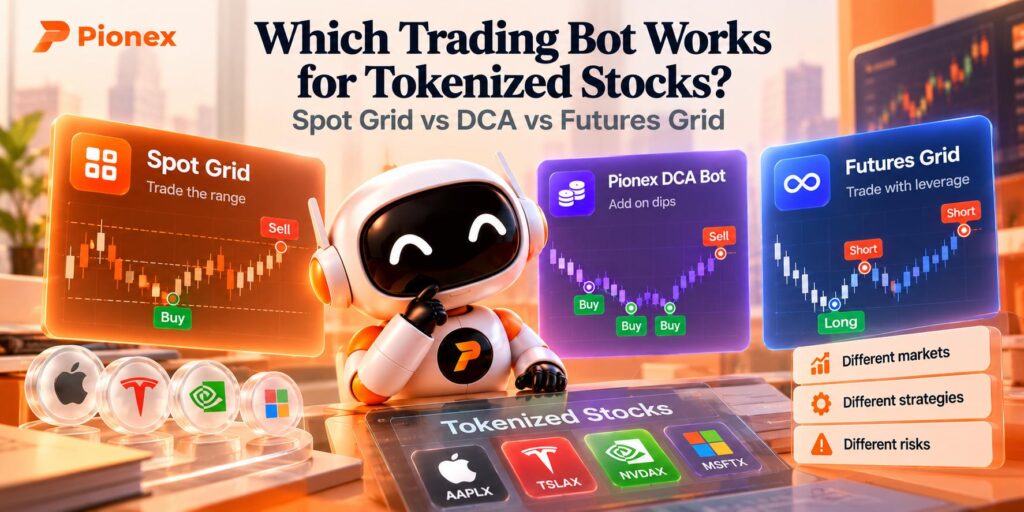
Tokenized stock trading bots such as Spot Grid, DCA and Futures Grid can automate supported tokenized-stock markets, but they solve different problems.
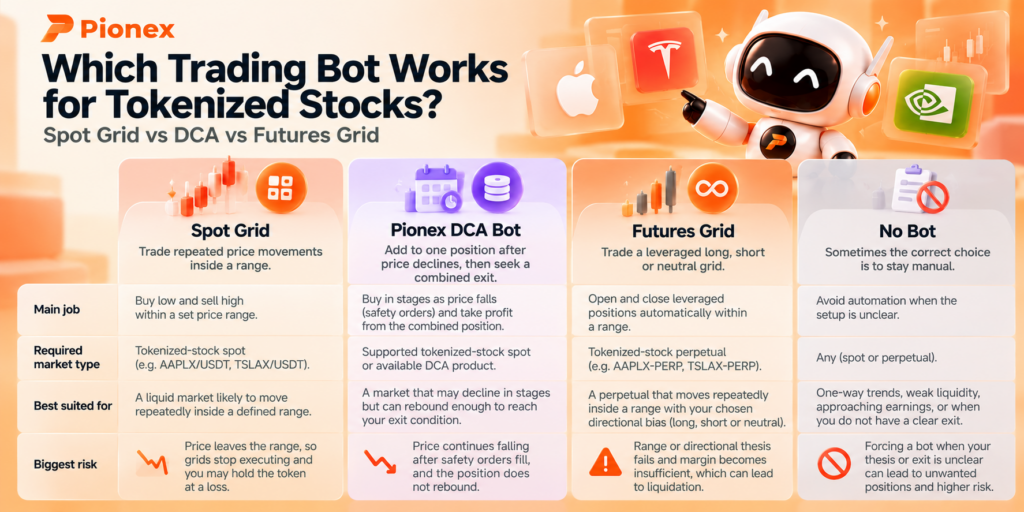
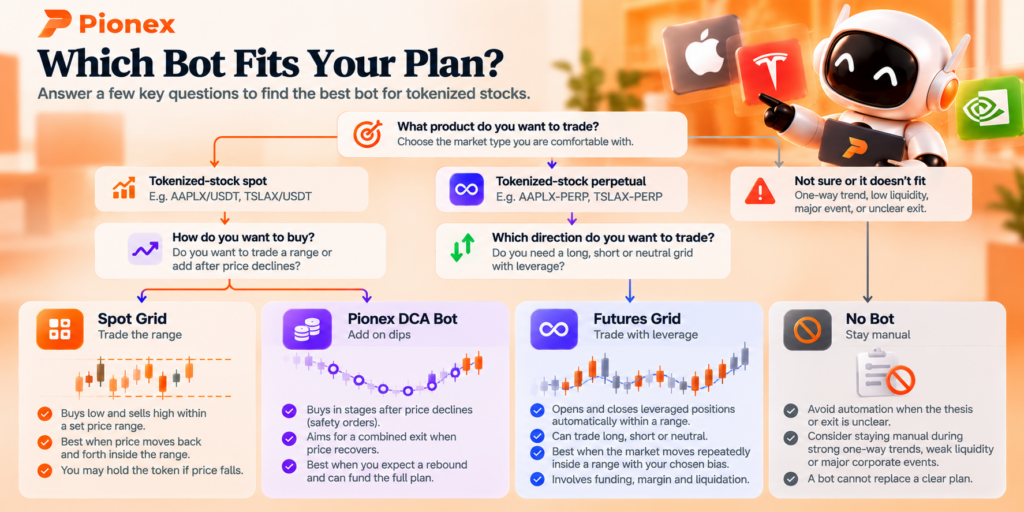
Choose Spot Grid when you expect a liquid spot token to move repeatedly inside a price range and you are willing to hold the token if price falls. Consider the Pionex DCA Bot when you deliberately want to add after price declines, can fund the complete safety-order plan and expect a sufficient rebound. Use Futures Grid only when you specifically need long, short or neutral perpetual exposure and understand funding, margin and liquidation.
Sometimes the correct choice is none of them. A strong one-way trend, weak liquidity, an approaching earnings announcement or an undefined exit can make automation a poor fit.
This guide focuses on the extra decisions created by tokenized stocks. For the basic order-entry process, use the existing guide to trading tokenized stocks with USDT.
If you are still deciding between broker automation, tokenized spot markets and stock-linked perpetuals, start with how trading bots for US stocks work.
Disclosure: Pionex publishes this guide and provides the bots and markets discussed. The comparison uses current Pionex documentation and market data, but it does not rank any bot as universally best or claim that automation improves returns.
Contents
- 1 The Bot Choice in One Table
- 2 Match the Bot to Your Actual Plan
- 3 Why Tokenized Stocks Change the Decision
- 4 When Spot Grid Fits
- 5 When the Pionex DCA Bot Fits
- 6 When Futures Grid Fits
- 7 How the Three Bots React to the Same Price Path
- 8 How Fees and Liquidity Change the Result
- 9 When to Choose No Bot
- 10 A Tokenized-Stock Bot Checklist
- 11 Frequently Asked Questions
- 12 Start With the Market Condition, Not the Bot Name
- 13 Methodology and Sources
The Bot Choice in One Table
The right bot depends on the price path, product and risk you intend to trade.
| Decision | Spot Grid | Pionex DCA Bot | Futures Grid |
|---|---|---|---|
| Market used | Tokenized-stock spot | Supported tokenized-stock spot or available DCA product | Tokenized-stock perpetual |
| Main job | Trade repeated movements inside a range | Add to one position after configured declines, then seek a combined exit | Trade a leveraged long, short or neutral grid |
| Market assumption | Price will revisit several levels inside a defined range | Price may fall in stages, then rebound enough to reach the exit condition | A perpetual will move repeatedly inside a range with the chosen directional bias |
| Capital structure | Capital is distributed across spot holdings and grid orders | Capital must cover the initial order and every planned safety order | Margin supports a futures position and grid orders |
| Leverage | No in standard Spot Grid | No in standard Spot DCA | Available, depending on the contract and settings |
| Funding | No | No for spot DCA | Yes |
| Liquidation | No futures liquidation | No futures liquidation for standard spot DCA | Yes |
| Main failure condition | Price leaves the range | Price continues falling after safety orders fill | Range or directional thesis fails and margin becomes insufficient |
| Tokenized-stock issue to watch | Spread, tracking, trading session and corporate events | Full safety-order capital, issuer risk and rebound assumption | Funding, price gaps, mark price, leverage and liquidation |
The simplest rule is this: choose the product before the bot. If you do not want a perpetual contract, Futures Grid should not remain on the shortlist. If you do not want to hold a tokenized stock through a decline, Spot Grid and DCA may also be unsuitable.
Match the Bot to Your Actual Plan
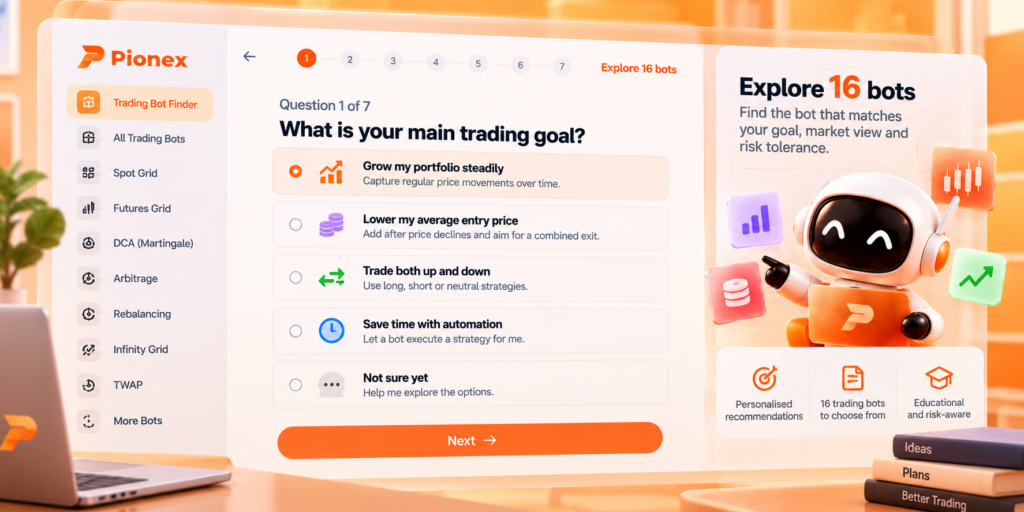
The Pionex Trading Bot Finder asks about your goal, market view, product preference, risk tolerance and monitoring time. Use its result as a shortlist, then confirm that the recommended bot supports the exact tokenized-stock market you want.
The Finder is educational. It does not connect to your account, predict the market or guarantee that a bot will make money.
Why Tokenized Stocks Change the Decision
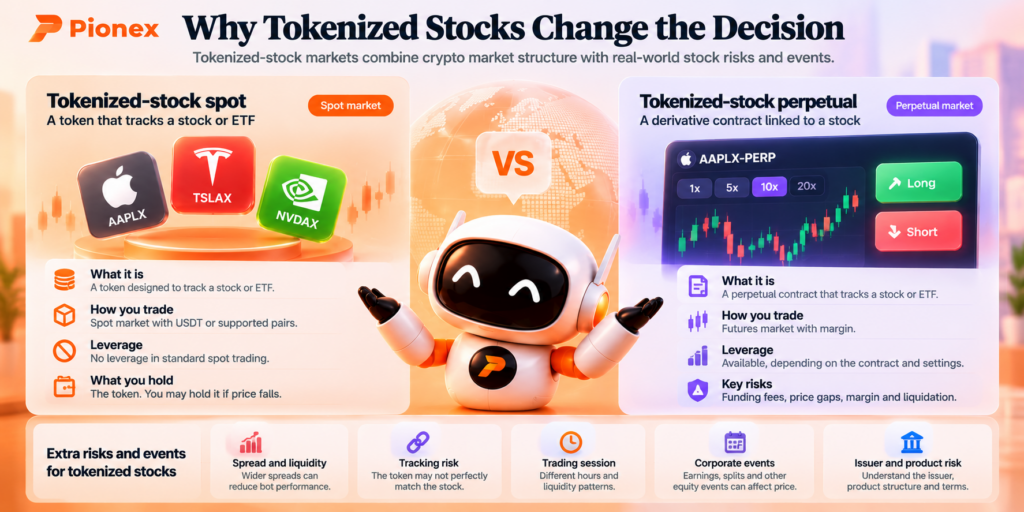
A bot that makes sense for BTC/USDT does not automatically make sense for AAPLX/USDT or a TSLAX perpetual. Tokenized-stock markets add risks and events that come from both the crypto venue and the referenced equity.
Spot tokens and perpetuals are different products
A tokenized-stock spot market gives you a token designed to track a stock or exchange-traded fund. A tokenized-stock perpetual is a derivative contract with funding, margin and liquidation mechanics.
Neither should be treated as an ordinary registered share held through a broker. Pionex’s tokenized stocks and xStocks guide explains the issuer, custody, tracking and eligibility differences.
Not every market follows the same clock
Some Pionex tokenized-stock markets are designated for continuous trading, while others close during defined sessions. The exact pair’s Trading Session controls whether new orders can execute.
Pionex also warns that a bot containing a closed-session token can pause as a whole. That means a bot may be unable to rebalance or adjust another asset until the market reopens.
Continuous trading creates a different problem. When Wall Street is closed, available liquidity and price discovery may weaken even if the tokenized market remains open. A 24/7 label does not guarantee a tight spread or a clean exit.
Earnings and corporate actions can break a range
An earnings release, dividend adjustment, stock split, merger announcement or regulatory decision can move the referenced stock sharply. A price range that looked reasonable the day before can become irrelevant after the event.
Pionex applies separate Position Reward rules to eligible spot holdings and tokenized-stock futures. Spot rewards can be paid in USDT, while futures adjustments can be handled through funding. Check the exact announcement and account record rather than assuming the treatment matches an ordinary shareholder dividend.
The token’s liquidity matters, not only the stock’s liquidity
Apple, NVIDIA and Tesla shares are heavily traded on US exchanges, but their tokenized markets have separate order books. Evaluate the bid, ask, order-book depth, 24-hour turnover and likely price impact on the exact Pionex market.
Spot and perpetual versions of the same stock-linked market can have very different spreads, order-book depth, turnover and trading sessions. Check both products in the live market before choosing a bot.
| Live market check | What to inspect | Why it matters |
|---|---|---|
| Spread | Current bid and ask | A wider spread increases entry and exit costs |
| Order-book depth | Available size near the current price | Thin depth can increase slippage |
| Turnover | Recent activity on the exact spot or perpetual market | The referenced US stock’s liquidity does not guarantee liquidity for the tokenized product |
| Trading session | Whether the exact market is open and when it pauses | A closed session can interrupt orders or bot activity |
| Bot support | Which bots appear in the live creation screen | Market listing does not guarantee support for every bot |
Higher turnover does not automatically make a perpetual the better choice. Futures still add funding, margin and liquidation risk, while spot products have separate issuer, tracking and custody considerations.
When Spot Grid Fits
Spot Grid is the clearer choice when you expect repeated movement inside a realistic range and want to avoid futures funding and liquidation.
The bot distributes capital across the tokenized spot asset and USDT orders. As price moves through the grid, it buys at lower levels and sells at higher levels. Multiple crossings can create multiple completed grid trades.
Spot Grid may fit when all of these conditions are true:
- The exact tokenized-stock spot market supports Spot Grid.
- The order book is liquid enough for the planned order sizes.
- You can explain why price may remain inside the chosen range.
- You are willing to hold the token if price falls below the lower boundary.
- You have a response for both an upside and downside range break.
- The expected movement between grids remains meaningful after fees and spread.
What happens outside the range?
Below the lower boundary, the bot can hold mostly the tokenized asset while new grid trading slows or pauses. Completed grid profit can remain positive while the falling token creates a larger unrealized loss.
Above the upper boundary, the bot can hold mostly USDT after selling through higher grid levels. If the market keeps rallying, it may capture less upside than simply holding the token.
Spot Grid avoids futures liquidation, but it does not prevent investment loss.
What tokenized-stock traders should check
Before starting, check the referenced company’s earnings date, major corporate actions and the market’s Trading Session. A narrow range placed just before a scheduled company event is vulnerable to a price gap.
Also compare grid spacing with the complete trading cost. Pionex’s tokenized-stock fee guide lists spot fees at 0.1% per fill. One completed buy and sell therefore costs 0.20% before spread and price impact.
If the gross movement captured by a cycle is too small, activity can look successful while net value is weak.
When the Pionex DCA Bot Fits
The Pionex DCA Bot fits a deliberate dip-buying and rebound plan, not ordinary calendar-based investing.
Traditional dollar-cost averaging often means buying a fixed amount every week or month. The Pionex DCA Bot discussed here uses an initial order and configured safety orders that add after price declines. It seeks to close the combined position when its take-profit condition is reached.
DCA may fit when all of these conditions are true:
- You intentionally want to add after specified declines.
- You have a reason to expect a rebound, not merely a hope that price will recover.
- You can fund the initial order and the complete safety-order ladder.
- You are willing to hold a larger position if several safety orders fill.
- You have a stop or invalidation point beyond the last planned order.
- The exact tokenized-stock market supports the required DCA product.
The first order hides the full capital commitment
Consider an illustrative DCA plan:
| Order | Trigger from prior order | Order amount | Cumulative capital |
|---|---|---|---|
| Initial order | At entry | 100 USDT | 100 USDT |
| Safety order 1 | 5% decline | 100 USDT | 200 USDT |
| Safety order 2 | Further 7% decline | 150 USDT | 350 USDT |
| Safety order 3 | Further 10% decline | 225 USDT | 575 USDT |
This is not a recommended configuration. It shows why a 100 USDT initial order can represent a plan requiring up to 575 USDT.
If the token continues falling after every safety order fills, the bot has deployed the full plan and may be left waiting for a rebound. A lower average entry does not erase the loss. It changes the price required for recovery while increasing the amount exposed.
Tokenized stocks add a rebound-timing problem
A stock-linked token can fall because of a company-specific event that permanently changes its valuation. Adding after an ordinary pullback is different from adding after an earnings miss, fraud allegation, product failure or regulatory action.
Before allowing the bot to add, define which events would invalidate the rebound thesis even if the next safety-order price is reached.
When Futures Grid Fits
Futures Grid fits only when a trader specifically wants a tokenized-stock perpetual and understands the added futures mechanics.
The bot trades a perpetual contract rather than holding the spot token. Pionex supports Long, Short and Neutral modes on eligible markets.
| Futures Grid mode | Market view | Main failure risk |
|---|---|---|
| Long | Price may oscillate inside a range with an upward bias | A sustained decline can deepen losses and move the position toward liquidation |
| Short | Price may oscillate inside a range with a downward bias | A sustained rally can deepen losses and move the position toward liquidation |
| Neutral | Price may move both ways around the starting area | Filled orders can create exposure, and a breakout can still create liquidation risk |
Neutral describes the starting structure. It does not mean risk-free, directionless forever or protected from liquidation.
Futures Grid may fit only when all of these conditions are true:
- You need long, short or neutral perpetual exposure.
- The exact tokenized-stock perpetual supports Futures Grid.
- You understand leverage, margin, mark price, funding and liquidation.
- The selected range matches the directional view.
- You can monitor the position at the frequency its risk requires.
- The estimated liquidation price and loss limit make sense together.
- You can afford the position without using money needed for essential expenses.
Funding and liquidation continue outside the grid logic
Leaving the grid range does not necessarily close the futures position. Margin, mark price, funding and liquidation risk can keep changing even when new grid cycles are not completing.
Pionex’s current fee guide lists standard tokenized-stock perpetual fees at 0.02% maker and 0.05% taker, with funding separate. Funding can be paid or received depending on the contract, position and current rate.
Do not choose Futures Grid because the projected percentage looks larger or because leverage lowers the displayed margin requirement. Higher leverage reduces the distance available before adverse movement threatens the position.
For the deeper product comparison, see Spot Grid vs Futures Grid.
How the Three Bots React to the Same Price Path
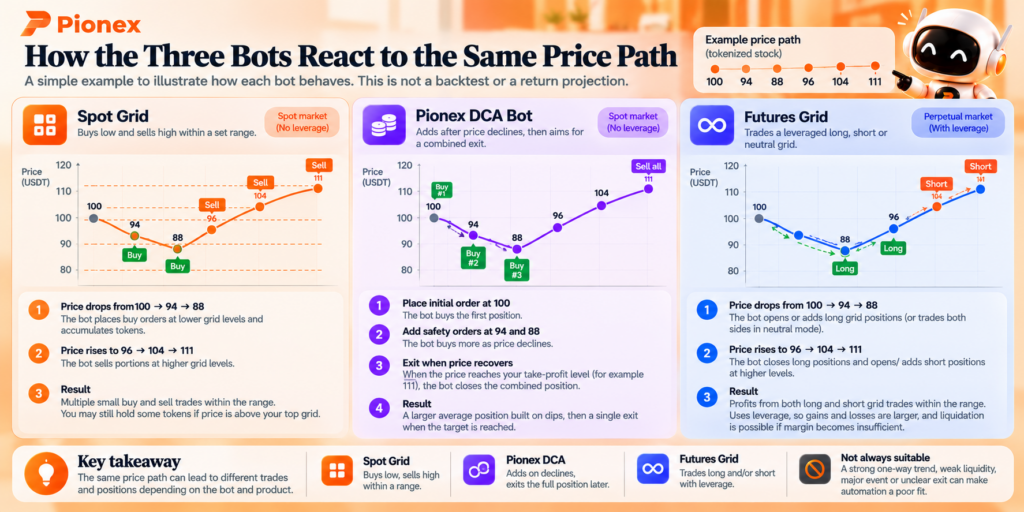
The price path explains the choice more clearly than a feature list.
Assume a hypothetical tokenized-stock market begins at 100 USDT and follows this sequence:
100 → 94 → 88 → 96 → 104 → 111
This is an illustration, not a backtest or forecast.
| Stage | Spot Grid | Pionex DCA Bot | Futures Grid |
|---|---|---|---|
| 100 to 94 | Lower grid buys may fill | A safety order may add to the position | Long or Neutral Grid may add exposure; Short Grid may benefit initially |
| 94 to 88 | More lower grid orders may fill if inside range | Additional safety orders may fill, increasing capital used | Long exposure loses; liquidation distance can shrink depending on leverage |
| 88 to 96 | Some grid cycles may complete | The combined position moves closer to its exit | Long or Neutral Grid may complete trades; funding and fees still apply |
| 96 to 104 | Higher grid sells may complete | The bot may reach take profit and close the combined position | Long Grid may benefit; Short Grid may lose |
| 104 to 111 | Spot Grid may sell through upper levels or leave the range | A closed DCA cycle may no longer participate | Result depends on mode, range, exposure, leverage and margin |
The example does not identify a winner because the settings determine the orders. It shows the different jobs:
- Spot Grid tries to monetize repeated crossings.
- DCA builds one combined position and looks for a sufficient rebound.
- Futures Grid combines grid execution with a leveraged perpetual position.
If price had fallen from 100 to 60 without rebounding, all three could lose. DCA could deploy every safety order, Spot Grid could hold the falling token below its range, and a leveraged Futures Grid could be liquidated.
How Fees and Liquidity Change the Result
A bot must earn more from its trading logic than it loses to fees, spread, price impact and, for futures, funding.
Spot Grid cost test
Pionex currently lists a 0.1% fee for each tokenized-stock spot fill. A completed buy and sell has a 0.20% fee rate before spread and price impact.
If a completed grid cycle captures a gross 0.50% move, the simplified remainder before spread is:
0.50% gross movement − 0.20% trading fees = 0.30% before spread and price impact
If the combined spread and price impact for both legs were 0.15%, the simplified remainder would become 0.15%. This hypothetical calculation excludes tax, changing execution prices and any opportunity cost from the held asset.
The lesson is not that 0.50% spacing is good or bad. It is that a narrow grid needs a market-specific cost estimate.
DCA cost test
Each filled order creates a trading cost. More safety orders can reduce the average entry price, but they also increase total capital, the number of fee-bearing fills and the position that must later be sold.
Evaluate the complete planned cycle, not the cost of the initial order alone.
Futures Grid cost test
Futures Grid adds funding to trading fees and execution costs. A strategy can complete profitable grid trades while funding and an unrealized position loss make total P&L negative.
Always compare:
Total P&L = realized grid result + unrealized position result − trading fees ± funding − other execution costs
Do not use grid profit alone as the performance measure.
When to Choose No Bot
Choose no bot when the market assumption is missing or the product risk does not fit you.
Do not automate the trade when:
- You cannot explain why the market should range or rebound.
- You expect a strong one-way rally and mainly want to retain full exposure.
- A major earnings or corporate event is approaching and your range does not account for a gap.
- The spread or order-book depth makes repeated small trades uneconomic.
- You cannot fund every planned DCA safety order.
- You do not understand the token issuer, trading session or product eligibility.
- You are considering Futures Grid only because its projected return is larger.
- You cannot explain funding, mark price and liquidation.
- You have no stop, invalidation condition or monitoring plan.
Waiting is a valid decision. A bot automates a strategy; it does not create one.
A Tokenized-Stock Bot Checklist
Before confirming a bot, answer these questions in order:
- Is the market a spot token or a perpetual contract?
- Is the exact pair available to my account and region?
- What Trading Session applies?
- Is there an earnings release or corporate action during the planned bot period?
- Does the pair support the selected bot?
- Is current liquidity sufficient for my order size?
- What exact price path must occur for the bot to work?
- What event or price invalidates the plan?
- What is the complete capital requirement?
- What are the fees, spread, price impact and possible funding?
- Which metric will I monitor: total P&L, not only grid profit?
- How will I exit if the market leaves the plan?
If the answer to questions 1 through 5 is unclear, do not proceed to the bot parameters.
Frequently Asked Questions
Which Pionex bot works best for tokenized stocks?
No bot works best in every market. Spot Grid fits repeated range movement without futures leverage. The Pionex DCA Bot fits deliberate staged buying followed by a rebound exit. Futures Grid fits traders who specifically need a long, short or neutral perpetual strategy and accept funding and liquidation risk.
Is the Pionex DCA Bot the same as buying every month?
No. The Pionex DCA Bot discussed here is a price-triggered, Martingale-style strategy. It adds safety orders after configured declines and seeks to close the combined position at a target. Fixed calendar purchases are a different method.
Can Spot Grid lose money without leverage?
Yes. If price falls below the range, the bot can hold more of the declining token. Positive completed grid profit can coexist with a larger unrealized loss, so total P&L matters more than grid profit alone.
Can Futures Grid be liquidated?
Yes. Futures Grid trades a perpetual contract supported by margin. An adverse price move, leverage, funding and insufficient margin can move the position toward liquidation.
Can I use these bots on AAPLX, NVDAX or TSLAX?
Pionex supports trading bots for eligible tokenized-stock markets, subject to product availability. To use Spot Grid, DCA or Futures Grid with AAPLX, NVDAX or TSLAX, check whether the specific trading pair and bot type are supported in the Pionex bot-creation interface. Availability may vary by trading session, market conditions and account eligibility.
Is a tokenized-stock bot available 24/7?
Not always. Only designated Pionex markets trade continuously. Other spot or futures markets can close during defined sessions, and a bot containing a closed-session token can pause. Check the Trading Session for the exact pair.
Should a beginner use Futures Grid for tokenized stocks?
A beginner should understand spot-market risk and standard bot behavior before using leveraged futures. Futures Grid adds margin, funding, mark price and liquidation, so a low minimum investment does not make it a lower-risk choice.
Start With the Market Condition, Not the Bot Name
Use Spot Grid for a defensible range, the Pionex DCA Bot for an intentional staged-buying and rebound plan, and Futures Grid only for a clearly understood perpetual strategy.
Before choosing any of them, confirm the exact product, market session, corporate calendar, liquidity, full capital requirement and failure condition. Then monitor total P&L rather than the most flattering profit number on the screen.
⚠️ This article is for informational purposes only and does not constitute financial or investment advice. Crypto trading carries significant risk including total loss of capital. Past performance is not indicative of future results. Always conduct your own research before trading.
Methodology and Sources
This is a documentation-based comparison. No live bot was funded or traded for this article.
- Bot mechanics were checked against current Pionex Spot Grid, DCA and Futures Grid documentation and the updated Grid Bot vs DCA Bot guide.
- Tokenized-stock product structure and trading-session risks were checked against the Pionex xStocks guide.
- Fees were checked against the Pionex tokenized-stock fee schedule, last checked there on August 20, 2026.
- Market availability, bot support, trading sessions, spreads and order-book depth should be confirmed on the live Pionex market and bot-creation screens.
- The worked price paths and cost examples are hypothetical illustrations, not forecasts or historical bot results.
