
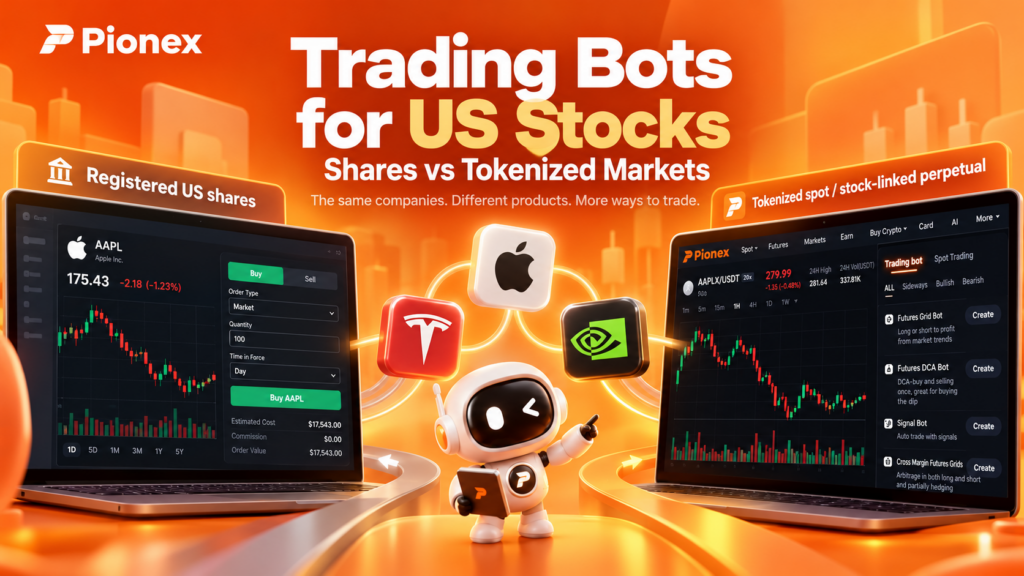
Yes, trading bots can automate strategies linked to US stocks. But the phrase “US stock trading bot” can describe two very different setups.
Contents
- 1 What Is a US Stock Trading Bot?
- 2 Can a Trading Bot Trade US Stocks?
- 3 Find the Bot Type That Matches Your Goal
- 4 What Does a US Stock Trading Bot Actually Trade?
- 5 Broker Bots vs Tokenized-Stock Bots
- 6 Which Bot Fits Each Stock-Market Condition?
- 7 How to Choose a Bot for Tokenized Stocks
- 8 What Can Go Wrong With a Stock Trading Bot?
- 9 How to Test a Stock Trading Bot
- 10 A Practical Decision Checklist
- 11 Frequently Asked Questions
- 12 Choose the Product Before the Bot
- 13 Methodology and Sources
What Is a US Stock Trading Bot?
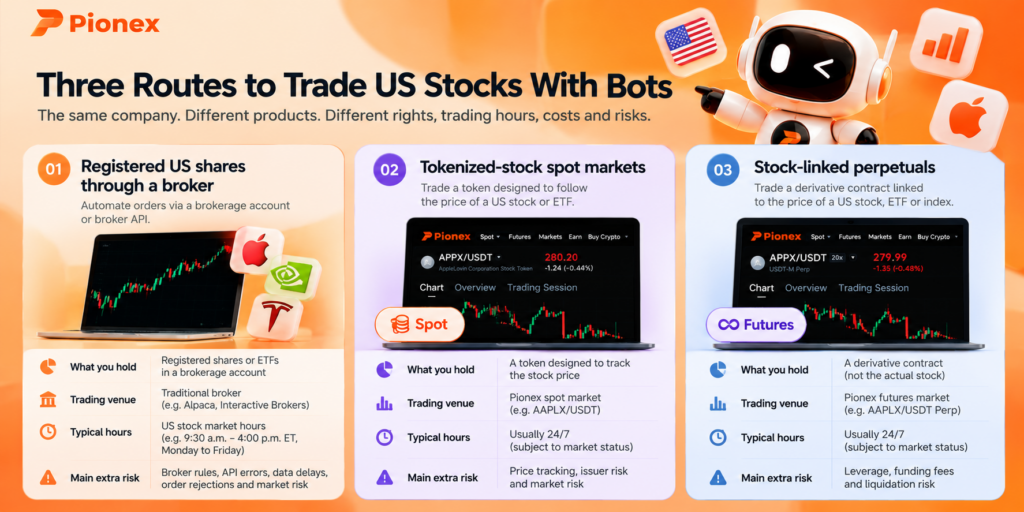
A US stock trading bot is software that automates orders for either registered US shares through a brokerage account or stock-linked products such as tokenized spot markets and perpetual contracts. The venue and product determine what you own, not the bot.
One route uses a brokerage account or broker application programming interface (API) to buy and sell registered US shares. The other uses a crypto platform to trade tokenized-stock spot markets or stock-linked perpetual contracts. These products can reference the same company, but they do not give you the same ownership rights, trading schedule, costs or risks.
Pionex belongs to the second group. It provides built-in bots on supported tokenized-stock and stock-linked markets; it does not turn those products into registered company shares held in a brokerage account.
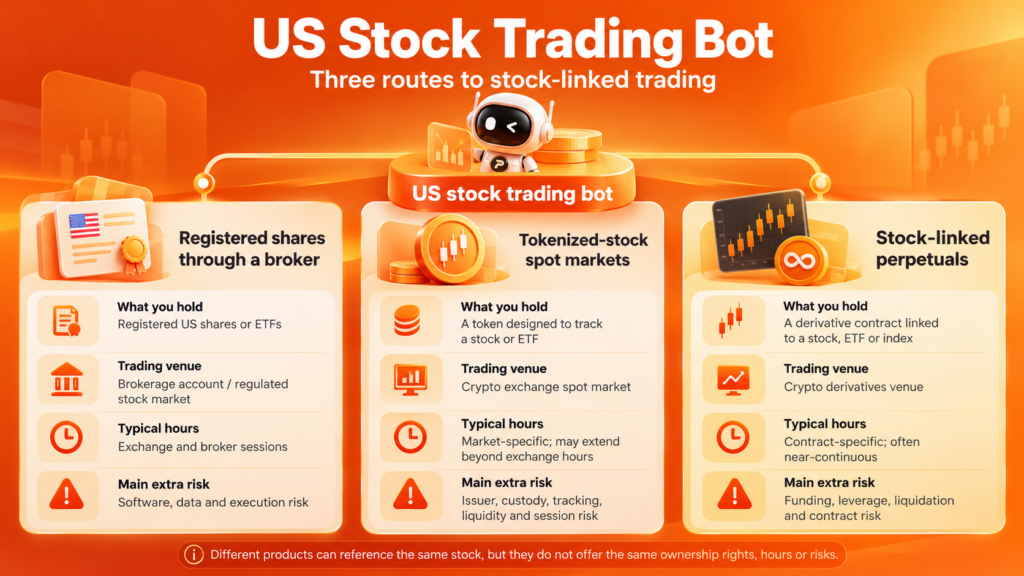
This guide explains the difference, shows which bot can fit each market condition, and gives you a practical checklist for choosing between broker automation, tokenized spot markets and stock-linked perpetuals.
Disclosure: Pionex publishes this guide and provides some of the trading products discussed. We distinguish Pionex products from brokerage shares, use official sources, and do not rank a Pionex product as universally “best.” Bot access, market status and regional eligibility can change.
Can a Trading Bot Trade US Stocks?
Yes. A trading bot can send, manage or repeat orders for US-listed shares when it is connected to a brokerage service that permits automated trading. A bot can also trade supported crypto-market products that reference US stocks, such as tokenized-stock spot pairs or stock-linked perpetual contracts.
The bot does not decide what legal product you own. The venue and market determine that.
- Broker route: The bot sends orders to a brokerage account that trades registered stocks or exchange-traded funds (ETFs).
- Tokenized spot route: The bot trades a token designed to follow the price of a stock or ETF.
- Perpetual route: The bot trades a derivative contract linked to the price of a stock, ETF or index. It can involve leverage, funding and liquidation.
A search for “a Tesla trading bot” could therefore lead to a bot trading TSLA shares through a broker, TSLAX/USDT spot on a crypto platform, or a TSLAX perpetual contract. Those are not interchangeable.
Find the Bot Type That Matches Your Goal
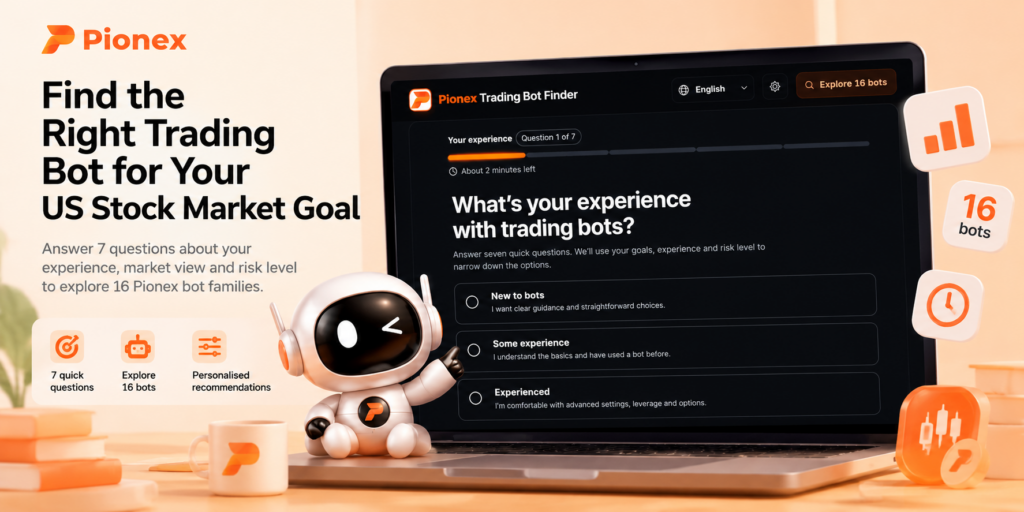
If you know the market you want but not the bot, use the Pionex Trading Bot Finder. It asks seven questions about your experience, market view, risk level and available time, then compares 16 Pionex bot families.
The Finder is an educational selection tool. It does not connect to your account, guarantee performance or replace checking whether a bot supports the exact stock-linked market you want to trade.
What Does a US Stock Trading Bot Actually Trade?
The safest way to evaluate a stock bot is to identify the product before evaluating the strategy.
1. Registered US shares through a broker
A broker-connected bot can submit orders for securities supported by that broker. For example, Alpaca’s official Trading API supports stock trading and market, limit, stop and other order types. It also provides a paper-trading environment for testing code with simulated funds.
This route is the clearest fit when your goal is to own or trade the actual brokerage product and use custom rules or code. It can require programming, data subscriptions, an approved brokerage account and careful handling of API credentials.
Broker trading is still risky. Automation can repeat a bad instruction faster than a person, and the bot may behave differently during volatile markets, rejected orders, delayed data or partial fills.
2. Tokenized-stock spot markets
A tokenized stock is a crypto-market token designed to provide price exposure to a stock or ETF. It is not automatically the same legal product as a registered share held through a broker.
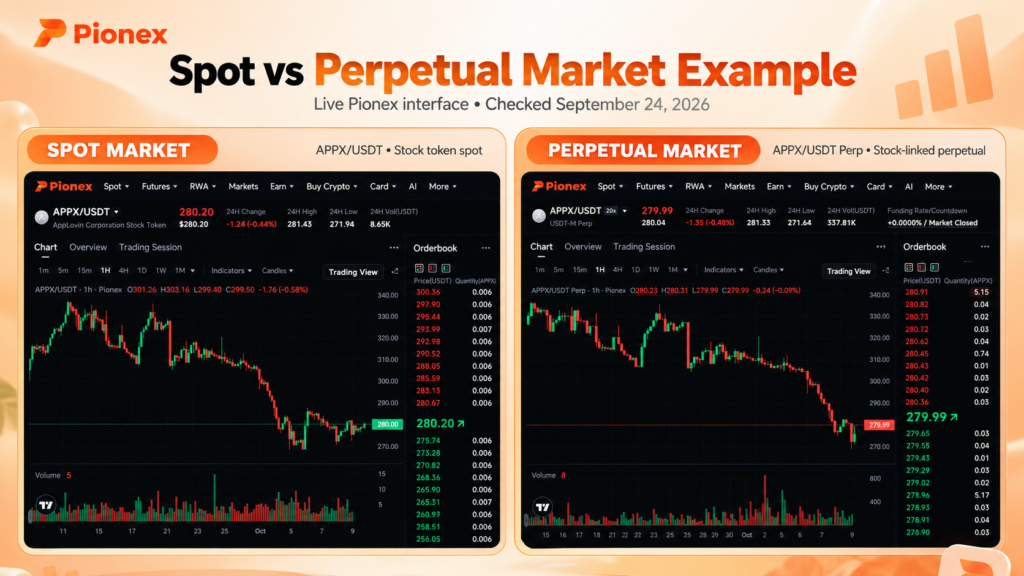
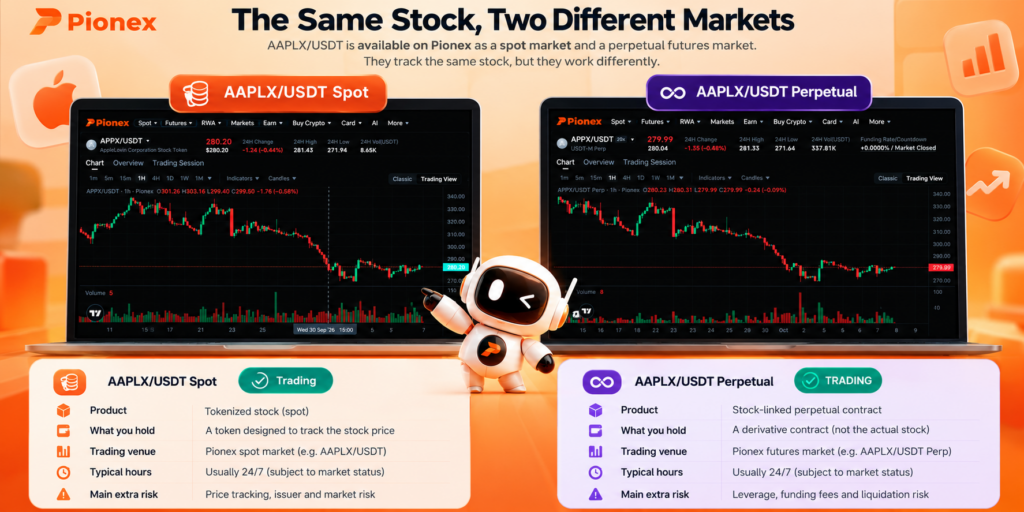
On Pionex, supported spot markets can be paired with USDT and may support built-in tools such as Spot Grid or DCA. A market listing does not by itself prove that every user can trade it or that every bot is available on it. Region, account status, product status and trading session still matter.
Pionex may offer stock-linked spot markets such as the examples below. Availability can change by region, account and market status, so check the live Pionex market and bot-creation screens before trading:
| Referenced company | Pionex spot market | Product type | What to verify |
|---|---|---|---|
| Apple | AAPLX/USDT | Tokenized-stock spot | Current market status in Pionex |
| NVIDIA | NVDAX/USDT | Tokenized-stock spot | Current market status in Pionex |
| Tesla | TSLAX/USDT | Tokenized-stock spot | Current market status in Pionex |
This is a verified sample, not a complete market list or an eligibility promise. See the Pionex xStocks guide for the wider product structure and current trading-session rules.
3. Stock-, ETF- or index-linked perpetuals
A perpetual is a derivative contract rather than a spot token. It can provide long or short price exposure without an expiry date, but open positions can pay or receive funding. Leverage also introduces liquidation risk.
Pionex may offer stock-, ETF- or index-linked perpetual markets such as the examples below. Contract status and eligibility can change, so confirm the live market and bot-creation screens before trading:
| Reference | Pionex perpetual market | What changes versus spot |
|---|---|---|
| Apple | AAPLX/USDT perpetual | Funding, margin and liquidation apply |
| NVIDIA | NVDAX/USDT perpetual | Funding, margin and liquidation apply |
| Tesla | TSLAX/USDT perpetual | Funding, margin and liquidation apply |
| SPDR S&P 500 ETF | SPYX/USDT perpetual | Index/ETF-linked derivative exposure |
| Invesco QQQ ETF | QQQX/USDT perpetual | Index/ETF-linked derivative exposure |
Do not choose a perpetual merely because its minimum appears lower or because leverage makes a position look larger. The relevant question is whether you understand the contract, funding, margin and liquidation price.
Broker Bots vs Tokenized-Stock Bots
The “best” route depends on the product you actually want.
| Decision | Broker-connected stock bot | Tokenized-stock spot bot | Stock-linked perpetual bot |
|---|---|---|---|
| What it trades | Registered securities supported by the broker | A token designed to track a stock or ETF | A derivative contract linked to a stock, ETF or index |
| Typical venue | Regulated brokerage | Crypto exchange | Crypto derivatives venue |
| Ownership | Brokerage security position | Token under the issuer’s product terms | No ownership of the reference asset |
| Automation method | API, third-party software or broker tools | Built-in bot or exchange API | Built-in futures bot or exchange API |
| Trading schedule | Exchange and broker sessions | Market-specific; some may trade beyond exchange hours | Contract-specific; some may run continuously |
| Main extra risks | Software errors, permissions, data and execution | Issuer, custody, tracking, liquidity and session risk | Funding, leverage, liquidation and contract risk |
| Best starting question | “Do I want actual brokerage shares?” | “Do I want unleveraged stock-linked exposure in USDT?” | “Do I fully understand leveraged derivatives?” |
If shareholder rights and ordinary brokerage ownership are essential, start with a broker. If you want USDT-settled stock-linked exposure and built-in crypto trading bots, examine the tokenized product. If you want a leveraged long, short or neutral strategy, examine the perpetual, but treat it as the higher-risk route.
For a platform-level comparison, see five tokenized-stock platforms compared.
Which Bot Fits Each Stock-Market Condition?
A bot should match the behavior you expect from the market. It should not be chosen from the largest backtest return or the most impressive screenshot.
| Your market view or task | Bot type to examine | Why it may fit | When it can fail |
|---|---|---|---|
| Price may move repeatedly inside a defined range | Spot Grid | Places buys and sells across the range without leverage | Price breaks below the range or rallies above it and does not return |
| You want to build a spot position gradually | DCA | Spreads entries across time or staged orders | The asset keeps falling, or the schedule ignores a changed thesis |
| You hold a basket of supported stock-linked assets | Rebalancing | Maintains target portfolio weights | Correlated assets fall together; rebalancing does not prevent loss |
| You expect a leveraged long, short or range strategy | Futures Grid | Automates orders on a perpetual contract | Funding, leverage or a range break causes large losses or liquidation |
| You already have an external rule or alert system | Signal Bot or broker API automation | Converts a defined signal into execution | Bad signals, connection failure, duplicate orders or weak risk limits |
Spot Grid is for a range, not every volatile stock
A Spot Grid Bot divides a chosen price interval into levels and places orders as price moves between them. It may fit a liquid stock-linked market that repeatedly oscillates inside a range.
Volatility alone is not enough. A stock can be volatile while trending sharply in one direction. If price falls below the lower boundary, the bot can stop completing grid cycles while holding a losing position. If price rises above the upper boundary, it may sell through the grid and miss further gains.
DCA is for staged buying, not automatic downside protection
A DCA strategy spreads purchases instead of making one entry. It can reduce the timing risk of a single purchase, but it cannot make a falling asset safe.
Before using DCA, define what would invalidate the reason for buying. A schedule should not force you to keep purchasing after the company, product or risk case has changed.
Futures Grid is a leveraged derivatives strategy
Futures Grid can automate long, short or neutral grid logic on an eligible perpetual. It adds several variables that a spot bot does not have: leverage, maintenance margin, liquidation price and funding.
A profitable series of grid trades does not guarantee positive total profit and loss. A large unrealized loss, funding cost or liquidation can outweigh completed grid gains.
How to Choose a Bot for Tokenized Stocks
Use the following order. It prevents the strategy name from distracting you from the product risk.
If you have already chosen a tokenized-stock market and want a deeper comparison of Spot Grid, DCA and Futures Grid, see which trading bot works for tokenized stocks.
1. Choose the legal and market product
Decide whether you want a registered share, a tokenized spot product or a perpetual contract. Do this before comparing bots.
2. Confirm that the market and bot are available
Check the exact ticker in the live platform. Confirm regional eligibility, current trading status, supported session and whether the bot appears for that market.
Do not infer availability from an old article, a similar ticker or an “X” suffix. Crypto symbols can look like stock-linked symbols without representing the same product.
3. State your market assumption in one sentence
Examples:
- “I expect AAPLX to remain between my lower and upper boundaries for the next four weeks.”
- “I want to accumulate NVDAX gradually without leverage for six months.”
- “I expect the TSLAX perpetual to trend downward, and I accept the liquidation risk of a short futures position.”
If the assumption is vague, the bot setup will also be vague.
4. Define the failure condition
Write down what would make you stop or reconfigure the bot:
- Price leaves the intended range.
- Spread or slippage becomes too large.
- The reference company reports material news.
- The trading session changes.
- Funding becomes too expensive.
- Drawdown reaches the limit you set before launch.
5. Estimate the full cost
Bot use does not remove trading fees. Pionex’s current tokenized-stock fee guide states that spot fills cost 0.1% each, so one buy and later sell costs 0.20% before spread and price impact. Standard tokenized-stock perpetual rates are listed as 0.02% maker and 0.05% taker, with funding separate.
The basic estimate is:
Net result = realized trading gains + unrealized position change − trading fees − spread − price impact − funding and other costs
The number labeled “grid profit” is only one component. Review total profit and loss.
For the full cost breakdown, see Pionex tokenized-stock fees and spreads.
6. Start with the smallest useful test
Use a paper account when your broker provides one. For a live crypto bot, use an amount small enough that an operational mistake or strategy failure does not threaten your finances.
The minimum allowed amount is not automatically a sensible budget. It only means the order rules accept the setup.
What Can Go Wrong With a Stock Trading Bot?
A bot automates instructions. It does not remove the risk of the product or correct a weak strategy.
The bot trades the wrong product
A user may search for “Apple stock bot” and assume AAPL, AAPLX spot and AAPLX perpetual are equivalent. They are different products with different rights and risk.
Check: venue, ticker, product type, issuer or contract terms, and whether leverage is involved.
The market leaves the bot’s assumptions
A range bot can become a poor fit when earnings, macroeconomic news or company events create a lasting trend. A DCA schedule can keep buying into a broken thesis. A futures bot can approach liquidation before the market reverses.
Check: price relative to the configured range, total P&L, margin, liquidation price and the original stop condition.
Trading continues or pauses at an unexpected time
Tokenized markets do not all use the same schedule. Pionex states that only designated 7×24 pairs trade continuously; other tokenized-stock spot and futures markets close during defined sessions. A bot containing a closed-session token can pause and may be unable to adjust other assets until trading resumes.
Even when a market remains open after Wall Street closes, liquidity and price discovery can change. A continuous clock does not guarantee a tight spread or an easy exit.
Read the Pionex case study on what happened to tokenized stocks after Wall Street closed for a practical example.
Fees consume small grid gains
Frequent execution creates more fee-bearing fills. A narrow grid may appear active while the average gain per cycle is too small after fees, spread and slippage.
Check: average gross gain per completed cycle against the round-trip cost under actual market conditions.
The provider makes unsupported AI or profit claims
FINRA warned in 2025 about unregistered auto-trading services that claim to be risk-free, beginner-friendly or capable of consistent high monthly returns. The CFTC has also warned that AI cannot predict sudden market changes or turn a trading bot into a guaranteed money machine.
Treat guaranteed returns, unexplained “AI” claims, pressure to share brokerage credentials and unverifiable performance screenshots as red flags.
The software fails
Possible failures include stale market data, a lost connection, rejected orders, duplicate instructions, partial fills and an incorrect position size.
Check: order logs, position limits, maximum daily loss, kill switch, alerting and what the bot does after reconnecting.
How to Test a Stock Trading Bot
Testing should answer whether the rules behaved as expected, not whether one backtest produced a large return.
1. Write the rule before viewing the result
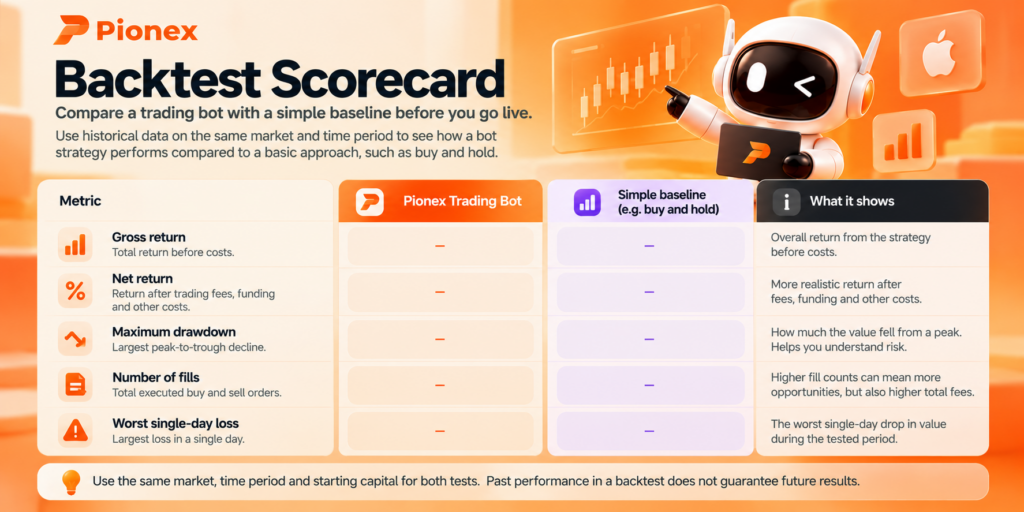
Record the entry logic, exit logic, market, time period, fees, position size and stop conditions. This reduces the temptation to change the rule until the historical chart looks good.
2. Use data that matches the product
Do not backtest a tokenized perpetual using only the underlying stock’s regular-session closing prices. The perpetual has its own order book, session, spread, funding and possible overnight behavior.
3. Include costs
Add trading fees, spread, slippage and funding where applicable. A high-turnover bot is particularly sensitive to small cost assumptions.
4. Separate training and test periods
Build the rule on one period and evaluate it on a later, untouched period. Then test different conditions: range, uptrend, downtrend, earnings gap and low-liquidity hours.
5. Paper trade or run a small forward test
Historical data cannot reproduce every live execution problem. Use broker paper trading where available, or a small live test with monitoring and a defined loss limit.
6. Compare the bot with a simple baseline
Compare the result with holding the asset, making one scheduled purchase, or taking no trade. A complex bot is not useful merely because it generated activity.
A Practical Decision Checklist
Before starting a bot linked to US stocks, answer each question:
- Am I trading a registered share, a tokenized spot product or a perpetual contract?
- What rights do I have under that product?
- Is the exact market available to my account and region?
- What session does it trade?
- Does the bot support this exact market?
- What market behavior must occur for the strategy to work?
- What event, price or loss will make me stop it?
- What are the fees, spread, slippage and funding costs?
- Can leverage cause liquidation?
- How will I notice a failed connection, rejected order or duplicate trade?
If you cannot answer the first three questions, do not proceed to bot settings yet.
Frequently Asked Questions
What is the best trading bot for US stocks?
There is no universal best bot. Use a broker-connected bot when you need registered US shares, Spot Grid when a supported tokenized spot market is expected to remain inside a range, DCA when you want staged unleveraged purchases, and Futures Grid only when a leveraged perpetual matches your plan and risk tolerance.
Can Pionex bots trade real US stocks?
Pionex bots can trade supported tokenized-stock spot markets and stock-linked perpetual contracts. These provide stock-linked price exposure but are not the same as registered US shares held in a brokerage account.
Can I use a Grid Bot for Apple, Tesla or NVIDIA?
You can examine a Grid Bot when the exact Pionex market currently supports it. Stock-linked spot pairs and matching perpetuals may be added, paused or unavailable in some regions. Check the live market and bot-creation screens for the exact ticker and your account eligibility before relying on availability.
Is a stock trading bot the same as an AI trading bot?
No. A stock trading bot may follow fixed rules without artificial intelligence. An AI tool may help analyze data or generate signals, while a separate execution system sends orders. Ask what the “AI” actually does and how its output is tested.
Can a trading bot guarantee profit?
No. Results depend on market movement, product structure, settings, execution and costs. A bot can lose money, and leverage can cause liquidation. Guaranteed returns are a warning sign.
Can a stock bot trade 24/7?
It depends on the venue and exact product. Registered US shares follow broker and exchange sessions. Some tokenized-stock or stock-linked markets trade beyond Wall Street hours, but not every Pionex market is 7×24. Check the Trading Session shown for the exact pair.
Should a beginner use a futures bot for stock-linked markets?
A beginner should normally understand spot products and basic bot behavior before considering a futures bot. Futures add leverage, funding, margin and liquidation, so a low displayed minimum should not be treated as lower risk.
Choose the Product Before the Bot
The most important decision is not Grid versus DCA. It is registered share versus tokenized spot versus perpetual contract.
Once the product is clear, choose a bot that matches a specific market assumption, calculate the full cost, define the failure condition and test the rule with realistic data. The tokenized-stock trading guide covers the Pionex setup flow for supported markets.
Trading bots can reduce repetitive work. They cannot make a weak assumption, an unsuitable product or excessive leverage safe.
⚠️ This article is for informational purposes only and does not constitute financial or investment advice. Crypto trading carries significant risk including total loss of capital. Past performance is not indicative of future results. Always conduct your own research before trading.
Methodology and Sources
This article separates brokerage shares, tokenized spot products and perpetual contracts before comparing automation methods.
- Pionex spot and perpetual example symbols were checked through live Pionex market metadata on October, 2026.
- Pionex product structure, sessions and bot behavior were checked against the Pionex xStocks guide and its linked first-party product references.
- Pionex bot-selection behavior was checked on the live Pionex Trading Bot Finder.
- Current Pionex cost examples were checked against Pionex tokenized-stock fees and spreads.
- Broker API and paper-trading examples were checked against Alpaca’s official Trading API documentation.
- Auto-trading and AI-claim risks were checked against FINRA’s auto-trading warning, the SEC’s auto-trading investor alert, and the CFTC’s AI trading-bot advisory.
Market availability, fees, sessions and regional eligibility can change. Confirm the live product before trading.
