
Pionex Market Data | August 23, 2026
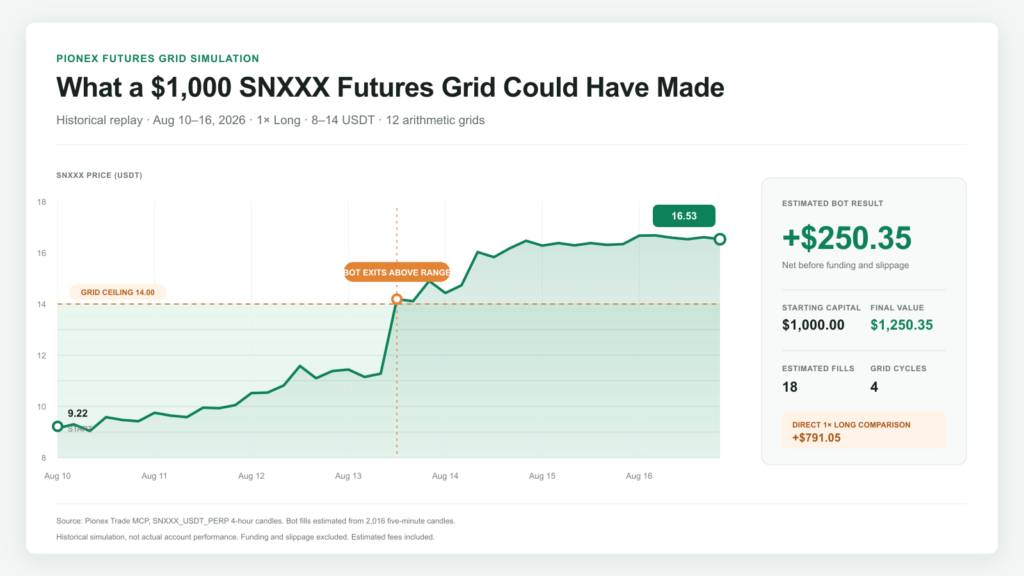
SNXXX/USDT Perp rose from 9.22 USDT to 16.53 USDT between August 10 and August 16, a 79.28% increase that made it the strongest verified stock-linked perpetual on Pionex that week. SNXXX is a USDT-settled perpetual contract linked to the Tradr 2X Long SNDK Daily ETF, not a tokenized SanDisk share. A hypothetical $100 of 1× long exposure at the weekly opening price would have become $179.28 before fees. The SNXXX Futures Grid Bot simulation below estimates that a $1,000 bot would have ended at $1,250.35 after trading fees, with funding and slippage excluded. The SPOT and PERP rankings remain separate.
Contents
- 1 Top tokenised stock assets this week at a glance
- 2 Top-performing Pionex SPOT markets
- 3 Top-performing Pionex PERP markets
- 4 Why SNXXX moved so sharply
- 5 What exactly is SNXXX on Pionex?
- 6 What the SNXXX chart shows
- 7 The $1,000 experiment: What would a Pionex Futures Grid Bot have made?
- 8 Futures Grid versus a direct 1× long position
- 9 Could different settings have produced a better result?
- 10 Where SNXXX stands now
- 11 What Could Push SNXXX Lower? Risks to Watch
- 12 How to monitor SNXXX on Pionex
- 13 Frequently Asked Questions
- 14 Disclaimer
Top tokenised stock assets this week at a glance
| Market | Weekly leader | Weekly return | What $100 became |
| SPOT | SKUUX/USDT | +43.74% | $143.74 |
| PERP | SNXXX/USDT Perp | +79.28% | $179.28 |
| $1,000 experiment | SNXXX Long Futures Grid | +25.03% estimated | $1,250.35 |
SPOT and PERP are not interchangeable. SPOT products do not carry perpetual funding or futures liquidation risk. PERP contracts can support leverage and short exposure, but introduce funding, margin and liquidation considerations. The wider selection is available on Pionex’s RWA markets page.
Top-performing Pionex SPOT markets
These rankings cover verified tokenized stock and stock-linked ETF products available as SPOT pairs. Ordinary crypto tickers ending in “X” were excluded.
| Rank | Pionex SPOT market | Product linked to | Weekly open | Weekly close | Return |
| 1 | SKUUX/USDT | GraniteShares 2x Long SK Hynix Daily ETF | 17.17 | 24.68 | +43.74% |
| 2 | RAMX/USDT | 2X Long DRAM ETF | 10.39 | 13.21 | +27.14% |
| 3 | DXYZX/USDT | Destiny Tech100 | 25.86 | 32.18 | +24.44% |
| 4 | MUUX/USDT | Direxion Daily MU Bull 2X Shares | 26.75 | 32.40 | +21.12% |
| 5 | TSLLX/USDT | Direxion Daily TSLA Bull 2X Shares | 8.13 | 8.74 | +7.50% |
SKUUX was the week’s strongest SPOT performer, but it is linked to a daily leveraged ETF. Buying it on the SPOT market avoids Pionex futures leverage, but it does not remove the underlying ETF’s daily reset and compounding risks.
The SPOT leaderboard also shows how strongly the memory-chip theme influenced the week. SKUUX, RAMX and MUUX all provide exposure connected to semiconductor or memory markets.
Top-performing Pionex PERP markets
The perpetual ranking is presented separately because these are derivatives. Returns below describe the contract price movement before leverage, fees or funding.
| Rank | Pionex PERP market | Underlying exposure | Weekly open | Weekly close | Return |
| 1 | SNXXX/USDT Perp | Tradr 2X Long SNDK Daily ETF | 9.22 | 16.53 | +79.28% |
| 2 | SHAZX/USDT Perp | SharonAI Holdings | 49.73 | 76.10 | +53.03% |
| 3 | NBISX/USDT Perp | Nebius Group | 191.98 | 278.89 | +45.27% |
| 4 | SNDKX/USDT Perp | SanDisk | 1,223.93 | 1,657.15 | +35.40% |
| 5 | SMCIX/USDT Perp | Super Micro Computer | 31.81 | 40.65 | +27.79% |
SNXXX’s 79.28% move was more than 26 percentage points ahead of SHAZX, the second-strongest perpetual market.
Source: Pionex Trade MCP daily candles for August 10 through August 16, 2026. Rankings measure the change from the August 10 opening price to the August 16 closing price. They rank price performance, not liquidity, risk-adjusted return or investment quality.
Why SNXXX moved so sharply
SanDisk entered the week with strong earnings behind it
SanDisk reported fiscal fourth-quarter revenue of $8.97 billion, up 51% sequentially. Datacenter revenue increased 103% from the previous quarter, while the company expanded its share-repurchase authorization by $14 billion.
SanDisk also projected fiscal first-quarter 2027 revenue between $10.30 billion and $10.80 billion. Those figures helped keep attention on SanDisk after its August 5 earnings release. Read SanDisk’s results
New AI-focused flash technology added another catalyst
On August 12, SanDisk and Kioxia unveiled ninth-generation 2Tb QLC 3D flash technology intended for AI and data-intensive infrastructure. The announcement strengthened the argument that NAND flash could benefit from growing AI storage requirements. Read the technology announcement
Investor Day extended the rally
SanDisk’s August 13 Investor Day outlined a fiscal 2028 to fiscal 2030 financial model targeting mid-to-high-teens revenue growth, approximately 80% non-GAAP gross margins and the return of 100% of excess cash after business investment.
The company also said agreements covering committed customer volumes could represent about 50% of fiscal 2027 bits and approximately two-thirds of fiscal 2028 bits. Read SanDisk’s Investor Day release
SNXXX targets twice the daily performance of SanDisk shares before fees and expenses. It is not designed to deliver exactly twice SanDisk’s cumulative weekly return. Daily resets, compounding and volatility can produce a materially different multi-day result. Read the SNXX prospectus
What exactly is SNXXX on Pionex?
SNXX is the Tradr 2X Long SNDK Daily ETF. It seeks 200% of SanDisk’s daily share-price movement before fees and expenses.
SNXXX is Pionex’s USDT-margined perpetual contract based on SNXX. See how to trade SNXXX on Pionex using bots. The exact Pionex market is:
SNXXX_USDT_PERP
For the product announcement, see Pionex’s official SNXXX listing notice.
It is not:
- SanDisk common stock
- A 1:1-backed SanDisk xStock
- The SNX cryptocurrency
- The SNDKX contract, which tracks SanDisk more directly
The Pionex trading screen listed SNXXX/USDT Perp as an active market with up to 25× leverage when checked on August 23. The experiment in this article uses only 1× leverage.
What the SNXXX chart shows
SNXXX began August 10 at 9.22 USDT, briefly reached a weekly low of 8.75 USDT and then accelerated through 10, 12 and 14 USDT. It recorded a weekly high of 16.80 USDT before closing August 16 at 16.53 USDT.
The shape of the move matters for a Grid Bot. There were some retracements, but the dominant structure was an upward breakout rather than a sideways range.
The $1,000 experiment: What would a Pionex Futures Grid Bot have made?
We replayed all 2,016 five-minute SNXXX candles recorded between August 10, 00:00 UTC and August 16, 23:55 UTC.
The grid range was selected using the preceding week, not SNXXX’s eventual 16.80 USDT high. Between August 3 and August 9, SNXXX traded between 7.93 and 13.65 USDT. Rounding those boundaries produced an 8 to 14 USDT range.
Simulation settings
| Setting | Input |
| Market | SNXXX/USDT Perp |
| Bot | Long Futures Grid |
| Starting capital | $1,000 |
| Leverage | 1× |
| Starting price | 9.22 USDT |
| Lower price | 8.00 USDT |
| Upper price | 14.00 USDT |
| Grid type | Arithmetic |
| Number of grids | 12 |
| Distance between levels | 0.50 USDT |
| Estimated quantity per grid | 9.20 SNXXX |
| Stop loss | None |
| Take profit | None |
This is a historical candle simulation. No SNXXX bot was running in the connected account during the period.
Estimated bot fills and profit
| Result | Estimated figure |
| Total fills | 18 |
| Buy fills | 4 |
| Sell fills | 14 |
| Completed buy-and-sell grid cycles | 4 |
| Completed-grid profit | $18.40 |
| Initial long-position profit | $232.75 |
| Gross total profit | $251.15 |
| Estimated trading fees | $0.80 |
| Funding and slippage | Excluded |
| Estimated net profit | $250.35 |
| Estimated final value | $1,250.35 |
| Return on starting capital | 25.03% |
The fee model applies Pionex’s standard 0.05% futures taker fee to the initial market entry and 0.02% maker fees to the grid orders. Actual fees depend on account tier and whether an order adds or removes liquidity. See Pionex’s fee explanation
The completed grid cycles
| Buy price | Sell price | Completed cycles | Gross profit |
| 9.50 USDT | 10.00 USDT | 1 | $4.60 |
| 11.00 USDT | 11.50 USDT | 2 | $9.20 |
| 12.00 USDT | 12.50 USDT | 1 | $4.60 |
| Total | 4 | $18.40 |
The distinction between grid profit and total profit is important. The bot did not generate $251.15 purely by buying low and selling high repeatedly.
Only $18.40 came from four completed grid cycles. Another $232.75 came from portions of the bot’s initial long position being sold progressively at 9.50, 10.00 and every 0.50 USDT level through 14.00 USDT.
Pionex also separates grid profit from total P&L because total P&L can contain directional position gains, unrealized P&L, trading fees and funding. How Pionex Futures Grid works
Futures Grid versus a direct 1× long position
| $1,000 strategy | Estimated net profit | Estimated final value | Return |
| SNXXX Long Futures Grid | $250.35 | $1,250.35 | 25.03% |
| Direct SNXXX 1× long | $791.05 | $1,791.05 | 79.10% |
| Difference | $540.70 | 54.07 percentage points |
The direct long position performed better because SNXXX was trending strongly upward.
A Long Futures Grid reduces its position as sell orders are completed. Once SNXXX crossed the 14 USDT upper boundary at approximately 15:20 UTC on August 13, the simulated bot had sold its remaining position. Normal grid trading then stopped above the configured range.
The direct long position continued participating as SNXXX moved from 14 USDT to its 16.53 USDT weekly close.
This does not mean a direct long position is generally superior. A Grid Bot can compare more favourably when price repeatedly crosses the same levels. This particular week offered only four completed grid cycles before turning into a breakout.
Could different settings have produced a better result?
A wider upper boundary could have kept the bot active longer, while more grids could have created smaller gaps between orders. A trailing-up feature could also have adjusted the range as price advanced.
However, applying those settings only after seeing the final chart would introduce hindsight bias. They would also change position size, fees, profit per grid and risk.
The useful lesson is not that traders should always select a wider range. It is that a fixed grid should be reviewed when price approaches its upper boundary with accelerating momentum.
Where SNXXX stands now
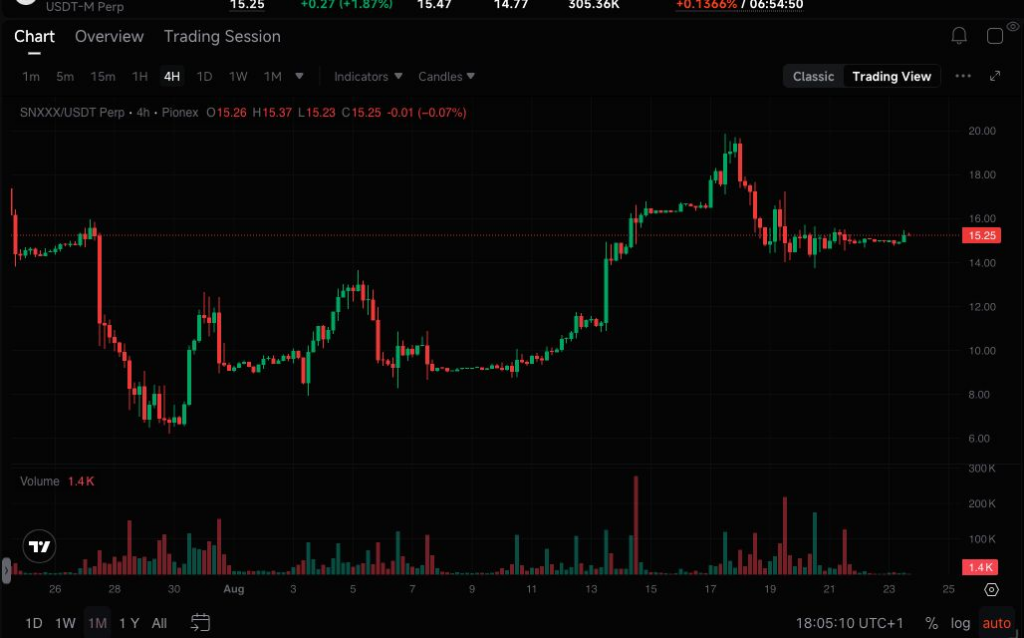
SNXXX traded at approximately 15.30 USDT when checked on August 23. Its latest 24-hour range was 14.77 to 15.47 USDT, with approximately 306,537 USDT in turnover.
That placed it about 7.44% below its August 16 close and 8.93% below the previous week’s 16.80 USDT high. The contract was also about 40.6% below its highest price in the available Pionex history, 25.75 USDT.
The current structure is therefore a pullback following a sharp rally, not a fresh breakout at the weekly high. The 14.77 to 15.00 area is the nearest observed support zone, while 16.53 to 16.80 is the first major recovery area from the previous week.
What Could Push SNXXX Lower? Risks to Watch
The SanDisk catalyst could fade
SNXXX amplified enthusiasm around earnings, AI-storage technology and Investor Day. Expectations are now high, and disappointment in demand, pricing, margins or customer agreements could reverse sentiment quickly.
SNXX also resets its leverage daily. Its return over several days can differ significantly from twice SanDisk’s cumulative return, especially during volatile back-and-forth trading.
The memory and AI trade could reverse
SKUUX, RAMX, MUUX, SNDKX and SNXXX all appeared among the week’s stronger markets. That concentration means the leaderboard was heavily exposed to the same memory and AI-infrastructure narrative.
A sector-wide reduction in AI spending expectations, weaker memory pricing or a broader technology sell-off could affect several of these products simultaneously.
Funding, liquidation and range risk remain
SNXXX is a perpetual contract. A long position may pay funding when the rate is positive, and funding can erode returns even when the market does not move sharply.
Leverage also increases liquidation risk. A narrow Grid Bot can stop trading after price leaves its range, while a highly leveraged position can be liquidated before the market returns. The 1× experiment above should not be used to estimate the outcome of a 5×, 10× or 25× bot.
⚠️ Futures Grid automation does not remove market risk. Check the live funding rate, liquidation price, range and order preview before creating a bot.
How to monitor SNXXX on Pionex
On the SNXXX trading screen
Watch the current price relative to the previous 14 USDT grid ceiling, the 16.53 to 16.80 resistance area and the recent 14.77 low.
Also monitor:
- The live funding rate and settlement countdown
- Estimated liquidation price
- Available margin
- Grid profit versus total P&L
- Whether price is repeatedly crossing levels or moving in one direction
- Whether the bot has stopped trading outside its range
Outside Pionex
The main underlying events come from SanDisk. Earnings, guidance, Investor Day materials, NAND pricing, AI-storage demand and customer agreements can all influence SNDK, SNXX and SNXXX.
Because SNXX targets twice SanDisk’s daily performance, traders should monitor both the ETF and SanDisk shares instead of relying on the SNXXX chart alone.
Frequently Asked Questions
What is SNXXX on Pionex?
SNXXX is a USDT-margined perpetual contract linked to the Tradr 2X Long SNDK Daily ETF. It provides derivative exposure to SNXX price movements and is not a traditional ETF share.
Is SNXXX an xStock or tokenized SanDisk share?
No. SNXXX is a stock-linked perpetual derivative. SNDKX is Pionex’s more direct SanDisk-linked product, while SNXX is a daily leveraged ETF targeting 200% of SanDisk’s daily performance.
Which Pionex SPOT market performed best from August 10 to August 16?
SKUUX/USDT was the strongest verified stock-linked SPOT market, rising 43.74% from 17.17 to 24.68 USDT. SKUUX is linked to the GraniteShares 2x Long SK Hynix Daily ETF.
Which Pionex perpetual performed best that week?
SNXXX/USDT Perp led the verified perpetual markets with a 79.28% increase. It rose from 9.22 to 16.53 USDT and reached a weekly high of 16.80 USDT.
Did a real SNXXX Futures Grid Bot make $250.35?
No. The figure is a historical simulation based on 2,016 five-minute Pionex candles. No SNXXX Futures Grid Bot was running in the connected account during the period, so the result should not be presented as an actual account return.
Why did the simulated Futures Grid underperform a direct long position?
The bot sold portions of its position as SNXXX crossed each grid level and had fully exited at 14 USDT. A direct long position remained exposed through the move to 16.53 USDT, so it benefited more from the sustained upward trend.
What is the minimum amount required for a SNXXX Futures Grid Bot?
The minimum is calculated from the selected range, grid count, leverage and current market price. Pionex’s parameter checker returned a minimum of 16.16 USDT for the 8 to 14 USDT, 12-grid, 1× configuration when checked on August 23, but this figure can change.
Which bot suits SNXXX’s current market structure?
A Futures Grid can be considered when SNXXX is repeatedly moving between defined support and resistance levels. A fixed grid is less effective during a straight breakout, while leverage should remain conservative because both SNXX and the perpetual contract can be highly volatile.
What are the main risks of trading SNXXX?
The main risks are a reversal in SanDisk or memory-sector sentiment, the daily-reset behaviour of the leveraged SNXX ETF, perpetual funding costs, range breakouts and liquidation when leverage is used. Traders can lose their entire allocated capital.
Disclaimer
This article is for informational purposes only and does not constitute financial or investment advice. Crypto trading carries significant risk including total loss of capital. Past performance is not indicative of future results. Always conduct your own research before trading.
Data sources: Pionex Trade MCP daily and five-minute candles for SNXXX_USDT_PERP and verified SPOT/PERP markets; Pionex market snapshot retrieved August 23, 2026; SanDisk Investor Relations; Tradr ETF documents. Simulated funding, spread and slippage were excluded.
