
SpaceX went public on June 12, 2026, on the Nasdaq under the ticker SPCX. For most retail investors outside the United States, buying the actual stock through a US brokerage is either complicated, restricted, or simply not available through their existing accounts.
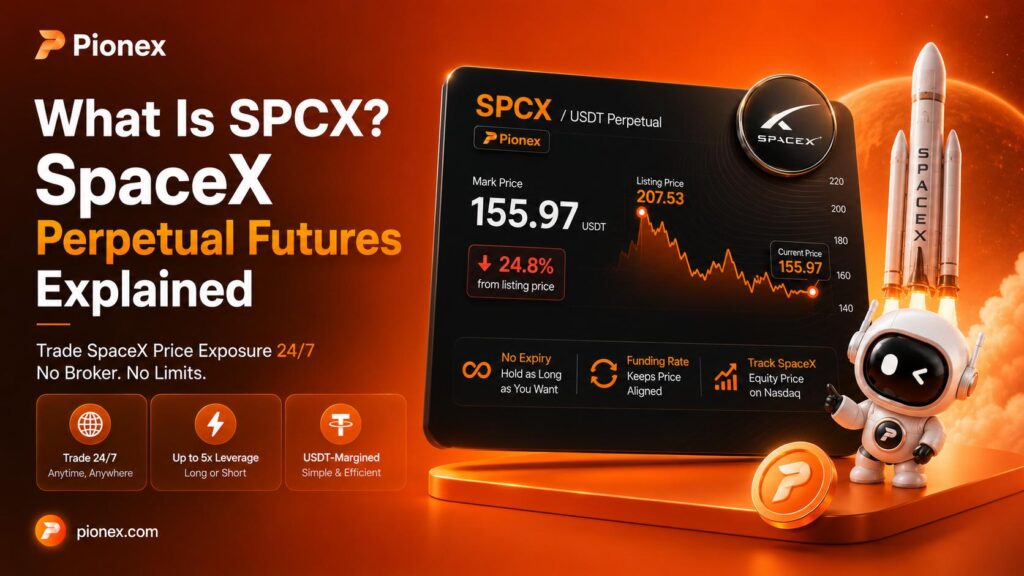
SPCX on Pionex is a different product entirely. It is a perpetual futures contract that lets you trade SpaceX price exposure 24/7 from anywhere in the world, with no brokerage account, no IPO allocation, and no waiting for Nasdaq to open.
This article explains what SPCX is, how it works, how it differs from owning the actual SpaceX stock, and what you need to know before trading it.
Contents
- 1 What Is SPCX on Pionex?
- 2 SPCX Stock vs. SPCX on Pionex: What Is the Difference?
- 3 What Is a Perpetual Futures Contract?
- 4 Why Did Pionex List SPCX Before the IPO?
- 5 What Happened to the Price Since Listing?
- 6 What Drives the SPCX Price?
- 7 How to Open an SPCX Position on Pionex
- 8 Can I Automate My SPCX Trade?
- 9 Frequently Asked Questions
- 10 Risk Disclosure
Contents
- 1 What Is SPCX on Pionex?
- 2 SPCX Stock vs. SPCX on Pionex: What Is the Difference?
- 3 What Is a Perpetual Futures Contract?
- 4 Why Did Pionex List SPCX Before the IPO?
- 5 What Happened to the Price Since Listing?
- 6 What Drives the SPCX Price?
- 7 How to Open an SPCX Position on Pionex
- 8 Can I Automate My SPCX Trade?
- 9 Frequently Asked Questions
- 10 Risk Disclosure
What Is SPCX on Pionex?
SPCX on Pionex is a USDT-margined perpetual futures contract. The underlying asset it tracks is SpaceX equity, specifically the publicly traded share price of Space Exploration Technologies Corp., which lists on Nasdaq under the ticker SPCX.
When you open a position in SPCX on Pionex, you are not buying SpaceX shares. You are entering a derivative contract that moves with the SpaceX stock price. If SpaceX goes up, a long SPCX position on Pionex goes up. If SpaceX goes down, a short SPCX position on Pionex profits.
The contract has no expiry date. You can hold it for one hour or one year. It settles in USDT, so you never need to handle actual SpaceX equity at any point.
New to tokenised stocks? Read : A-Z of Tokenised Stocks/xStocks [2026]
SPCX Stock vs. SPCX on Pionex: What Is the Difference?
| SPCX on Nasdaq | SPCX Perpetual on Pionex | |
| What you own | Actual SpaceX shares | A derivative contract |
| Trading hours | Nasdaq hours only | 24/7 |
| Leverage | No (standard margin via broker) | Up to 5x |
| Short selling | Requires broker approval | Available to all users |
| Settlement currency | USD | USDT |
| Minimum capital | Varies by broker | 10 USDT |
| Broker account required | Yes | No |
| Geographic restrictions | Varies by country | Based on Pionex terms |
The core difference is access and flexibility. SpaceX stock on Nasdaq is available through a US brokerage during market hours. SPCX perpetuals on Pionex are accessible to crypto traders globally at any hour, with both long and short options and built-in leverage.
What Is a Perpetual Futures Contract?
A perpetual futures contract is a type of derivative that tracks the price of an underlying asset without an expiration date. Unlike traditional futures contracts, which expire on a fixed date and require settlement, a perpetual contract stays open indefinitely as long as you hold margin in your account.
Three mechanics define how a perpetual contract works.
Mark price. The price you see on Pionex for SPCX is the mark price, which tracks the broader market price of SpaceX stock adjusted for the contract structure. It is not identical to the Nasdaq closing price at every moment but converges toward it continuously.
Funding rate. Because perpetual contracts never expire, the market uses a funding rate mechanism to keep the contract price aligned with the spot price. When more traders are long than short, long holders pay a small periodic fee to short holders. When more traders are short than long, short holders pay long holders. The funding rate adjusts automatically based on market imbalance. This is a carrying cost you pay or receive depending on your position direction and market conditions.
Leverage and margin. Perpetual contracts allow you to control a larger position than your deposited capital. At 5x leverage on Pionex, 100 USDT of margin controls a 500 USDT position. Gains and losses both scale proportionally. If the price moves 20% against a 5x leveraged position, the position is liquidated. Setting a stop loss before entering is essential.
Why Did Pionex List SPCX Before the IPO?
Pionex listed the SpaceX perpetual contract on May 21, 2026, when SpaceX was still a private company. At that point, SpaceX had filed its S-1 registration statement with the SEC but had not yet priced or begun trading on Nasdaq.
Pionex was able to list a pre-IPO perpetual because the contract tracks SpaceX equity value, which had an established secondary market price even before the IPO. Secondary market transactions in SpaceX shares had been taking place for years through private platforms. The Pionex contract used this pre-IPO valuation as its pricing basis.
This gave Pionex traders access to SpaceX price exposure weeks before the Nasdaq listing, making Pionex one of the first exchanges globally to offer this contract.
What Happened to the Price Since Listing?
The Pionex SPCX contract listed at 207.53 USDT on May 21, 2026. As of June 25, 2026, it trades at approximately 155.97 USDT. Understanding why requires understanding three separate events.
The technical repricing on June 10. When Pionex originally priced the contract, it used SpaceX’s estimated share count of 11.87 billion shares. SpaceX’s amended S-1/A filing updated this to 13.08 billion shares. Pionex adjusted the contract mark price using an adjustment coefficient of 1.10 to reflect the correct fundamentals. All trader PnL was protected through a one-time offsetting fee. No trader lost money from this adjustment alone, but the chart price moved down.
IPO price discovery. The pre-IPO Pionex listing reflected secondary market optimism about SpaceX’s valuation. SpaceX’s actual IPO priced at $135 per share, below the implied level in the early Pionex contract price. Once public market trading began, the perpetual converged toward the Nasdaq price.
Post-IPO volatility. SpaceX opened its Nasdaq debut at $150, peaked at $225.64 on June 16, then pulled back sharply to $147.11 on June 23. The current price around $155 reflects where the market has settled after the initial IPO surge.
For a full breakdown of each event and its impact on early traders, see: [SpaceX IPO: What Happened to Early SPCX Traders on Pionex].
What Drives the SPCX Price?
Since SpaceX is now a publicly traded company, the same factors that move the Nasdaq stock move the Pionex perpetual.
Starlink. Starlink accounted for approximately 61% of SpaceX’s 2025 revenue at $11.4 billion. Subscriber growth, enterprise contracts, and government deals are the primary fundamental drivers. Starlink’s adjusted EBITDA margin was approximately 63%, making it the profit engine of the entire business.
xAI and X. SpaceX acquired Elon Musk’s AI startup xAI in early 2026, which brought with it xAI’s data centers, the Grok AI models, and the social network X. xAI reported a $6.35 billion operating loss in the period before the IPO. Investors are watching whether AI capital expenditure scales toward profitability.
Starship development. SpaceX has completed over 650 orbital launches with a greater than 99% mission success rate across Falcon rockets. Starship milestones, both successes and delays, affect sentiment.
Earnings. SpaceX is expected to release its first public earnings report in August 2026. This will be the first time the company provides publicly audited financial results since listing, and it will reset market expectations for Starlink growth, xAI losses, and Starship investment.
Lockup expiration. SpaceX’s insider lockup structure allows some employees to sell portions of their holdings shortly after the first quarterly results. The full lockup expires approximately 180 days after the June 12 listing. Increased supply at lockup expiration is a standard post-IPO risk.
How to Open an SPCX Position on Pionex
- Log into your Pionex account at pionex.com
- Go to Futures in the main menu
- Search for SPCX under the xStocks or Stock Tokens section
- Select Long if you expect the price to rise, or Short if you expect it to fall
- Set your leverage between 1x and 5x
- Enter your position size in USDT
- Set a Take Profit and Stop Loss
- Confirm the trade
The minimum position size is 10 USDT. Setting a stop loss is not optional if you are using leverage. Know your liquidation price before confirming.
Can I Automate My SPCX Trade?
Yes. Pionex has built-in trading bots that work directly with SPCX perpetuals at no subscription cost. You pay only the standard 0.05% trading fee.
The Futures Grid Bot is the most commonly used. It places a ladder of buy and sell orders within a price range you define, capturing profit each time the price oscillates between levels. It runs in long, short, or neutral mode depending on your market view. The AI-assisted setup suggests parameters based on recent price data.
For a full breakdown of which bot suits which market condition, see: [How to Trade SpaceX (SPCX) on Pionex: A Complete Guide].
Frequently Asked Questions
Is SPCX the same as SpaceX stock? No. SPCX on Pionex is a perpetual futures contract that tracks the SpaceX stock price. You do not own actual SpaceX shares when you hold SPCX on Pionex.
Do I need a US brokerage to trade SPCX on Pionex? No. Pionex is a crypto exchange. You deposit USDT and trade directly. No US brokerage account or bank transfer to the United States is required.
What is the maximum leverage for SPCX on Pionex? 5x, using USDT-margined perpetual contracts.
Can I short SpaceX on Pionex? Yes. Perpetual contracts support both long and short positions. The Futures Grid Bot also has a dedicated short mode for automated short strategies.
What is a funding rate? A small periodic fee paid between long and short holders to keep the perpetual contract price aligned with the underlying spot price. Depending on market conditions, you pay or receive the funding rate.
Is SPCX on Pionex available in Taiwan and other Asian markets? Pionex is widely used across Taiwan, mainland China, and Southeast Asia. Check Pionex’s terms of service for the most current list of supported regions.
What was preSpaceX? preSpaceX was the original name of the SpaceX tokenized stock listed on Pionex before the IPO. On May 28, 2026, Pionex conducted a 1:5 split of all preSpaceX holdings and renamed the product to SPCX, aligning with the official Nasdaq ticker.
Related read: If SPCX is the rocket side of the Musk trade, TSLLX is the Tesla side with 2x daily voltage. For the Tesla-linked version, read How To Buy The 2x Tesla ETF (TSLL) On Pionex.
Risk Disclosure
Perpetual futures trading involves substantial risk including total loss of your position. Leverage amplifies both gains and losses. SPCX on Pionex is a derivative contract, not actual SpaceX equity. Price can deviate from the Nasdaq stock price due to funding rates, liquidity conditions, and market structure. Past price performance does not indicate future results. Always set a stop loss. Understand your liquidation price before opening a leveraged position. Only trade with capital you can afford to lose.
This article is for informational purposes only and does not constitute financial advice. Price data referenced as of June 25, 2026.
