
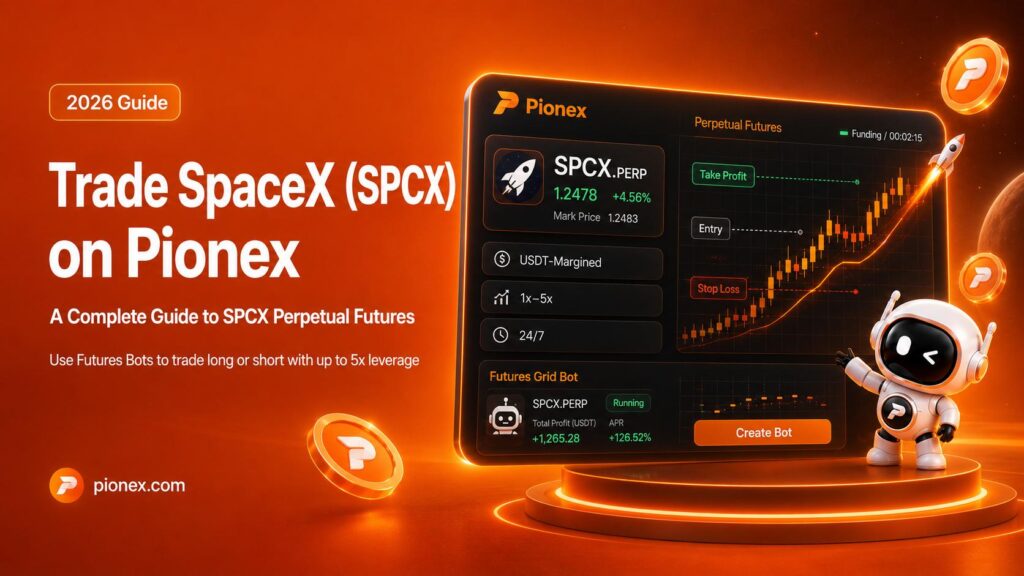
SpaceX went public on June 12, 2026, pricing at $135 per share in what became the largest IPO in history, raising $75 billion at a valuation approaching $1.8 trillion. Pionex listed the SPCX perpetual futures contract on May 21, weeks before anyone else, giving traders early exposure before Wall Street opened the doors.
This guide explains what SPCX is on Pionex, what happened since listing, how to trade it, and how to use Pionex’s bots to manage positions without sitting at a screen all day.
Contents
What Is SPCX on Pionex?
SPCX is a USDT-margined perpetual futures contract that tracks SpaceX equity. It is not a tokenized share. You do not own SpaceX stock when you hold SPCX on Pionex. What you hold is a derivative that moves with SpaceX’s market price, settled in USDT, with no expiration date.
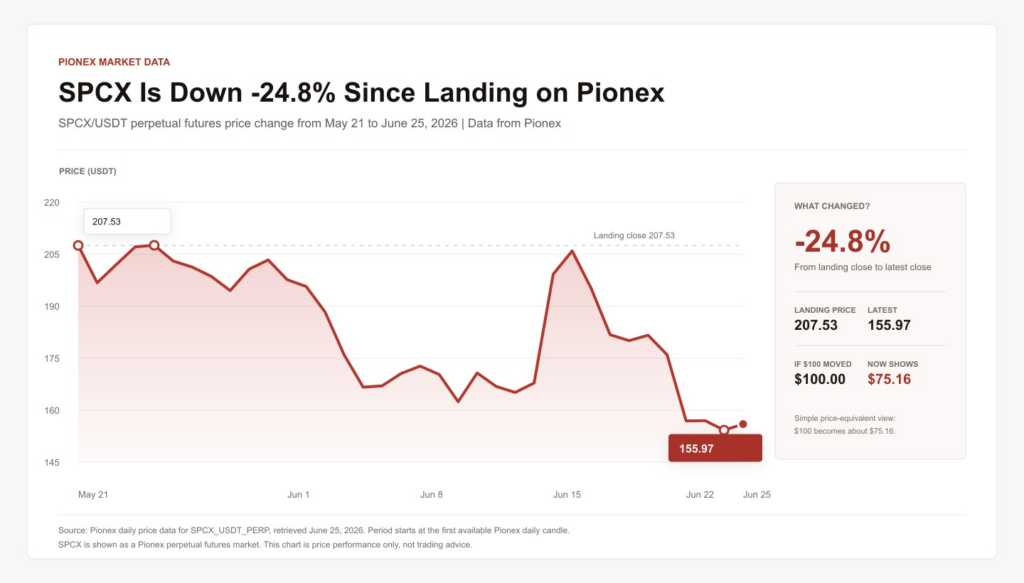
The contract was first listed as preSpaceX/USDT on Pionex’s spot market before SpaceX filed its S-1 with the SEC. On May 28, 2026, Pionex conducted a 1:5 stock split of preSpaceX holdings and renamed the contract to SPCX, aligning with the Nasdaq ticker confirmed in SpaceX’s SEC filing. The SPCX/USDT perpetual futures market went live on May 21, 2026, with a listing close price of 207.53 USDT.
As of June 25, 2026, SPCX is trading at approximately 155.97 USDT, down 24.8% from its Pionex listing price.
Why the Price Has Dropped Since Listing
This is the first question most traders ask, and it deserves a direct answer.
SPCX was priced on Pionex before SpaceX’s S-1 was public. The early pricing used an estimated share count of 11.87 billion shares. When SpaceX’s amended S-1/A filing updated the estimated share count to 13.08 billion shares, Pionex adjusted the contract pricing accordingly.
The adjustment coefficient was 1.10, meaning the mark price was divided by 1.10 to reflect the revised share count. This was not a loss caused by market movement. It was a technical repricing to keep the contract aligned with SpaceX’s actual fundamentals.
Pionex offset the price adjustment with a one-time fee to ensure no trader suffered a net PnL impact from the repricing alone. Long positions received fee income equal to their new unrealized loss. Short positions paid a fee equal to their new unrealized gain. The net effect was zero.
After the repricing, SPCX has tracked SpaceX’s post-IPO price action. SpaceX priced its IPO at $135 per share on June 11. The stock opened for trading on Nasdaq the following day. SPCX on Pionex has moved broadly in line with public market prices since then, adjusted for the perpetual contract structure.
Understanding the Contract Specs
| Parameter | Detail |
| Contract | SPCX/USDT Perpetual |
| Margin Type | USDT-Margined |
| Maximum Leverage | 5x |
| Minimum Trade | 10 USDT |
| Trading Hours | 24/7 |
| Funding Fee | Periodic, paid between long and short holders |
| Settlement | No expiry, continuous |
The funding rate mechanism means holding a leveraged position has a carrying cost. If more traders are long than short, long holders pay a funding fee to short holders, and vice versa. This is standard for all perpetual futures markets.
How to Open a SPCX Trade on Pionex
- Log into your Pionex account at pionex.com
- Navigate to Futures in the main menu
- Select the xStocks or Stock Tokens category
- Search for SPCX
- Choose your direction: Long (you expect the price to rise) or Short (you expect it to fall)
- Set your leverage (1x to 5x)
- Enter your position size in USDT
- Set a Take Profit and Stop Loss before confirming
A few things to check before placing a trade. First, confirm you are looking at the perpetual market, not the spot market. Second, set a stop loss. SPCX can move sharply on news. Third, understand your liquidation price before entering. At 5x leverage, a 20% move against your position triggers liquidation.
Using Pionex Bots to Trade SPCX
Manual trading works. But SpaceX-related news can drop at any hour, and markets do not wait. Pionex’s built-in bots let you define a strategy in advance and let the bot execute it. There are no subscription fees. You pay only the standard 0.05% trading fee.
Futures Grid Bot
This is the most straightforward bot for SPCX. You define a price range and a number of grid levels. The bot places buy orders at the bottom of each grid and sell orders at the top, automatically capturing profit each time the price oscillates between levels.
It runs in three modes: Long (profits when price trends up), Short (profits when price trends down), and Neutral (captures profit from volatility in both directions regardless of trend).
Start capital: as low as 10 USDT. The bot includes an AI-assisted parameter setup that suggests a price range and grid count based on recent price data. You can override any parameter manually.
Best suited for: traders who expect SPCX to trade within a range around a known event, such as SpaceX earnings releases, Starlink subscriber updates, or launch milestones.
Leveraged Grid Bot
Same structure as the standard Futures Grid Bot, but runs using borrowed capital from Pionex’s lending pool, up to 5x leverage. Your grid profits scale up proportionally, and so does the downside. The bot includes automatic liquidation price reduction as a built-in buffer.
Best suited for: traders with a strong directional view who want more exposure without manually sizing positions.
Futures Grid Bot (Neutral Mode)
If you are uncertain which direction SPCX moves next but you expect volatility, the neutral grid captures profit from movement in both directions. It does not require you to pick a side.
Best suited for: periods when there is a known upcoming event, such as a Starship test, SpaceX earnings report, or Starlink milestone announcement, and you expect sharp movement but not a clear directional trend.
Cross Margin Futures Grids Bot
The most capital-efficient option. This bot runs both a long grid and a short grid simultaneously on the same pair, sharing margin between them. Profit from one side compensates for temporary losses on the other.
Best suited for: traders who want to capture moves in both directions at the same time without doubling their margin requirement.
All bots support native stop loss, take profit, and trigger price controls. You can set the bot to activate only when SPCX reaches a specific price level, which is useful if you are waiting for a dip before entering.
What Drives SPCX Price
Since SpaceX is now publicly traded on Nasdaq under the ticker SPCX, the same factors that move the stock will move the Pionex perpetual.
Starlink revenue growth. Starlink accounted for approximately 61% of SpaceX’s total 2025 revenue, generating $11.4 billion. Subscriber counts, enterprise contract announcements, and government deals all move the stock.
Launch cadence. SpaceX has completed over 650 orbital launches with a greater than 99% mission success rate across Falcon rockets. Launch failures or delays would be negative catalysts. Successful Starship milestones tend to be positive.
Elon Musk news. Given Musk’s role across SpaceX, Tesla, and other ventures, news that affects his broader corporate situation can create short-term volatility in SPCX.
Valuation multiples. SpaceX entered public markets at close to 1.8 trillion USD in valuation. The company reported $18.67 billion in 2025 revenue with a GAAP net loss of approximately $5 billion. As a high-growth, high-valuation name, it will be sensitive to broader risk-off moves in equity markets.
IPO lockup dynamics. Most insiders face a lockup restriction after the June 12 listing. When lockups expire, supply increases. This is a known risk factor for the months following the IPO.
Frequently Asked Questions
Is SpaceX still a private company? No. SpaceX priced its IPO on June 11, 2026 and began trading on Nasdaq under the ticker SPCX on June 12, 2026.
What happened to preSpaceX? preSpaceX was a tokenized stock that Pionex listed before the IPO. On May 28, 2026, Pionex conducted a 1:5 split of all preSpaceX holdings and renamed the product to SPCX. If you held 1 preSpaceX before the split, you received 5 SPCX after.
Why did SPCX price drop from 207.53 to around 156? Two factors. First, Pionex repriced the contract in June to reflect the updated SpaceX share count from the S-1/A filing (11.87 billion revised to 13.08 billion). This technical adjustment applied an adjustment coefficient of 1.10 and was offset with a one-time fee to protect trader PnL. Second, SpaceX’s post-IPO market price has settled below the pre-IPO valuation that Pionex’s early pricing reflected.
Can I short SPCX on Pionex? Yes. Perpetual contracts support both long and short positions. The Futures Grid Bot also has a dedicated short mode.
What is the maximum leverage for SPCX? 5x, using USDT-margined margin.
Do I pay a fee to use the trading bots? No subscription fee. You pay only the standard Pionex trading fee of 0.05% per transaction.
Is this trading advice? No. This article is for informational purposes only. Leveraged futures trading carries significant risk including total loss of your position. Only trade with capital you can afford to lose.
Risk Disclosure
Digital asset and tokenized stock perpetual futures trading involves substantial risk. Leverage amplifies both gains and losses. Pionex does not guarantee any returns or assume liability for trading outcomes. SpaceX perpetual futures on Pionex are derivatives, not actual shares of SpaceX. Price can deviate from the underlying stock due to funding rates, liquidity, and market conditions. Always set a stop loss and understand your liquidation price before opening a leveraged position.
Data sourced from Pionex daily price data for SPCX_USDT_PERP, retrieved June 25, 2026. SpaceX IPO information sourced from public SEC filings and press coverage. This is not financial advice.
