
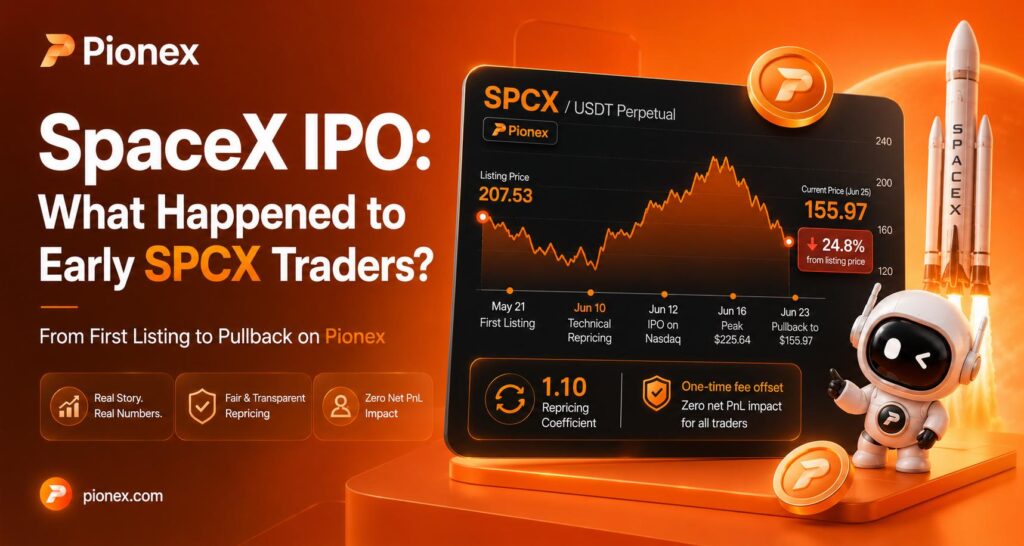
On May 21, 2026, Pionex listed a SpaceX perpetual futures contract when SpaceX was still a private company. The listing price was 207.53 USDT. As of June 25, SPCX trades at approximately 155.97 USDT on Pionex, down 24.8% from that opening price.
That number looks bad on a chart. But the full story is more complicated, and understanding it matters whether you held through it, missed it, or are considering entering now.
This article walks through every major event from listing to today, including what caused the price to move, what the technical repricing was about, and what the post-IPO price action actually means for traders holding SPCX on Pionex.
Contents
The Timeline, From First Listing to Today
May 21, 2026: Pionex Lists SPCX Perpetuals
Pionex went live with the SpaceX perpetual futures contract under the ticker preSpaceX/USDT. At the time, SpaceX had confidentially filed its draft S-1 registration statement with the SEC in April but had not yet published its public prospectus. SpaceX remained a private company with no public share price.
The listing price on Pionex reflected pre-IPO secondary market valuations. The opening close price was 207.53 USDT per contract, implying a share count estimate of approximately 11.87 billion shares.
Pionex was among the first exchanges globally to offer this contract, giving traders access to SpaceX price exposure weeks before the Nasdaq listing.
May 20, 2026: SpaceX Files Its Public S-1
SpaceX published its S-1 registration statement with the SEC on May 20, 2026. The filing gave the public its first detailed look at SpaceX’s finances: $18.67 billion in 2025 revenue, a GAAP net loss of approximately $5 billion, and Starlink accounting for roughly 61% of total revenue.
The filing confirmed SpaceX would list on Nasdaq under the ticker SPCX.
May 28, 2026: preSpaceX Split and Rename
Pionex conducted a 1:5 split of all preSpaceX holdings and renamed the product to SPCX, aligning with the official Nasdaq ticker. Every trader who held 1 preSpaceX before the split received 5 SPCX after. The price per unit adjusted proportionally. The SPCX/USDT perpetual futures market continued trading at the post-split price.
June 1, 2026: SpaceX Files S-1/A Amendment
SpaceX filed Amendment No. 1 to its S-1, updating several details. The amended filing disclosed the revised total share count: 13.08 billion shares, up from the 11.87 billion figure Pionex had used when pricing the initial contract listing.
June 10, 2026: Pionex Reprices the SPCX Contract
This is the event that most traders noticed but not everyone understood.
Because the contract was originally priced using an estimated share count of 11.87 billion shares, and SpaceX’s updated prospectus disclosed 13.08 billion shares, Pionex adjusted the contract mark price to reflect the correct fundamentals. The adjustment coefficient was 1.10, meaning the mark price was divided by 1.10.
For a trader who held a position with an entry price of 165 USDT and a mark price of 165 USDT before the adjustment, the new mark price became approximately 150 USDT after applying the coefficient. This created an unrealized loss of 15 USDT for long holders.
Pionex offset this with a one-time fee payment: long holders received 15 USDT in fee income, exactly matching the new unrealized loss. Short holders paid 15 USDT in fee, offset by the equivalent unrealized gain. The net PnL impact for all traders was zero.
This was a technical correction to keep the contract aligned with SpaceX’s actual capitalization table, not a market loss. Traders who understood this held their positions without concern. Those who did not understand it saw the price drop and sold.
June 11, 2026: SpaceX IPO Priced at $135
Goldman Sachs and 20 other underwriters priced the SpaceX IPO at $135 per share, valuing the company at approximately $1.77 trillion at IPO price. The deal raised $75 billion, making it the largest IPO in history. Retail investors received approximately 30% of the float, three times the standard allocation for a deal of this size, distributed through Robinhood, Fidelity, Charles Schwab, SoFi, and E*TRADE.
June 12, 2026: SpaceX Begins Trading on Nasdaq
SpaceX COO Gwynne Shotwell rang the opening bell at the Nasdaq MarketSite in New York. SPCX opened at $150, rose as high as $176.52 during the session, and closed at $161.11, a 19.3% gain over the IPO price on first-day volume of over 500 million shares.
At the closing price, SpaceX’s market cap crossed $2 trillion, making it the sixth-largest publicly traded company in the United States at the time.
Perpetual futures on crypto exchanges, including Pionex, tracked closely to the public market close. The Pionex SPCX perp moved in line with the Nasdaq price, adjusted for the perpetual contract structure and funding rates.
June 13, 2026: MSCI Includes SpaceX
Under MSCI’s early-inclusion methodology, SpaceX was added to the MSCI World and MSCI ACWI indices the day after listing. With an estimated 4% public float and passive funds tracking those indices running into the tens of trillions of dollars, this created structural, price-insensitive buying pressure in the days immediately following the IPO.
June 15 to June 16, 2026: SPCX Peaks at $225.64
SpaceX shares climbed another 20% on June 15, the first full Monday of trading. The combination of retail enthusiasm, MSCI index inclusion buying, and tight float pushed SPCX to an all-time high of $225.64 on June 16, 2026, approximately 67% above the IPO price.
At this point, traders who had held Pionex SPCX perpetuals from the early listing and through the repricing were deep in profit if they had entered at or near the listing price of 207.53 and had not been shaken out by the June 10 adjustment.
June 23, 2026: SPCX Drops to $147.11
The rally reversed sharply. SpaceX fell 16% in a single session on June 23, hitting a low of $147.11. Headlines attributed the drop to valuation concerns, analyst downgrades, and the reality that the stock had run 67% above IPO price within days of listing on no new fundamental news.
CFRA had initiated coverage with a sell rating and a $115 price target. Morningstar valued SpaceX at $63 per share, flagging the gap between current valuation and near-term earnings visibility.
Traders who had taken profit near the peak or set automated take profit orders through Pionex bots benefited. Those who held through the pullback without a stop loss saw gains reverse.
June 25, 2026: Current Price at 155.97 USDT
As of today, SPCX trades at approximately 155.97 USDT on Pionex. The Nasdaq stock is trading around $154 to $156, consistent with the perpetual futures price after accounting for the contract structure.
The stock is down 31% from its all-time high but still 15% above the IPO price of $135.
What the Chart Is Actually Showing
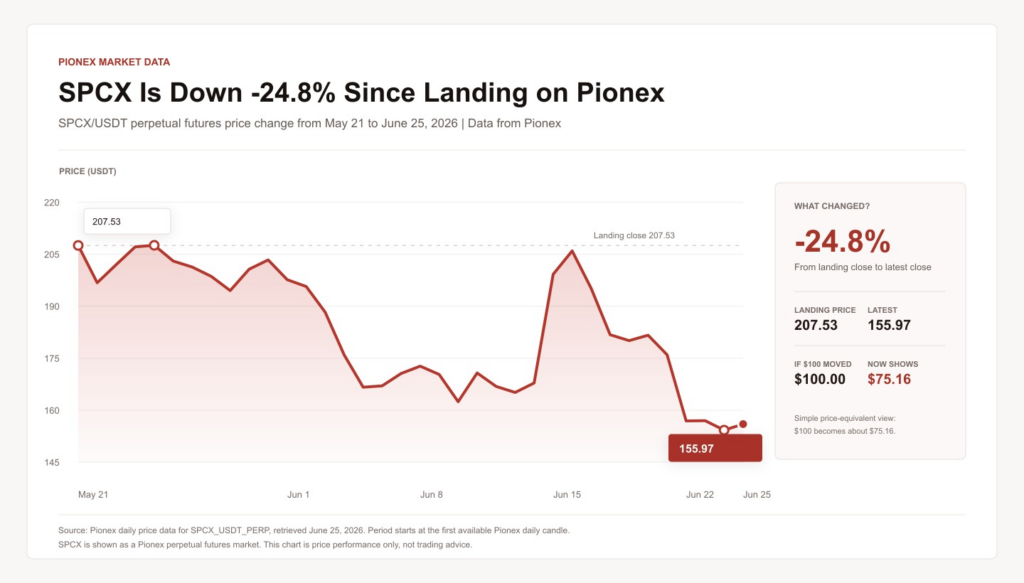
The -24.8% on the Pionex SPCX chart since May 21 is a combination of three separate events:
1. The technical repricing on June 10. This adjusted the mark price down by approximately 9% using the 1.10 adjustment coefficient. No trader lost money from this event. All PnL was offset by the one-time fee. But the chart price dropped, and it looks like a loss to anyone reading the chart without context.
2. Post-IPO price discovery. The early Pionex listing at 207.53 reflected pre-IPO secondary market optimism. SpaceX’s actual IPO priced at $135, below the level embedded in the original Pionex contract price. Once the public market set the price, perpetuals on all exchanges, including Pionex, converged toward the publicly traded share price.
3. Post-peak pullback. SPCX peaked at $225.64 on June 16 and has pulled back to the current $155 range. This is a normal post-IPO pattern for high-profile listings that run sharply above the offering price on speculative demand before settling toward a more sober valuation.
Traders who understood all three of these dynamics and managed their positions accordingly, including using Pionex bots with take profit settings, had a very different experience than those who held passively and watched the chart.
What Comes Next for SPCX
Three catalysts are worth watching in the second half of 2026.
SpaceX’s first public earnings report. The company is expected to release its first publicly audited earnings statement in August 2026. This will be the first time investors can assess Starlink subscriber growth, xAI capital expenditure progress, and Starship program economics against the current valuation in a public forum.
Insider lockup expiration. SpaceX’s lockup structure is unusual. Some early employees and select recipients can sell 20% of their shares shortly after the first quarterly results. The full lockup expires approximately 180 days after the June 12 listing, pointing to around December 2026. When supply increases, price often pulls back.
Nasdaq-100 inclusion. Under revised Nasdaq rules effective May 2026, SpaceX could qualify for Nasdaq-100 inclusion in as little as 15 trading days from listing. Bloomberg Intelligence estimated this could force passive index funds to absorb roughly $600 billion worth of SPCX shares. If this occurs, it creates sustained mechanical buying regardless of short-term price sentiment.
How Pionex Traders Can Position for the Next Move
The Pionex SPCX perpetual market gives you tools that the Nasdaq stock does not.
On Nasdaq, you can only buy or hold SPCX. On Pionex, you can go long, go short, or run an automated grid strategy that captures profit from price oscillation in either direction. All of this runs 24/7, including during Asian trading hours when Nasdaq is closed.
The Futures Grid Bot in neutral mode is suited to traders who expect SPCX to remain volatile between the current level and the August earnings release but are not certain of the direction. It does not require you to pick a side. You define a price range, set the grid levels, and the bot buys low and sells high within that band automatically.
If you have a directional view, the long or short Futures Grid Bot modes let you run a directional grid with a stop loss built in. The minimum capital to start is 10 USDT.
For traders who want to amplify their position, the Leveraged Grid Bot runs the same structure using up to 5x leverage. Understand your liquidation price before using leverage on any trade.
Risk Disclosure
Perpetual futures trading involves substantial risk including total loss of your position. Leverage amplifies both gains and losses. The SPCX contract on Pionex is a derivative, not actual SpaceX equity. Past price performance does not indicate future results. Set a stop loss. Know your liquidation price. Only trade with capital you can afford to lose.
Price data sourced from Pionex SPCX_USDT_PERP daily candles retrieved June 25, 2026, and public market data from Nasdaq/investing.com. SpaceX IPO data sourced from SEC filings and published financial press. This article is for informational purposes only and does not constitute financial advice.
