
Contents
- 1 Introduction
- 2 Can You Trade US Stocks on Pionex?
- 3 The June Leaderboard: Top 10 Tokenized Stock Tokens on Pionex
- 4 What Drove These Moves
- 5 What This Month’s List Tells You
- 6 Why Pionex Traders in Taiwan and Asia Pay Attention to This Data
- 7 How to Trade These Tokens on Pionex
- 8 Tokenized Stocks Are Not Regular Stocks
- 9 FAQ
Introduction
June 2026 has been one of the strongest months of the year for US equity markets, and that strength has shown up clearly in Pionex’s tokenized stock pairs.
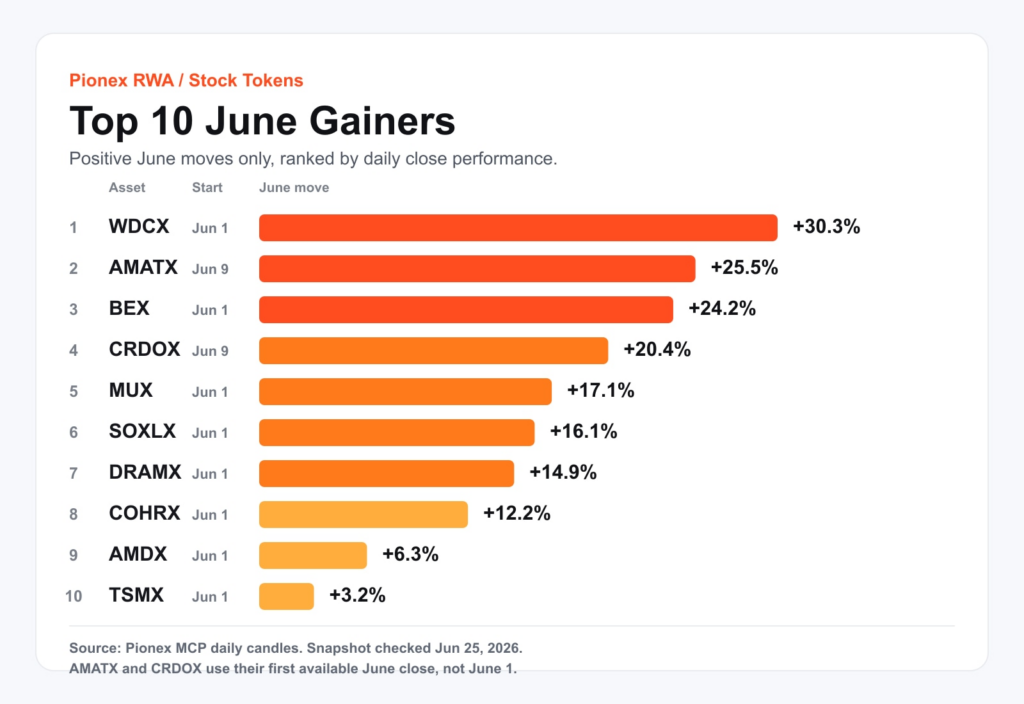
Using Pionex MCP daily candle data, this article ranks the top 10 tokenized stock tokens on Pionex by their June month-to-date performance, as of June 25, 2026. All prices are in USDT. All returns are measured from each token’s first available June close, which is June 1 for most tokens, and the first available June close for AMATX and CRDOX.
The leaderboard this month is dominated by storage and semiconductor names, with one crypto-native equity and one biotech optical play rounding out the list.
Can You Trade US Stocks on Pionex?
Yes. Pionex lists over 220 tokenized stock and ETF pairs settled in USDT. These include well-known names like AAPLX, TSLAX, NVDAX, and GOOGLX, alongside sector-specific tokens like SOXLX and DRAMX.
These are not brokerage accounts. You do not get shareholder rights, SIPC protection, or direct share ownership. What you get is 24/7 USDT-denominated exposure to the price movements of underlying US equities, with access to Pionex’s full suite of trading bots on supported pairs.
For eligible traders who prefer USDT settlement, tokenized-stock markets can provide an alternative route to price exposure. They are not a substitute for legal access, shareholder rights, or local suitability checks. You fund with USDT, trade in the same interface you use for crypto, and settle in seconds rather than days.
The June Leaderboard: Top 10 Tokenized Stock Tokens on Pionex
Data sourced from Pionex MCP daily candles. Snapshot taken June 25, 2026. AMATX and CRDOX did not have June 1 candles in the pulled data, so their first available June close is used as the start price.
| Rank | Token | Start Used | Start Price (USDT) | Latest Close (USDT) | June Move |
| 1 | WDCX | Jun 1 | 549.20 | 715.40 | +30.3% |
| 2 | AMATX | Jun 9 | 499.19 | 626.66 | +25.5% |
| 3 | BEX | Jun 1 | 274.38 | 340.87 | +24.2% |
| 4 | CRDOX | Jun 9 | 233.85 | 281.46 | +20.4% |
| 5 | MUX | Jun 1 | 1,040.39 | 1,218.66 | +17.1% |
| 6 | SOXLX | Jun 1 | 225.76 | 262.10 | +16.1% |
| 7 | DRAMX | Jun 1 | 68.27 | 78.42 | +14.9% |
| 8 | COHRX | Jun 1 | 363.90 | 408.40 | +12.2% |
| 9 | AMDX | Jun 1 | 507.47 | 539.20 | +6.3% |
| 10 | TSMX | Jun 1 | 438.39 | 452.54 | +3.2% |
Past performance does not indicate future results. These are tokenized instruments, not registered securities.
What Drove These Moves
1. WDCX (+30.3%) – The AI Storage Story of the Month
WDCX tracks Western Digital (NASDAQ: WDC), and if there is one stock that defined June 2026 in the US market, it is this one.
Western Digital posted fiscal Q3 2026 revenue of $3.34 billion, a 45.5% year-over-year increase, with adjusted EPS of $2.72 against a street consensus of $2.39. The company guided Q4 revenue to a midpoint of $3.65 billion, signaling that demand remains extremely strong.
The catalyst that ignited the June rally was a wave of analyst upgrades in the second week of the month. Morgan Stanley raised its price target to $650 from $488, citing a structural shortage of high-capacity hard disk drives driven by AI data center demand. JPMorgan moved its target to the same level on identical reasoning. Mizuho, Citi, Bank of America, and Wells Fargo each followed with their own upgrades.
The supply-demand picture behind this is straightforward. AI data center buildout requires massive storage for training datasets and inference logs. HDD demand is growing at roughly 40% to 50% annually, while supply growth is running at 30% to 35%. Western Digital’s 2026 production capacity is essentially sold out, giving the company meaningful pricing power. The stock closed at an all-time high of $746.23 on June 18.
For Pionex traders, WDCX delivered a 30.3% return in June from the June 1 open. That is the top performance on this leaderboard.
2. AMATX (+25.5%) – Semiconductor Equipment Catches the AI Wave
AMATX tracks Applied Materials (NASDAQ: AMAT), the world’s largest semiconductor equipment maker by revenue. The June move started later than WDC’s, which is why AMATX’s start date in this dataset is June 9 rather than June 1. Its gain from that point to June 25 was 25.5%.
Applied Materials supplies the deposition, etch, and inspection systems that chipmakers use to build semiconductors. When demand for AI chips rises, the equipment that makes those chips also benefits, though typically with a lag. That lag played out in June.
Wells Fargo upgraded AMAT to Buy in the final week of the month, raising its price target to $715 from $520. Bank of America separately lifted its target to $720 from $540. On June 15, the company introduced two new chipmaking systems aimed at precision processing in deep 3D structures, directly addressing the manufacturing requirements of next-generation AI chips.
3. BEX (+24.2%) – Crypto Exchange Exposure
BEX is one of Pionex’s tokenized instruments with crypto-native underlying exposure. It was the third-strongest performer in June, rising 24.2% from its June 1 close.
4. CRDOX (+20.4%) – Another Crypto-Linked Gain
CRDOX posted a 20.4% gain from its first available June close of June 9. Like BEX, it carries crypto-adjacent exposure and benefited from the broader market sentiment improvement in June.
5. MUX (+17.1%) – Memory’s Monster Month
MUX tracks Micron Technology (NASDAQ: MU), and June was a significant month for Micron ahead of its fiscal Q3 earnings report on June 24.
Micron has crossed a $1 trillion market capitalization in 2026, driven by AI-driven demand for its HBM (high bandwidth memory), DRAM, and NAND products. The company’s fiscal Q2 revenue came in at approximately $24 billion. Ahead of the June 24 earnings report, multiple analysts raised price targets substantially, and Micron announced a strategic agreement with Anthropic in early June to scale next-generation AI infrastructure.
The context for MUX’s 17.1% June gain is the same structural story driving WDCX: AI systems consume memory and storage at a rate that current production cannot fully match. Micron is one of only three companies, alongside Samsung and SK Hynix, that can supply HBM4 for NVIDIA’s Vera Rubin platform.
Micron reported Q3 EPS of $25.11 after market close on June 24, against a consensus of $20.28, and guided Q4 EPS to $30.00 to $32.00 against a consensus of $24.80. Results were described as the strongest quarter in the company’s history.
6. SOXLX (+16.1%) – The Leveraged Semiconductor ETF Play
SOXLX tracks the Direxion Daily Semiconductor Bull 3X ETF (SOXL), a 3x leveraged fund on the Philadelphia Semiconductor Index. It is not a stock, but it trades on Pionex like one.
A 16.1% gain in SOXLX during June reflects the strength of the broader semiconductor sector this month. Given the 3x leverage structure of the underlying ETF, SOXLX amplifies daily moves in the SOX index significantly. That cuts both ways: strong months like June produce outsized gains, but the ETF also suffers from daily compounding drag during volatile or sideways periods.
Traders using SOXLX on Pionex are effectively taking a leveraged position on the semiconductor sector as a whole, with names like NVIDIA, TSMC, Broadcom, Qualcomm, and Micron all represented in the underlying index.
7. DRAMX (+14.9%) – A New Entrant for the AI Memory Trade
DRAMX tracks the Roundhill Memory ETF (DRAM), a fund specifically focused on memory semiconductor companies. Micron is its largest holding. The ETF was described as a 28% weight in Micron Technology ahead of the June 24 earnings report, making DRAMX particularly sensitive to Micron’s results.
DRAMX rose 14.9% in June, a return that closely mirrors the performance of the underlying memory sector. For traders who wanted exposure to the AI memory theme without concentrating in a single name, DRAMX on Pionex offered a diversified route.
8. COHRX (+12.2%) – Coherent’s Optical Infrastructure Play
COHRX tracks Coherent Corp (NYSE: COHR), a manufacturer of optical components, lasers, and compound semiconductors used in data center interconnects and telecommunications networks.
Coherent sits in an interesting position in the AI infrastructure stack. Data centers that process AI workloads at scale require high-speed optical networking to move data between servers and across facilities. Coherent’s transceiver and photonics products serve exactly that demand. The stock gained 12.2% on Pionex in June, a more moderate move compared to memory names, but reflecting the same underlying demand driver: AI data center buildout.
9. AMDX (+6.3%) – AMD Holds Gains, Trails Its Peers
AMDX tracks Advanced Micro Devices (NASDAQ: AMD). AMD has been one of the strongest performing stocks of 2026 overall, up more than 150% year to date by mid-June according to analyst commentary. Its June gain on Pionex was a more modest 6.3%, reflecting the fact that much of AMD’s 2026 outperformance had already been priced in before the month began.
AMD’s position in the AI chip market, particularly through its MI300X and MI350 AI accelerators and its data center GPU roadmap, keeps it in the same thematic space as the larger movers on this list. But when a stock has already run 150% year to date, the incremental gain in any given month tends to compress.
10. TSMX (+3.2%) – Taiwan’s Anchor Stock Closes Out the List
TSMX tracks Taiwan Semiconductor Manufacturing Company (NYSE: TSM), the world’s largest contract chipmaker and a foundry partner to virtually every major chip designer, including Apple, NVIDIA, AMD, and Qualcomm.
TSMC’s June gain of 3.2% was the smallest on this leaderboard, but it is worth noting that TSMC remains one of the most globally significant companies in the semiconductor value chain. For Taiwanese and Chinese traders in particular, TSMC is a familiar name with deep local relevance. The company’s Hsinchu fabs are among the most advanced semiconductor manufacturing facilities on the planet.
The modest June move reflects TSMC’s relatively stable profile compared to more volatile memory and equipment names. TSMC tends to be a lower-beta way to participate in the semiconductor upcycle.
What This Month’s List Tells You
The June 2026 leaderboard on Pionex has a clear theme: AI infrastructure.
Seven of the top eight performers are directly tied to the physical layer of AI, the hard drives, memory chips, equipment, and optical networks that make large-scale AI deployment possible. This is not the software layer, where most casual AI discussions happen. This is the hardware that sits in data centers, and in June 2026 it was the market’s best-performing segment.
The dominance of storage (WDCX), memory (MUX, DRAMX), equipment (AMATX), and leveraged semiconductor exposure (SOXLX, AMDX) on this list reflects a specific moment in the AI investment cycle. Markets are moving from betting on AI models to building out the infrastructure those models need to run at scale.
TSMC’s presence at the bottom of the list, with a small but positive gain, is actually consistent with its role as the stable backbone of the semiconductor supply chain. It tends to move less dramatically than memory or equipment names, but it rarely goes sideways for long.
Why Pionex Traders in Taiwan and Asia Pay Attention to This Data
TSMC employs tens of thousands of people in Taiwan. NVIDIA, Western Digital, and Micron are names that domestic investors follow closely because their supply chains run through Taiwan and across the rest of Asia.
Pionex lets eligible users take USDT-denominated positions on supported tokenized-stock markets without opening a traditional U.S. brokerage account. Regional and issuer restrictions apply, so confirm account and product eligibility before trading.
The table above is not a recommendation. But it is a real picture of which tokenized instruments moved the most on Pionex in June, drawn directly from Pionex MCP candle data.
How to Trade These Tokens on Pionex
All tokenized stock pairs on Pionex trade against USDT. You can open spot positions manually, or use Pionex’s trading bots on supported pairs.
The Spot Grid Bot is the most commonly used tool on stock tokens. You define a price range and grid count, and the bot automatically buys at lower prices within the range and sells at higher prices, capturing the volatility without requiring you to time entries manually. For tokens that move within a defined band rather than trending hard in one direction, this can be a practical approach.
The DCA Bot lets you allocate a fixed USDT amount on a schedule, accumulating a position over time rather than committing all capital at once.
Pionex charges a flat 0.1% tokenized-stock spot trading fee per fill, with no account fees or subscription costs. Futures Grid Bots require a minimum investment of 10 USDT. Spot trading can begin from approximately $1 equivalent.
Regional availability applies. Not all pairs are accessible from all jurisdictions. Check current eligibility on the Pionex platform before trading.
Tokenized Stocks Are Not Regular Stocks
Before trading any instrument on this list, understand what these tokens are and what they are not.
Tokenized stock tokens on Pionex give you price exposure. They do not give you shareholder rights, voting rights, traditional stock dividends, SIPC protection, or direct ownership of the underlying company. Eligible holders may instead receive USDT holding rewards reflecting corporate equity adjustments. Prices track the underlying equity, but can deviate during off-hours when on-chain liquidity carries the load rather than the full order book.
The AI infrastructure trade that drove much of this month’s list is also not a guaranteed long-term narrative. Memory cycles can reverse, analyst upgrades can come with subsequent downgrades, and a stock that has gained 1,000% over the past year carries different risk characteristics from one that is starting from a lower base.
Trade with capital you can afford to lose. Use bots where they match your strategy, not simply because the instrument moved strongly last month.
FAQ
Which tokenized stock token performed best on Pionex in June 2026?
WDCX, the token tracking Western Digital, posted the strongest June performance at +30.3%, from a start price of 549.20 USDT to a close of 715.40 USDT as of June 25, 2026. Source: Pionex MCP daily candle data.
Why did storage and memory stocks lead in June 2026?
A wave of analyst upgrades in mid-June, led by Morgan Stanley, JPMorgan, and others, highlighted a structural shortage of high-capacity hard disk drives and AI memory driven by data center demand. Western Digital, Applied Materials, and Micron were the primary beneficiaries.
What is SOXLX on Pionex?
SOXLX tracks the Direxion Daily Semiconductor Bull 3X ETF (SOXL), a 3x leveraged fund on the Philadelphia Semiconductor Index. It amplifies daily moves in the broader semiconductor sector and is a higher-risk instrument than individual stock tokens.
What is DRAMX on Pionex?
DRAMX tracks the Roundhill Memory ETF (DRAM), which focuses on memory semiconductor companies, with Micron Technology as its primary holding.
Can I use a Pionex bot on these tokenized stock tokens?
Yes. Pionex bots, including the Spot Grid Bot and DCA Bot, can be configured on supported tokenized stock pairs. Not all pairs may be available in all regions.
Is TSMC available on Pionex?
Yes, TSMX/USDT tracks Taiwan Semiconductor Manufacturing Company (TSMC). It gained 3.2% in June 2026 and was ranked 10th on this month’s leaderboard.
Data: Pionex MCP daily candles, snapshot taken June 25, 2026. AMATX and CRDOX use their first available June close, not June 1, as the start date. Past performance does not indicate future results. This article is for informational purposes only and does not constitute financial or investment advice. Tokenized stocks carry significant risks including peg risk, liquidity risk, regulatory risk, and the risk of total loss.
See also:
