
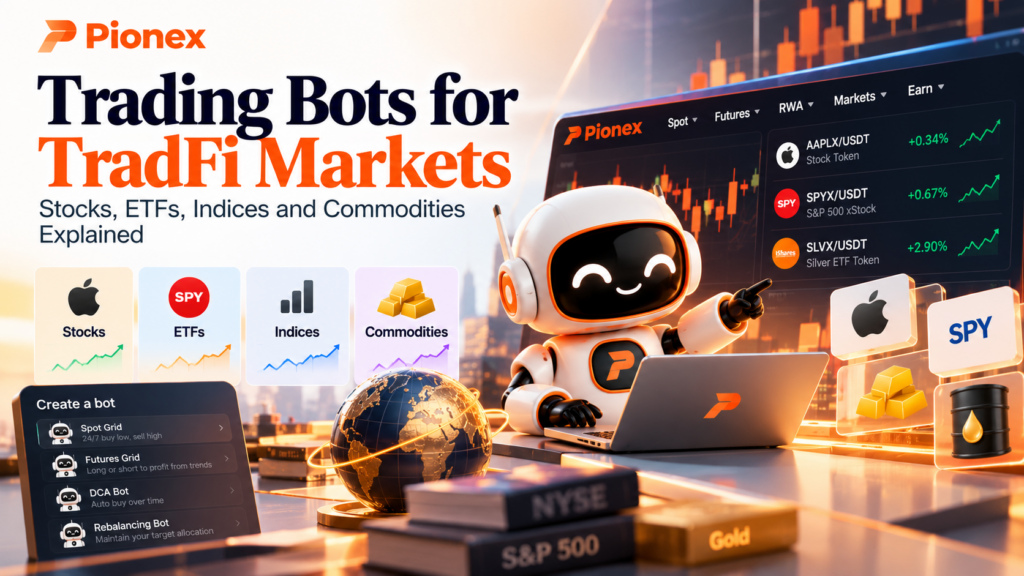
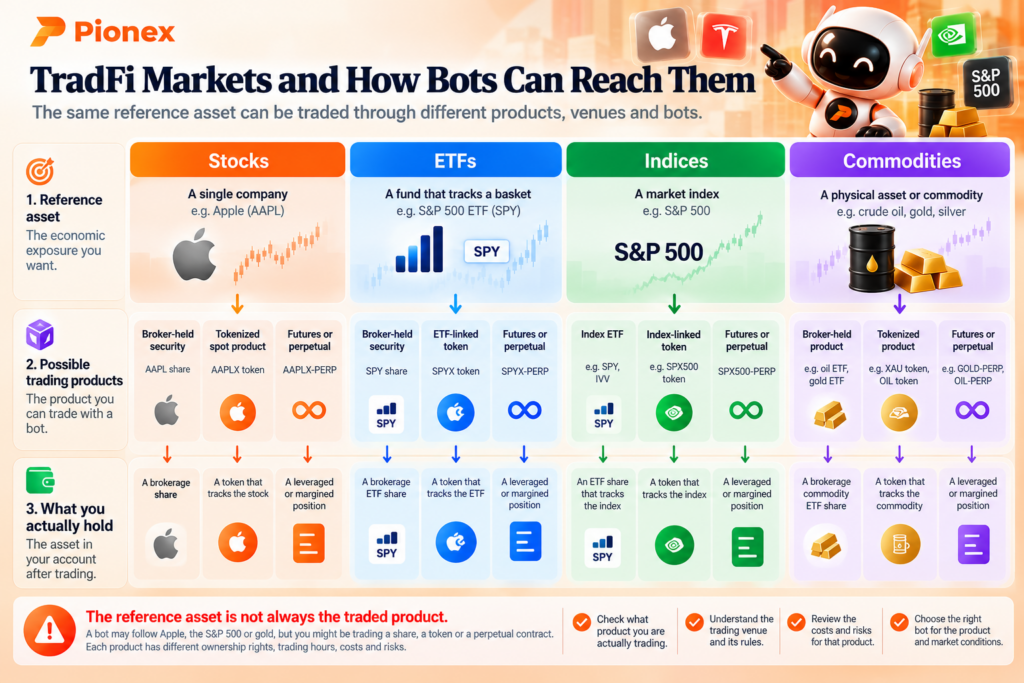
Trading bots can automate markets linked to stocks, exchange-traded funds (ETFs), indices and commodities. But “TradFi trading bot” does not identify one product. A bot may trade registered securities through a broker, a tokenized spot product on a crypto platform, or a perpetual contract that references a traditional asset. Those routes can follow the same Apple share, S&P 500 ETF or oil fund while creating different ownership rights, trading hours, costs and risks.
On Pionex, TradFi-linked automation means supported tokenized spot markets and perpetual contracts. It does not mean that a Pionex bot buys registered US shares, an index itself, a barrel of oil or physical silver.
This guide explains what each category means, how bots reach it, and what to verify before automating a trade.
Disclosure: Pionex publishes this guide and provides some of the tokenized markets and bots discussed. We separate first-party product facts from general market definitions and do not treat Pionex products as equivalent to traditional brokerage ownership.
Contents
- 1 What Does TradFi Mean in a Trading Bot?
- 2 What Can a TradFi Bot Actually Trade?
- 3 Stocks, ETFs, Indices and Commodities Compared
- 4 Which Pionex Markets Fit These Categories?
- 5 How Do Bots Automate TradFi-Linked Markets?
- 6 Why Trading Hours Still Matter
- 7 What Costs and Risks Should You Check?
- 8 How to Choose the Correct Route
- 9 Frequently Asked Questions
- 10 The Reference Is Not the Product
- 11 Methodology and Sources
What Does TradFi Mean in a Trading Bot?
TradFi is shorthand for traditional finance. In bot marketing, the term may cover equities, ETFs, market indices, commodities, foreign exchange or bonds. The label describes the economic reference, not necessarily the legal product being traded.
That distinction matters because a bot cannot change the nature of an instrument.
- A broker bot can send orders for securities supported by the brokerage account.
- A tokenized-market bot can trade a crypto token designed to follow a traditional asset.
- A futures or perpetual bot trades a derivative contract rather than the referenced asset.
- A signal bot can translate an external alert into an order, but the connected venue still determines the product.
If you ask for “an S&P 500 bot,” you still need to specify whether you mean an ETF such as SPY, an ETF-linked token, an index future, or another derivative. The S&P 500 index is a calculation representing a basket of companies. Investor.gov notes that an investor cannot buy a market index directly; exposure normally comes through a fund or derivative that tracks it.
What Can a TradFi Bot Actually Trade?
Start with the product, then evaluate the automation.
| Route | What the bot sends orders for | What you hold | Typical extra risk |
|---|---|---|---|
| Brokerage automation | Registered shares, ETFs or broker-supported derivatives | A brokerage security or contract position | Broker permissions, market data, software and execution |
| Tokenized spot automation | A token designed to track a stock or ETF | The token under its issuer and platform terms | Issuer, custody, tracking, liquidity and session risk |
| Perpetual automation | A stock-, ETF- or commodity-linked perpetual contract | A leveraged or margined derivative position | Funding, mark price, margin and liquidation |
| External signal automation | The exact market supported by the receiving venue | Whatever product that venue executes | Signal quality, webhook failures, duplicate orders and product risk |
The automation layer can place, cancel or repeat orders. It cannot give a token voting rights, turn an ETF into the index it follows, or remove leverage from a perpetual.
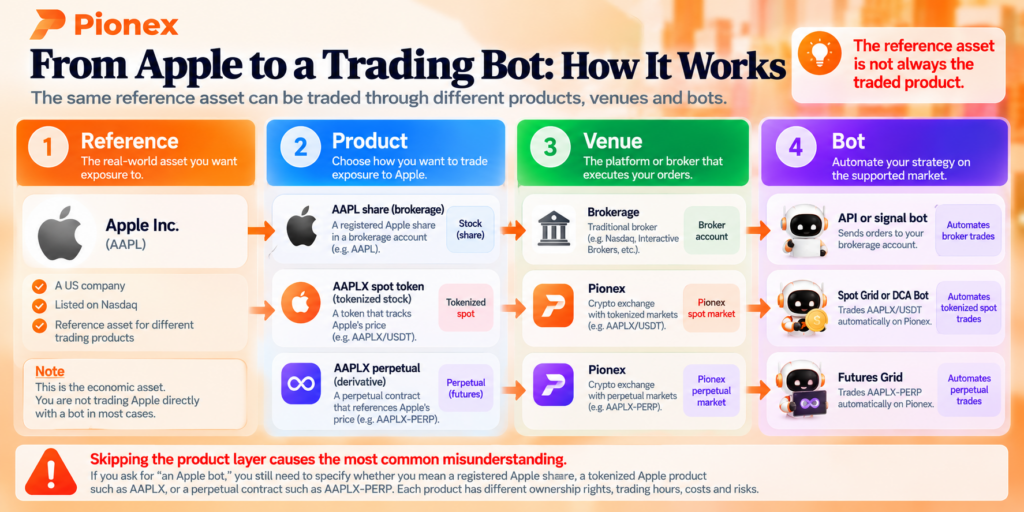
For the full route decision, read how trading bots for US stocks work.
Stocks, ETFs, Indices and Commodities Compared
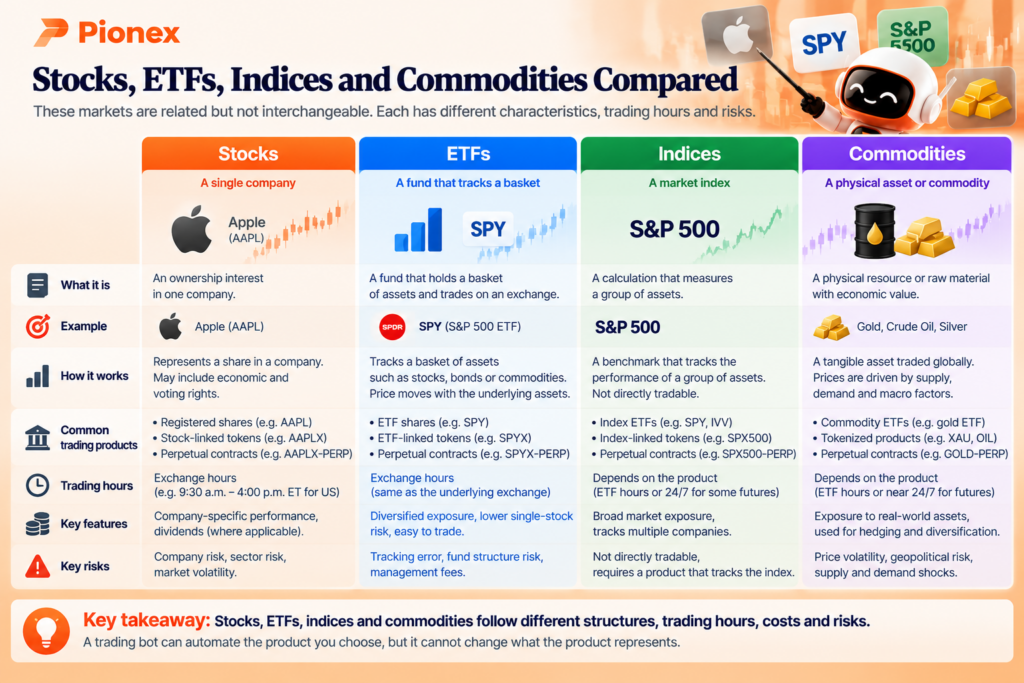
These categories overlap, but they are not interchangeable.
Stocks represent an interest in one company
A traditional stock represents an ownership interest in a company. A registered share may include economic and voting rights, depending on the security and account structure.
A stock-linked token or perpetual references the price of that stock without automatically providing the same ownership rights. AAPLX, NVDAX and TSLAX on Pionex are examples of stock-linked market symbols, not ordinary AAPL, NVDA or TSLA shares in a brokerage account.
ETFs are tradable funds
An ETF pools assets in a portfolio and its shares trade on an exchange. The portfolio may hold stocks, bonds, commodities or other assets. An ETF can track an index, follow an active strategy or provide specialized exposure.
SPY and QQQ are ETFs. The S&P 500 and Nasdaq-100 are indices. Saying “index bot” when the traded product actually follows an ETF can hide an important layer of fees, tracking and product structure.
An index is a measurement, not a share
A market index measures a basket according to published rules. It cannot be purchased directly. Exposure normally comes from an index fund, ETF, future, option or another derivative.
Therefore, a bot advertised for an index may actually trade an ETF-linked market or a derivative. Confirm the ticker and contract specification instead of relying on the marketing label.
Commodity exposure can come through several products
Gold, silver and oil are commodities, but a retail trader may encounter them through physical assets, futures, commodity pools, ETFs, exchange-traded products or derivatives.
A token linked to a silver ETF is not physical silver. A market linked to an oil fund is not a crude-oil futures contract. The CFTC warns that commodity exchange-traded products can behave differently from traditional stock funds because they may use futures, swaps or other commodity interests.
Which Pionex Markets Fit These Categories?
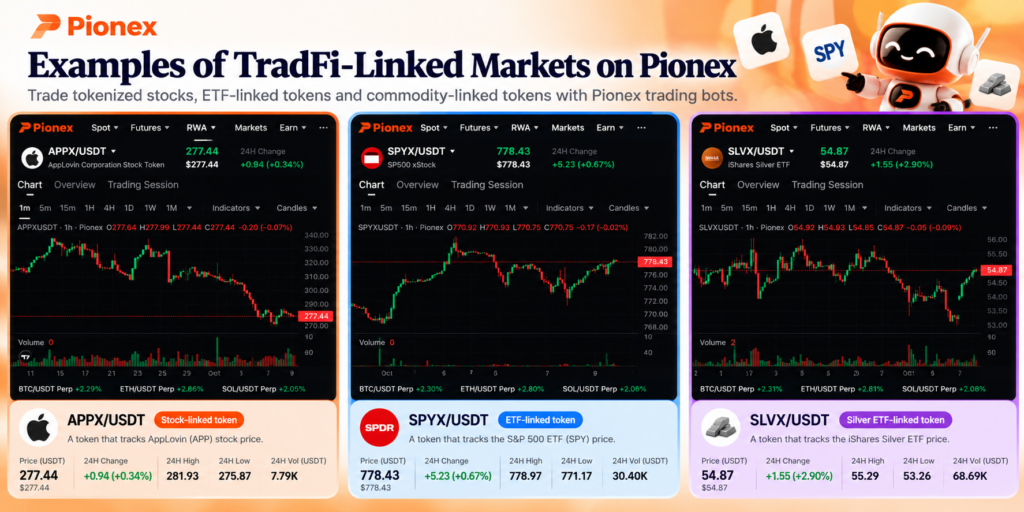
Pionex lists a changing selection of tokenized spot and perpetual markets linked to traditional assets. Availability, regional access, bot compatibility and trading sessions can change.
The following examples illustrate Pionex market references available when this guide was last reviewed. Because listings, regional access, bot compatibility and sessions can change, confirm each market in Pionex before trading.
| Reference category | Example reference | Pionex spot market | Matching perpetual | Availability check |
|---|---|---|---|---|
| Single-company stock | Apple | AAPLX/USDT | AAPLX/USDT perpetual | Confirm the live spot and perpetual markets in Pionex |
| Single-company stock | NVIDIA | NVDAX/USDT | NVDAX/USDT perpetual | Confirm the live spot and perpetual markets in Pionex |
| Single-company stock | Tesla | TSLAX/USDT | TSLAX/USDT perpetual | Confirm the live spot and perpetual markets in Pionex |
| Broad-market ETF | SPDR S&P 500 ETF | SPYX/USDT | SPYX/USDT perpetual | Confirm the live spot and perpetual markets in Pionex |
| Technology ETF | Invesco QQQ ETF | QQQX/USDT | QQQX/USDT perpetual | Confirm the live spot and perpetual markets in Pionex |
| Silver-linked ETF | iShares Silver Trust | SLVX/USDT | SLVX/USDT perpetual | Confirm the live spot and perpetual markets in Pionex |
| Oil-linked fund | United States Oil Fund | USOX/USDT | USOX/USDT perpetual | Confirm the live spot and perpetual markets in Pionex |
This table describes the market references, not ownership of the underlying shares, index constituents, silver or oil. SPYX and QQQX are ETF-linked examples. SLVX and USOX are fund-linked examples that provide indirect commodity exposure.
The presence of a ticker does not prove that your account can trade it or that every Pionex bot supports it. Check the live market and bot-creation screens.
For issuer, custody and token rights, use the Pionex tokenized stocks and xStocks guide.
How Do Bots Automate TradFi-Linked Markets?
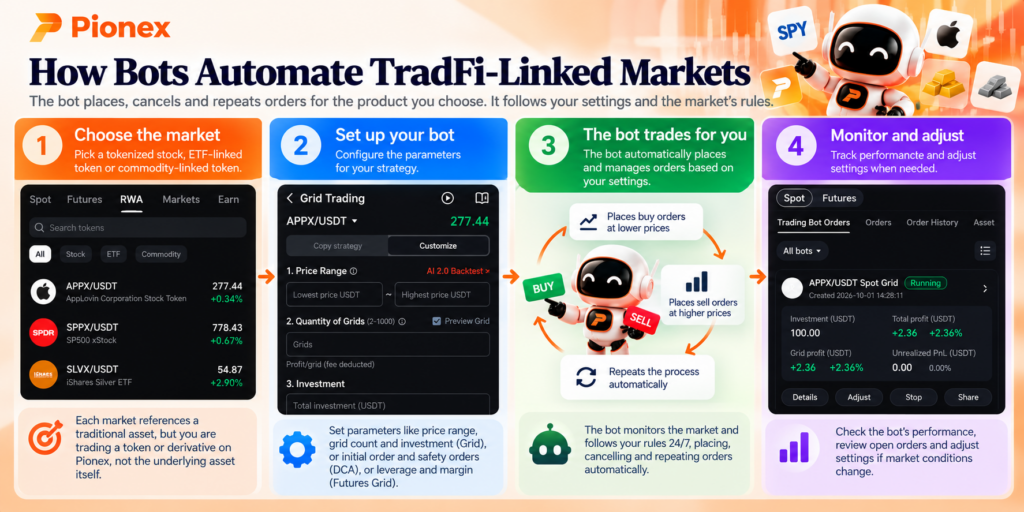
The bot should match the product and expected price path.
Spot Grid trades repeated movements inside a range
Spot Grid may fit a supported tokenized spot market when price is expected to cross several levels inside a defined range. It has no futures liquidation, but it can hold a falling token below the lower boundary.
Pionex DCA builds a spot position in stages
The Pionex DCA Bot uses an initial order and safety orders triggered after configured declines. It is a staged dip-buying and rebound strategy, not the same as buying a fixed amount every calendar month.
Futures Grid automates a perpetual
Futures Grid can use Long, Short or Neutral modes on an eligible perpetual. It adds leverage, funding, margin and liquidation. A larger projected return or lower displayed margin does not make it a better fit.
Signal Bot executes tested external alerts
Pionex Signal Bot can receive TradingView strategy alerts through a webhook and execute supported futures orders. The signal must define the market, direction, size and risk rules. A webhook does not validate the strategy or prevent losses.
For a narrow comparison of the three main built-in choices, read Spot Grid vs DCA vs Futures Grid for tokenized stocks.
If you know the product you want but not the bot family, use the Pionex Trading Bot Finder. It asks seven questions and compares 16 bot families. Treat the result as an educational shortlist, then confirm support for the exact market.
Why Trading Hours Still Matter
Crypto trades continuously, but TradFi-linked products may not.
Pionex states that only designated 7×24 tokenized markets trade continuously. Other markets close during defined sessions. A bot containing a closed-session token can pause and may be unable to adjust other assets until trading resumes.
Even when a market remains open after Wall Street closes, price discovery can change. The referenced exchange may be closed, liquidity may be thinner, spreads may widen and new information may move the token before the traditional market reopens.
Different references also follow different calendars:
- A US stock or ETF follows US market events and holidays.
- A commodity-linked fund may trade US equity-market hours even when the underlying commodity future trades on another schedule.
- A perpetual may remain available while its reference market is closed, subject to platform rules and maintenance.
Do not infer a trading session from the asset label. Read the Trading Session for the exact pair.
The dedicated guide “Can Stock Trading Bots Run After Wall Street Closes?” will cover bot pauses, off-hours liquidity and price discovery in depth. Until that article is published, use the Pionex trading-session guidance.
What Costs and Risks Should You Check?
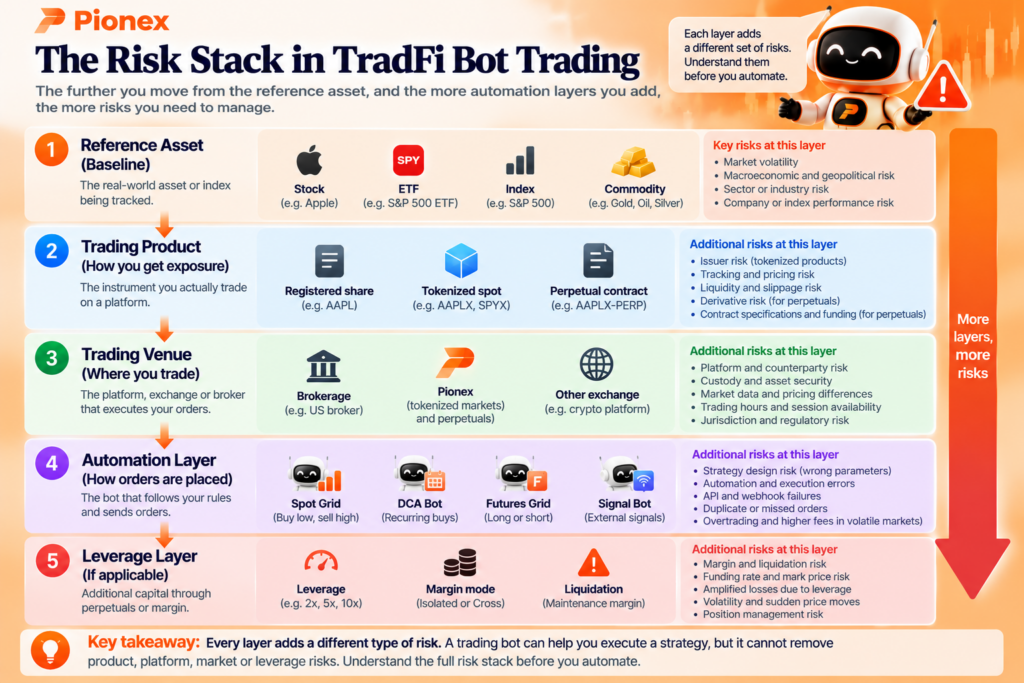
TradFi-linked automation combines several cost and risk layers.
Product costs
Pionex’s current tokenized-stock guide lists 0.1% per spot fill. A completed buy and sell therefore costs 0.20% before spread and price impact. Standard tokenized-stock perpetual rates are listed as 0.02% maker and 0.05% taker, with funding separate. Check the live rate applicable to your account.
Use this simplified calculation:
Net bot result = realized trading result + unrealized position change − fees − spread − price impact ± funding − other costs
Product-structure risks
- Stock-linked token: issuer, custody, tracking, liquidity and rights risk.
- ETF-linked token: the token layer plus the fund’s own holdings, fee and tracking structure.
- Commodity-fund-linked token: the token and fund layers plus futures roll, contango, backwardation or commodity-market effects where relevant.
- Perpetual: funding, mark price, margin, liquidation and contract risk.
Automation risks
Stale data, webhook delays, duplicate orders, rejected orders, incorrect sizing and a failed connection can turn a reasonable rule into a poor execution.
How to Choose the Correct Route
Use this order:
- Name the economic exposure. One company, a basket, a market benchmark or a commodity theme?
- Name the exact product. Registered security, ETF, tokenized spot product or perpetual?
- Confirm what you hold. Share, fund share, token or derivative contract?
- Check the live market. Account access, region, trading status, session and order-book depth.
- Choose the bot by market behavior. Range, staged rebound, leveraged direction or external signal?
- Define failure. Price break, event risk, maximum loss, funding limit or execution fault?
- Estimate total cost. Fees, spread, price impact, funding and product expenses where relevant.
- Start with a small test. Use paper trading when available or an amount that can be lost without affecting essential finances.
If you cannot name the exact product and what you hold, stop before choosing the bot.
Frequently Asked Questions
What is a TradFi trading bot?
A TradFi trading bot automates orders for a market linked to traditional finance, such as stocks, ETFs, indices or commodities. The bot may trade a registered security through a broker, a tokenized spot product, or a derivative. The exact product determines ownership, costs and risk.
Can Pionex bots trade stocks and ETFs?
Pionex bots can automate supported tokenized spot markets and perpetual contracts linked to stocks or ETFs. They do not convert those products into registered shares held in a brokerage account. Check the exact market, bot support and regional eligibility.
Can a bot buy an index directly?
No. A market index is a measurement of a basket and cannot be purchased directly. A bot may trade an ETF, fund, future, token or derivative designed to track that index. Verify which product the ticker represents.
Can Pionex bots trade commodities?
Pionex may list supported markets linked to commodity funds, including products such as SLVX and USOX. These markets do not represent direct ownership of physical silver or oil. Check current availability, confirm whether the product is a spot token or perpetual, and review the underlying fund and token structure before trading.
Are TradFi bots available 24/7?
Not always. Only designated Pionex markets trade continuously. Other stock-, ETF- or fund-linked markets can close during defined sessions. Even in a continuous market, off-hours liquidity and price discovery may differ from the referenced market.
Which bot is best for TradFi markets?
There is no universal best bot. Spot Grid may fit repeated range movement in a supported spot market, Pionex DCA may fit a staged rebound plan, and Futures Grid may fit an understood perpetual strategy. The product, price path, liquidity and risk limit must be chosen first.
The Reference Is Not the Product
The phrase “stock bot,” “index bot” or “commodity bot” tells you what a market references. It does not tell you what the bot trades.
Identify the product first. Then confirm the venue, session, costs and rights. Only after that should you select an automation method that matches a specific market assumption and failure condition.
⚠️ This article is for informational purposes only and does not constitute financial or investment advice. Crypto trading carries significant risk including total loss of capital. Past performance is not indicative of future results. Always conduct your own research before trading.
Methodology and Sources
- Pionex market symbols and status were checked through live Pionex market metadata on October 9, 2026.
- Pionex product structure, fees, sessions and withdrawal rules were checked against the Tokenized Stocks and xStocks Guide and linked Pionex help-center sources.
- Bot distinctions were checked against current Pionex Spot Grid, DCA, Futures Grid and Signal Bot documentation.
- Stock, ETF and index definitions were checked against Investor.gov’s ETF glossary and index-fund bulletin.
- Commodity-product risks were checked against the CFTC commodity ETP advisory.
Market availability, bot support, fees, sessions and regional eligibility can change. Confirm the live product before trading.
