
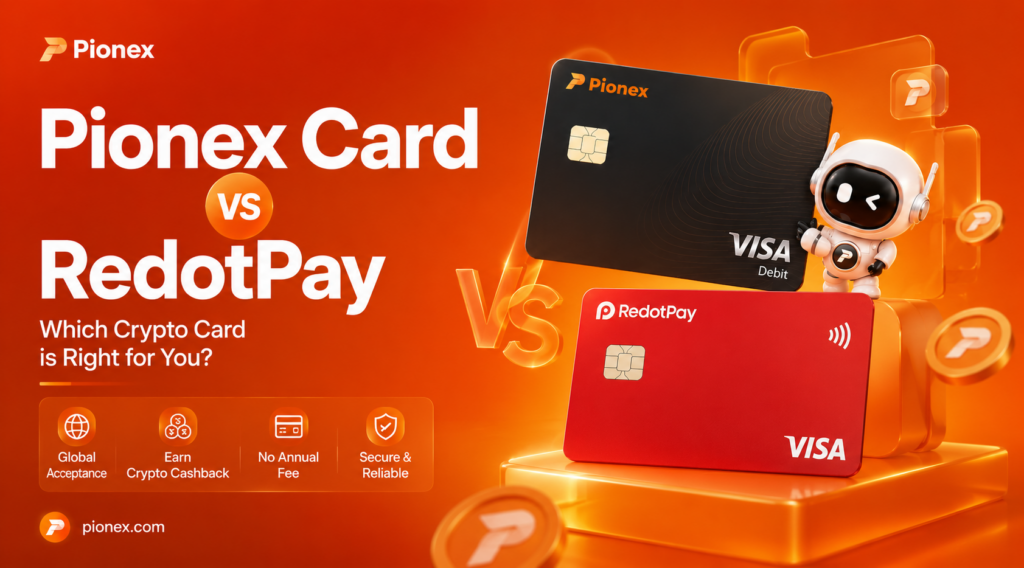
Pionex Card pays 1% cashback and 5% APR with no issuance fee. RedotPay has no cashback, charges up to $100 for a card, and costs 2.2% on international spending. Here is the full side-by-side.
Both Pionex Card and RedotPay let you spend USDT anywhere Visa is accepted. Both have no annual fee. Both support Apple Pay and Google Pay. After that, the gap opens up fast.
This comparison covers every fee, every feature, and the specific situations where each card wins. For most users already on Pionex, Pionex Card comes out ahead on net cost, returns, and free physical-card access through Pionex Pay. RedotPay’s main advantages are higher spending limits and support for more crypto assets.
For the full Pionex Card breakdown including cashback mechanics and how the card works, read the main review: Pionex Card: The Crypto Card That Actually Pays You Back.
Contents
- 1 The Numbers First
- 2 Fee Reality Check: What You Actually Pay With Pionex vs Redotpay cards
- 3 The Cashback Gap
- 4 The 5% APR Difference
- 5 Where RedotPay May Be The Better Choice
- 6 Country Availability: Who Goes Where
- 7 KYC: Ease of Getting Started
- 8 Whose Card Is This For?
- 9 Frequently Asked Questions
- 10 To Recap,
The Numbers First
| Feature | Pionex Visa Card | RedotPay |
| Annual fee | Free | Free |
| Virtual card issuance | Free | 10 USDT |
| Physical card issuance | Free, contact Pionex Pay | 100 USDT |
| FX fee on non-USD purchases | 1% | 2.2% (1% conversion + 1.2% FX) |
| FX fee on USD purchases | Free | 1% |
| Cashback | 1% USDT, no cap | None |
| Net cost on international spend | Effectively 0% (FX offset by cashback) | 2.2% |
| Interest on card balance | 5% APR, no lock-up | None |
| Per transaction limit | 10,000 USDT | 100,000 USDT |
| Daily spend limit | 10,000 USDT | 1,000,000 USDT |
| Monthly spend limit | 50,000 USDT | Not capped |
| ATM withdrawal | 2% fee (physical Visa card) | 2% fee (physical card) |
| KYC required | Yes (Level 2) + regional balance requirement | Optional for virtual card |
| Apple Pay / Google Pay | Yes | Yes |
| Samsung Pay | No | Yes |
| Supported assets | USDT only | USDT, USDC, BTC, ETH, SOL, others |
| Available in Russia | Yes | No |
| Available in Algeria | Yes | Check official list |
| Countries | 100+ | 150+ |
Fee Reality Check: What You Actually Pay With Pionex vs Redotpay cards
The numbers look similar until you run a real spending scenario.
Scenario: You spend $500 at an international merchant
With Pionex Visa Card:
- FX fee charged: $5.00 (1%)
- Cashback credited: $5.00 (1%)
- Net cost: $0
With RedotPay:
- FX fee charged: $11.00 (2.2%)
- Cashback credited: $0
- Net cost: $11.00
Scenario: You spend $2,000 per month internationally
With Pionex Visa Card: net $0 in FX costs. You also earn approximately $8.30/month in 5% APR on a $2,000 card balance buffer.
With RedotPay: $44 per month in FX fees with no offset. At $2,000/month that is $528 per year going directly to fees with nothing coming back.
Scenario: You spend $500 at a USD merchant (Amazon, US-based SaaS)
With Pionex Visa Card: No FX fee. 1% cashback still applies. Net gain: $5. With RedotPay: 1% conversion fee on USD purchases. Net cost: $5.
The USD purchase case is one area where the gap is often missed. RedotPay charges 1% even on USD transactions because the conversion from USDT to USD still applies. Pionex treats USD and USDT at a fixed 1:1 rate with no fee.
The Cashback Gap
RedotPay has no ongoing cashback programme. A Solana Card promotion ran in February 2026 offering 1.5 to 3% back on the first three daily transactions, but that ended on February 28, 2026. The standard RedotPay card earns nothing on purchases.
Pionex Card pays 1% back in USDT on every eligible purchase with no monthly cap. Spend $10,000 in a month, you get $100 back. That is real USDT credited to your card account, not points, not vouchers, not a token you then have to figure out how to use.
At $1,000/month in eligible spending, the Pionex cashback adds up to $120 per year. That is money RedotPay users leave on the table every month.
The 5% APR Difference
This is the feature most comparisons miss entirely.
Whatever USDT is sitting in your Pionex Card account earns 5% APR continuously. No lock-up period. The application balance requirement varies by region: most users need at least 10 USDT, while a small number of regions may require 100 USDT. You can transfer funds in and out whenever you want.
If you keep $1,000 in your card account as a spending buffer, that is $50 a year just from holding it there. If you keep $5,000, it is $250 a year.
RedotPay offers no interest on card balances. The platform has yield products elsewhere in the app, but nothing tied to the card balance itself.
For someone who keeps a spending buffer of $2,000 in their card account:
- Pionex: $100/year in APR, plus cashback
- RedotPay: $0 in APR, minus 2.2% FX fees on international spend
Where RedotPay May Be The Better Choice
There are three areas where RedotPay has a real advantage.
1. Spending limits
RedotPay’s limits are exceptional: $100,000 per transaction and $1,000,000 per day. Pionex Visa Card caps at $10,000 per transaction and $50,000 per month. If you are making large individual purchases, paying for business expenses, or moving significant capital through the Visa network, RedotPay’s limits handle amounts that Pionex currently cannot.
2. Physical card availability
Pionex physical cards are free and available by contacting Pionex Pay directly. RedotPay charges 100 USDT for its physical card. Both cards support ATM withdrawals and in-store payments when a physical card is issued.
3. Crypto asset diversity
RedotPay accepts BTC, ETH, USDT, USDC, SOL, and over 20 other cryptocurrencies. Pionex Card only accepts USDT transfers. If your holdings are spread across multiple assets and you do not want to convert everything to USDT first, RedotPay accepts more of them directly.
Country Availability: Who Goes Where
Both cards cover 100+ countries. The differences in specific markets matter.
Russia: Pionex Card is available. RedotPay is not. For users in Russia, this is a significant difference.
Algeria, Malaysia, Singapore, Germany, India: Both cards are available in these markets. Pionex Card’s zero-net FX cost makes it the better everyday option in all of them.
United States: Neither card is available.
France, Austria, Japan: Neither card is available.
For the full Pionex Card country list, see Where Does Pionex Card Work.
KYC: Ease of Getting Started
RedotPay has a lower barrier to entry for users who want to get started quickly. Its virtual card can be used without completing KYC, allowing eligible users to create a card, fund it with supported crypto, and begin spending within minutes.
Pionex Card requires Level 2 KYC and the balance shown on the application page. Most users need at least 10 USDT, while a small number of regions may require 100 USDT. Existing Pionex traders may already meet the requirement; new users need to complete identity verification first.
For physical cards, Pionex costs less: request a free card through Pionex Pay, while RedotPay charges 100 USDT and requires KYC.
If completing KYC is your biggest priority, RedotPay offers a smoother path for virtual card users. If you already use Pionex or do not mind completing identity verification, the extra step may be worth it in exchange for features such as 1% cashback and 5% APR on your card balance.
Whose Card Is This For?
Choose Pionex Card if:
- You are already using Pionex for trading
- You spend internationally and want FX cost to net to zero
- You want to earn interest on your card balance
- You are in Russia or another market where RedotPay is unavailable
- You want a free virtual card with no issuance fee
- You prefer simplicity over a broader crypto ecosystem
Choose RedotPay if:
- You need to make purchases above $10,000 per transaction
- You prefer RedotPay’s larger per-transaction limits
- You hold BTC, ETH, SOL, or other assets and do not want to convert to USDT first
- KYC friction is a concern and you want the option to start without it
- You are comfortable paying 2.2% on international transactions for the access and limits you get
A practical middle ground: Some users keep both. Pionex Card handles daily spending, cashback, APR, and free physical-card access. RedotPay can serve users who need larger individual purchases or broader crypto-asset support.
Frequently Asked Questions
Which card has lower fees overall?
For everyday international spending, Pionex Card is cheaper. The 1% FX fee is fully offset by 1% cashback, making the net cost zero on eligible purchases. RedotPay charges 2.2% on international transactions with no cashback offset. On USD purchases specifically, Pionex charges nothing while RedotPay charges 1%.
Does RedotPay have cashback?
No. As of June 2026, RedotPay has no ongoing cashback programme. A promotional Solana Card cashback offer ended in February 2026.
Which card earns interest on my balance?
Pionex Card earns 5% APR on the USDT held in your card account, with no lock-up. RedotPay does not pay interest on card balances.
Can I use Pionex Card in Russia?
Yes. Pionex Card is available to eligible users in Russia. RedotPay is not available in Russia.
Which has higher spending limits?
RedotPay, by a large margin. Up to $100,000 per transaction and $1,000,000 per day. Pionex Visa Card limits are $10,000 per transaction and $50,000 per month.
Is the RedotPay physical card worth the $100 fee?
For most Pionex users, no. Pionex physical cards are free and can be requested directly from Pionex Pay. RedotPay’s 100 USDT physical card may suit users who specifically need RedotPay’s higher limits or broader asset support.
Which card requires less KYC to get started?
RedotPay’s virtual card requires no KYC. Pionex Card requires Level 2 KYC and a regional account-balance requirement. Most users need at least 10 USDT, while a small number of regions may require 100 USDT.
To Recap,
RedotPay is a utility card. It prioritises access, limits, and asset diversity over returns. The 2.2% FX fee and zero cashback are the price of those exceptional limits and broad crypto support.
Pionex Card is a returns card. The 1% cashback and 5% APR are the two features no equivalent card currently matches at this tier. For users who spend internationally and hold USDT, those two features mean you are earning while you spend, not just spending without penalty.
For Pionex users, the decision is simple. Your card is already in your ecosystem, it costs nothing to get, and the return structure is better for everyday use. Add it from the Wallet tab, fund it with USDT, and you are earning from the first purchase.
For users evaluating both, the decision comes down to spending size and supported assets. Pionex wins for USDT spending under $10,000 per transaction, especially when cashback, APR, and a free physical card matter. RedotPay may fit larger purchases or users who want to spend additional crypto assets.
Need setup help? Visit the Pionex Card Support Centre for application, fees, and card usage guides.
Disclaimer: This article is for informational purposes only and does not constitute financial advice. Fees, features, and availability for both products may change. All RedotPay data is sourced from publicly available information as of June 2026. Verify current terms directly with each provider before applying.
