
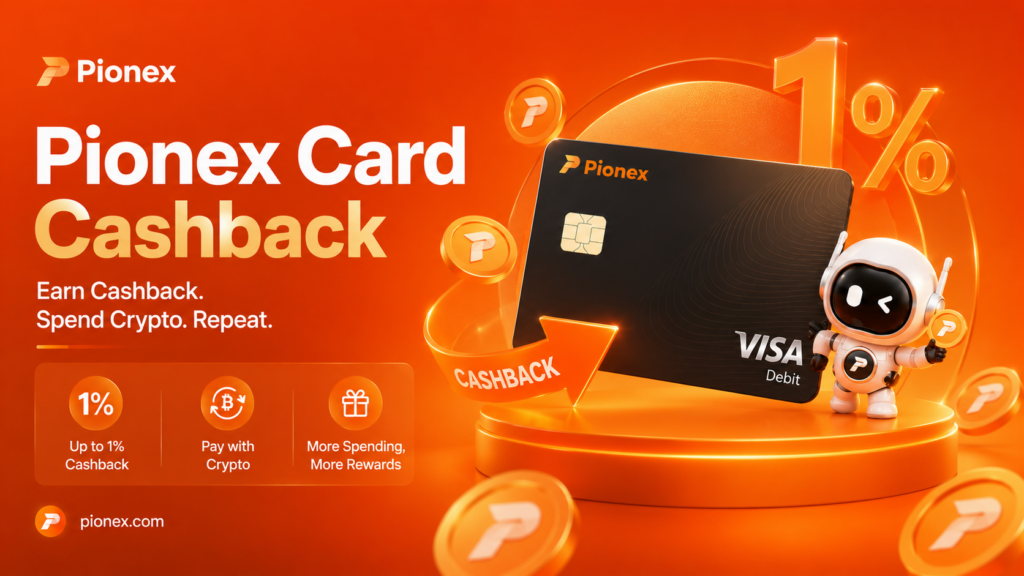
Pionex Card currently advertises 1% cashback on everyday spending and an extra 5% at selected merchants, for up to 6% total on eligible purchases. Pionex Pay also advertises 5% Flexible Earn with hourly payouts. Cashback eligibility, partner offers and the Flexible Earn rate can change, so check the live product terms before using the examples below.
This guide shows what 1% everyday cashback means at several spending levels. The examples use eligible spending only and do not include Flexible Earn, excluded payments, refunds or future programme changes.
For the full fee schedule and card overview, read the main review: Pionex Card review for current fees, rewards and eligibility.
Contents
- 1 How Pionex Card Cashback Works
- 2 What 1% Cashback Means at Four Spending Levels
- 3 Transaction Fees and Cashback Are Separate
- 4 How Flexible Earn Affects the Card Balance
- 5 What Partially Reduces the Cashback Value
- 6 Is 1% Cashback Competitive?
- 7 Cashback and Flexible Earn Are Separate Benefits
- 8 A Simple Cashback Example
- 9 Frequently Asked Questions
- 10 Is Pionex Card Cashback Worth It?
How Pionex Card Cashback Works
The current Pionex Pay page advertises 1% cashback on everyday spending. Selected partner merchants can add another 5%, bringing the published total to as much as 6% on eligible purchases.
The Pionex Pay FAQ says cashback is available on purchases without a reward limit. Eligibility, selected-merchant offers and exclusions can still change, so confirm the current rules in your account before spending.
What 1% Cashback Means at Four Spending Levels
These examples assume every purchase is eligible for the standard 1% cashback. They exclude transaction fees, partner bonuses, refunds and Flexible Earn.
| Monthly eligible spending | Monthly cashback at 1% | Annual cashback at 1% |
|---|---|---|
| $500 | $5 | $60 |
| $1,500 | $15 | $180 |
| $3,000 | $30 | $360 |
| $8,000 | $80 | $960 |
Actual cashback can be lower if a payment is excluded or refunded. A selected-merchant offer may increase the reward while that offer remains active.
Transaction Fees and Cashback Are Separate
The current Pionex Pay FAQ lists a 1% transaction fee. The product page separately advertises 1% cashback on everyday eligible spending.
On a $500 eligible purchase, 1% equals a $5 transaction fee and $5 cashback. The fee and reward are applied under separate rules, so do not assume every payment will have a guaranteed zero net cost.
How Flexible Earn Affects the Card Balance
Pionex Pay currently advertises 5% Flexible Earn with hourly payouts on the card balance. This benefit is separate from cashback.
The published rate can change. Do not treat 5% as a guaranteed permanent return or add a fixed Flexible Earn amount to the cashback examples. Confirm the current rate and terms in your account before keeping funds there for yield.
What Partially Reduces the Cashback Value
It is worth being clear about the situations where the cashback does not fully play out.
Refunds: Full refunds reclaim the entire cashback. If you buy and return a lot, the effective cashback rate drops. For regular purchases you keep, this is not a factor.
Small transaction fees: Purchases of 1 USD or less are subject to a small transaction fee structure. The first one per person per month is free. After that, 0.2 USDT per transaction. If you make a lot of sub-dollar purchases, the 0.2 USDT fee can exceed the cashback earned on that transaction. For most spending patterns, this is a minor edge case.
Mastercard vs Visa: If you use the Mastercard variant, the FX fee is 2% against 1% cashback, leaving a net 1% FX cost on non-USD purchases. For heavy international spenders, the Visa card is the better option specifically because the cashback and FX fee cancel out completely.
Excluded merchants: eToro, TikTok, and Wise are confirmed excluded from cashback. The full list is in the app. Check it if those platforms are significant in your spending.
Is 1% Cashback Competitive?
Compared to other crypto cards targeting the same tier of user:
RedotPay: No cashback at all on standard cards. Pionex wins outright.
Bybit Card: Its current rewards program starts at 2% cashback with a $5 monthly cap for base users, while higher tiers reach up to 10% with larger caps. Pionex pays 1% USDT cashback without a monthly cap. Compare the live tier rules in the official Bybit Card rewards guide.
KAST Card: Seasonal cashback rates that change quarterly. Season 5 offered 6% in MOVE tokens. The conversion from MOVE tokens to spendable value adds steps and uncertainty. Pionex pays directly in USDT with no conversion required.
Traditional bank cards: Most flat-rate cashback cards pay 1 to 2% in the markets where Pionex Card operates (Malaysia, Singapore, Germany, etc.). Pionex at 1% is in range with no annual fee to offset, which changes the net comparison significantly. A bank card paying 1.5% but charging $95/year in annual fees needs $6,333 in annual spend to break even on the fee before any reward has real value.
Cashback and Flexible Earn Are Separate Benefits
Cashback depends on eligible spending. Flexible Earn depends on the balance, current rate and product terms. Keeping the two benefits separate makes the examples easier to verify and avoids presenting a projected total as guaranteed.
A Simple Cashback Example
A user with $1,500 in eligible monthly spending would earn $15 in standard cashback for that month, or $180 across 12 months if the same spending and programme rules continued.
This example excludes transaction fees, partner bonuses, refunds and Flexible Earn. It illustrates the 1% calculation and does not promise a future return.
Frequently Asked Questions
How much cashback does Pionex Card offer?
The current Pionex Pay page advertises 1% cashback on everyday eligible spending. Selected partner merchants can add another 5%, bringing the published total to as much as 6%.
Is Pionex Card cashback limited?
The live Pionex Pay FAQ says cashback is earned on purchases without a reward limit. Eligibility, exclusions and programme terms can still change.
Does every purchase earn cashback?
No. Cashback applies to eligible purchases. Check the current programme rules in your account before assuming that a payment will earn a reward.
Is 5% Flexible Earn guaranteed?
No. Pionex Pay currently advertises 5% Flexible Earn with hourly payouts, but the rate and terms can change. Confirm the current offer in your account.
Do the spending examples include Flexible Earn?
No. The examples calculate standard 1% cashback on eligible spending only. They exclude transaction fees, partner bonuses, refunds and Flexible Earn.
Is Pionex Card Cashback Worth It?
The value depends on how much eligible spending you put through the card. Standard 1% cashback equals $10 for every $1,000 of eligible purchases. Selected-merchant offers may increase the reward while they remain active.
Transaction fees, exclusions and refunds can reduce the final value. Flexible Earn is a separate, variable benefit and should not be added as a guaranteed return.
Need setup help? Visit the Pionex Card Support Centre. For country and merchant restrictions, see Where Does Pionex Card Work?
Disclaimer: This article is for informational purposes only. Cashback, Flexible Earn, fees and programme terms may change. Verify the current terms in Pionex Pay and your account before making a decision. All examples are illustrative and were checked against the published Pionex Pay information on September 2, 2026.
