
You’ve probably watched Bitcoin rise, thought about buying, and then wondered what would happen if the price dropped the moment you entered a trade.
That’s a reasonable concern, especially when you’re still learning how trading works.
The good news is that you don’t have to risk your savings to find out whether you understand a trading strategy.
You can practise first.
That’s what paper trading is for. It gives you a way to test trading decisions, learn from mistakes, and become familiar with the market before putting real money on the line.
Contents
- 1 Does Pionex have paper trading?
- 2 What is paper trading?
- 3 How does paper trading work?
- 4 Why should beginners try paper trading?
- 5 Can you practise crypto trading with $100?
- 6 Paper trading vs. live trading: What’s the difference?
- 7 How to start paper trading crypto
- 8 How to use Pionex Demo Trading step by step
- 9 What about paper trading with crypto trading bots?
- 10 Five common paper trading mistakes to avoid
- 11 How long should you paper trade before using real money?
- 12 Frequently asked questions about paper trading
- 13 Final thoughts
Does Pionex have paper trading?
Yes. Pionex offers Futures Demo trading, where users can practise manual futures trading with virtual PUSD instead of real funds. The app shows a 500,000 PUSD practice balance. Availability and the interface may vary by region and app version.
In this guide, we’ll explain how paper trading works, how to get started, what it can teach you, and how to explore automated trading strategies.
What is paper trading?
Paper trading is the practice of buying and selling financial assets using virtual money instead of real money.
You follow market prices, decide when to enter or exit a trade, and track what would have happened to your investment.
For example, suppose Bitcoin is trading at $60,000.
You believe the price will rise, so you open a simulated $1,000 position.
A few days later, Bitcoin reaches $63,000, a 5% increase.
Your simulated position would now be worth $1,050, giving you a $50 profit before fees.
If Bitcoin fell to $57,000 instead, your simulated position would lose $50.
Neither outcome affects your actual bank account.
The money isn’t real, but the exercise helps you understand how price movements affect trading decisions.
Paper trading originally referred to recording hypothetical trades on paper. Today, trading platforms offer demo accounts, virtual portfolios, and simulators that make the process easier.
How does paper trading work?
Most paper trading platforms follow a similar process.
1. You receive virtual funds
A simulator gives you a fictional account balance, perhaps $10,000 or $100,000.
You can use that balance to practise trading without depositing real money.
2. You choose an asset
Depending on the platform, you might practise trading Bitcoin, Ethereum, stocks, forex, or other supported markets.
3. You place a simulated trade
You decide whether to buy or sell, how much to trade, and when to exit.
Some simulators also let you practise stop-loss orders, take-profit orders, and more advanced trading techniques.
4. You follow the result
As market prices change, the simulator updates your virtual profit or loss.
You can close the position and review what happened.
5. You learn from the outcome
This is the most useful part.
Did you enter too early? Was your stop loss too close? Did the market behave differently from what you expected?
Paper trading gives you room to investigate these questions without paying for every mistake.
One limitation is that simulated trades may execute more smoothly than real trades. Actual trading involves liquidity, spreads, slippage, and sometimes additional costs that a simulator may not reproduce accurately.
Why should beginners try paper trading?
1. You can make mistakes without losing money
Every new trader makes mistakes.
You might misunderstand an order type, choose a poor entry price, or exit a position too early.
Making those mistakes in a demo account is considerably cheaper than learning through repeated losses.
2. You can test a trading strategy
Imagine you have two ideas.
One involves buying Bitcoin whenever its price falls by 5%. The other involves buying and selling as the price moves within a defined range.
Which strategy works better?
Instead of guessing, you can test both using historical data or a suitable trading simulator.
You can then compare the results, including how often each strategy trades, the size of its losses, and how it performs under different market conditions.
3. You can learn how trading orders work
Market orders, limit orders, stop losses, and take-profit orders can be confusing when you’re starting out.
Paper trading lets you practise using them.
For instance, you can place a limit buy order below the current market price and observe whether the market reaches your chosen entry.
You can also experiment with stop losses to understand how traders attempt to limit downside risk.
4. You can develop better trading habits
A trading plan is easier to follow when you’ve practised using one.
Before each simulated trade, write down why you’re entering, what outcome you expect, and what would make you exit.
Over time, you’ll have a record of your decisions instead of relying on memory.
5. You can explore automated trading
Not everyone wants to watch price charts throughout the day.
Some traders prefer strategies that automatically place orders according to predefined rules.
Paper trading and strategy testing can help you understand how those rules behave before you consider live automated trading.
Can you practise crypto trading with $100?
Yes. You don’t need a large simulated balance to learn.
In fact, practising with a realistic amount can make your results more useful.
Suppose you intend to start live trading with $100. Testing strategies with a virtual $100 balance helps you understand the limitations of that budget.
For example:
| Trade | Virtual amount | Price change | Result before fees |
|---|---|---|---|
| Bitcoin buy | $100 | +5% | +$5 |
| Ethereum buy | $100 | -8% | -$8 |
| Bitcoin buy | $100 | +2% | +$2 |
These examples assume unleveraged positions and exclude trading costs.
A $5 gain might look small, but it represents a 5% return on a $100 position.
Likewise, an $8 loss represents an 8% decline.
Practising with an amount similar to your intended live budget can also reveal whether minimum order sizes, fees, and position-sizing rules make a strategy practical.
Paper trading vs. live trading: What’s the difference?
The biggest difference is that paper trading doesn’t expose your real money to market losses.
However, there are other differences worth understanding.
| Feature | Paper trading | Live trading |
|---|---|---|
| Money | Virtual funds | Real funds |
| Financial losses | Simulated | Real |
| Market prices | Often live or historical | Live |
| Order execution | Simulated | Depends on actual market liquidity |
| Trading fees | May be estimated or omitted | Applicable fees charged |
| Emotional pressure | Usually lower | Often higher |
| Main purpose | Learning and testing | Executing real trades |
Paper trading can help you become familiar with trading mechanics. It cannot fully prepare you for the emotions involved when your own money is at risk.
A strategy that feels easy to follow with virtual funds might become difficult when you’re facing real losses.
That’s why successful paper trading results should be treated as evidence of practice, not proof that a strategy will be profitable.
How to start paper trading crypto
If you’re completely new to crypto trading, start with a simple process.
Step 1: Choose what you want to learn
Are you trying to understand how to buy Bitcoin?
Do you want to practise setting stop losses?
Or are you interested in testing an automated strategy?
Your goal determines which tools you need.
Step 2: Find a suitable simulator
Look for a paper trading platform that supports the market and order types you want to practise.
Check whether it uses live market prices, includes realistic trading fees, and allows you to review previous trades.
Some platforms offer manual demo trading, while others support strategy backtesting or simulated automated execution.
These features are different, so check what the platform actually provides.
Step 3: Set a realistic virtual budget
If you intend to trade with $200 in the future, consider practising with $200 rather than a fictional $100,000 balance.
This makes position sizing and percentage returns more relevant to your situation.
Step 4: Create a simple trading plan
Before opening a simulated trade, decide:
- Which asset you want to trade.
- Why you think its price might move.
- Where you want to enter.
- How much you’re willing to lose on the trade.
- When you’ll close the position.
Step 5: Track your results
Don’t judge a strategy based on one profitable trade.
Record multiple trades and review the results.
Pay attention to your total profit or loss, average gain, average loss, maximum drawdown, and whether you followed your original rules.
Step 6: Review before risking real money
After a period of practice, examine what you’ve learned.
Can you explain why your trades worked or failed? Do you understand the risks? Have you tested your approach in more than one market condition?
If not, continue practising.
There’s no deadline for moving from paper trading to live trading.
How to use Pionex Demo Trading step by step
Pionex Futures Demo lets you practise manual futures trading without depositing real money. It provides 500,000 PUSD in virtual funds so you can explore order types, leverage, position sizing, and risk controls before considering a live trade.
PUSD in Demo Trading is a practice balance. It has no real monetary value and cannot be withdrawn or transferred. You can also review the Pionex Futures Demo guide.
Step 1: Open the Pionex app
Log in to your Pionex account, select Trade from the bottom navigation, and open the Futures trading screen.
Step 2: Find the Demo Trading option
From the futures screen, tap the three-dot menu in the upper-right corner. Open More, select Demo trading, and follow the prompt to claim the virtual PUSD balance.
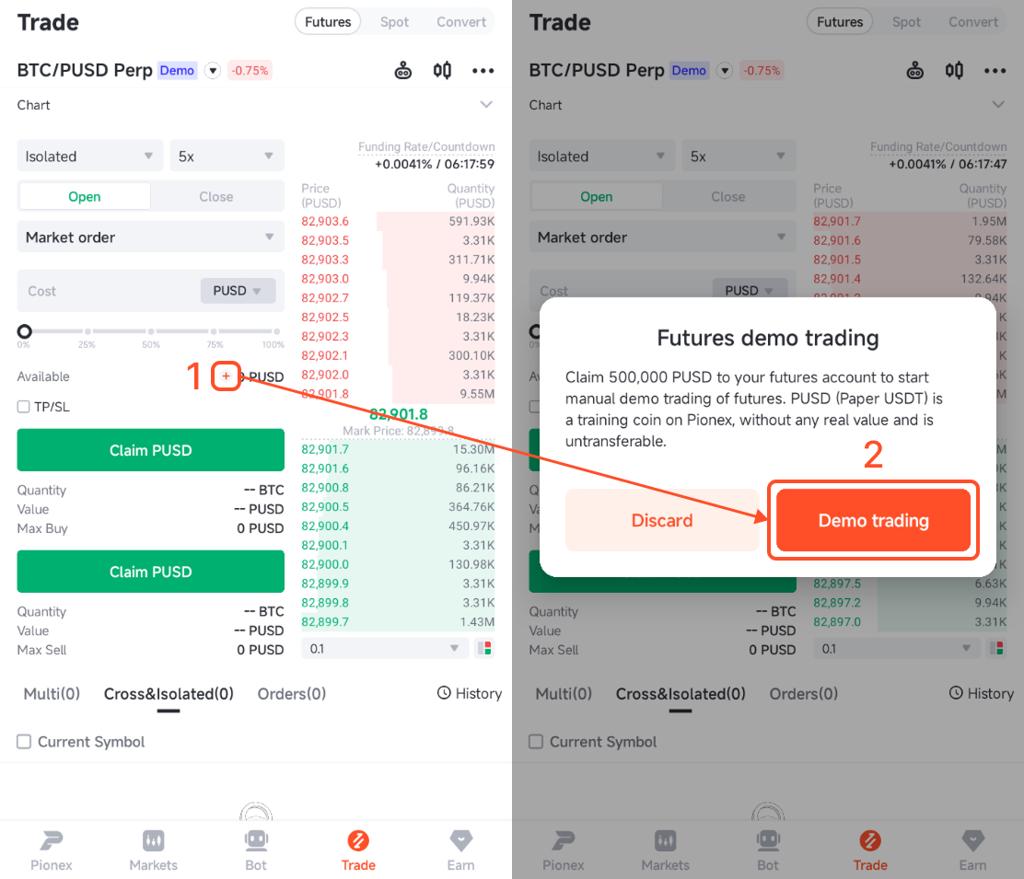
Step 3: Practise with 500,000 PUSD
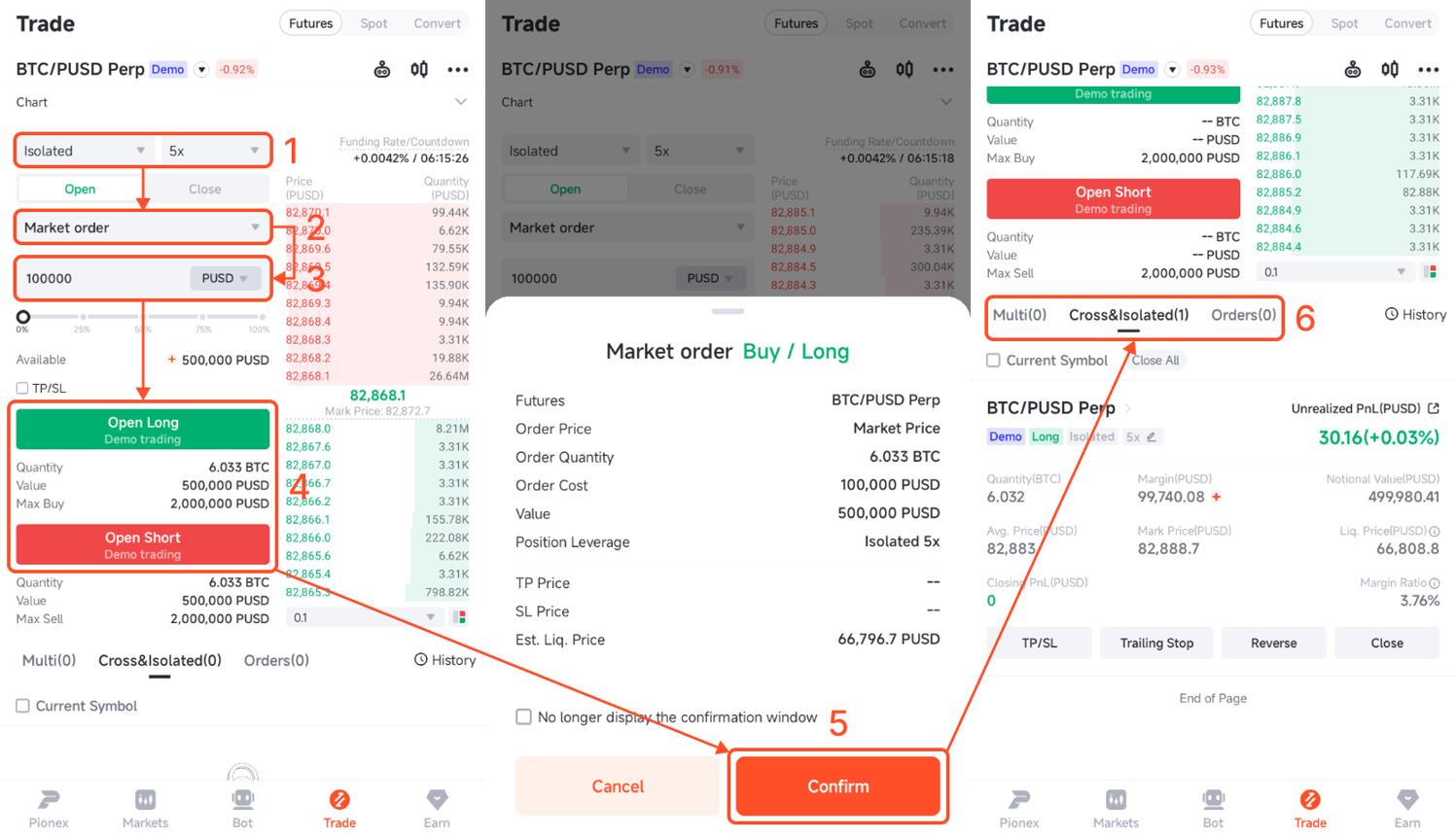
When Demo Trading opens, a Demo label appears beside the trading pair. You can choose a supported order type, adjust leverage and position size, and practise opening long or short futures positions.
- Practise opening and closing long or short positions.
- Experiment with leverage and position sizing.
- Learn how market and supported order types work.
- Test take-profit and stop-loss settings.
- Observe how price movements affect a simulated position.
Can you practise trading bots with Pionex Demo Trading?
Do not assume that Futures Demo and automated bot testing offer the same functions. The Demo Trading feature shown here supports simulated manual futures trading, but it does not establish that every Pionex trading bot can run in demo mode.
If you are comparing automated strategies, the Pionex Trading Bot Finder can help you explore bot types based on your experience, goals, and risk preferences. It is a recommendation tool, not a simulated trading account.
Is Pionex Demo Trading free?
Pionex provides virtual PUSD for practising supported futures trades without using real capital. Check the latest app requirements and supported markets because Demo Trading availability and features may change.
Demo Trading can help you learn futures mechanics, but simulated results do not guarantee similar performance in live markets.
What about paper trading with crypto trading bots?
Manual trading is only one approach.
Crypto trading bots use predefined rules to place orders automatically. Depending on the strategy, a bot might buy when prices fall, sell when prices rise, or maintain a target allocation across several assets.
For example, a Spot Grid Bot is designed to place buy and sell orders at different price levels within a selected range.
If Bitcoin moves repeatedly within that range, the bot attempts to capture those price movements.
But if Bitcoin falls sharply below the range, the bot may be left holding an asset that has lost value.
This is why understanding the strategy matters before using automation.
You can study how a bot is designed to behave, test its rules where appropriate simulation tools are available, and review its risks before committing real funds.
Not sure which trading bot strategy to practise? Start with the Pionex Trading Bot Finder
One challenge beginners face is choosing a strategy in the first place.
You might have heard of Grid Bots, DCA Bots, Futures Grid, or Rebalancing Bots without knowing which one matches your goal.
The Pionex Trading Bot Finder helps narrow down those choices.
It asks seven questions about your trading experience, goals, market expectations, risk tolerance, leverage preferences, and how often you can monitor a bot.
Based on your answers, it compares 16 trading bot types and provides a suggested match, alternatives, risk explanations, and setup guidance.
For example:
| Your goal | Strategy worth exploring |
|---|---|
| Trade repeated price movements within a range | Spot Grid |
| Add purchases after configured price declines | DCA Bot |
| Maintain a target allocation across several assets | Rebalancing Bot |
| Explore leveraged directional trading | Futures strategies, with additional risk education |
Pionex’s DCA Bot uses staged purchases after price declines. It should not be confused with simply buying a fixed dollar amount every week.
Is the Pionex Trading Bot Finder a paper trading simulator?
No. The Finder is a strategy-selection and educational tool. It doesn’t provide a virtual balance or execute simulated trades.
Its role in the paper trading process comes earlier: helping you identify which automated strategy you want to understand and potentially test.
You can use the Finder to explore a strategy, study its rules and risks, and then check whether an appropriate demo or backtesting environment supports it.
Pionex also documents a separate Futures Demo feature for practising manual futures trading with virtual funds. That should not be confused with simulated execution of every bot in the Finder.
Explore the Pionex Trading Bot Finder
Five common paper trading mistakes to avoid
1. Trading with an unrealistic balance
Practising with $100,000 when you intend to invest $100 can encourage position sizes and habits that won’t translate well to your actual budget.
Use a balance that reflects your plans.
2. Ignoring trading fees
A strategy that makes frequent small trades may look profitable before fees.
If a simulator doesn’t include fees, calculate their estimated impact separately.
3. Changing strategies after every loss
One losing trade doesn’t necessarily mean a strategy is useless.
Review whether the loss was consistent with your trading plan before changing the rules.
4. Taking excessive risks because the money isn’t real
Virtual funds can make large positions and high leverage feel harmless.
But if your goal is to prepare for live trading, practise with the same risk limits you would use with real money.
5. Assuming paper trading profits guarantee future returns
Market conditions change.
A strategy that performed well during a sideways market might struggle during a strong downtrend.
Simulated performance also cannot reproduce every aspect of live execution.
Treat your results as information to learn from, not a prediction of future profits.
How long should you paper trade before using real money?
There isn’t a fixed number of days.
Someone learning basic market orders might become comfortable with the mechanics relatively quickly. Someone testing a more complex strategy may need weeks or months of observation.
Instead of focusing only on time, consider whether you can consistently follow your plan, explain your results, and identify the conditions in which your strategy could lose money.
You should also understand the difference between a profitable strategy and a profitable period.
A few winning trades during a rising market don’t necessarily mean you’ve developed a reliable approach.
Frequently asked questions about paper trading
Is paper trading free?
Many platforms offer free paper trading or demo accounts, although some advanced simulators and backtesting services charge fees. Check the terms of the platform you’re considering.
Can I withdraw paper trading profits?
No. Paper trading uses virtual funds, so any profits are simulated and cannot be withdrawn as real money.
Is paper trading good for beginners?
Yes. It can help beginners understand order types, price movements, position sizing, and basic risk management without exposing real capital to trading losses.
Can I paper trade Bitcoin?
Yes. Crypto simulators that support Bitcoin allow you to practise buying and selling it using virtual funds. Available features vary by platform.
Can I paper trade using trading bots?
Some platforms support simulated automated strategies or bot backtesting. Others only offer manual demo trading. Check whether your chosen platform supports the specific bot and strategy you want to test.
Does Pionex offer demo trading?
Pionex documents a Futures Demo feature for manual futures trading with virtual funds. Availability can depend on your region and app version. The Pionex Trading Bot Finder is a separate tool for comparing trading bot strategies.
Is paper trading the same as backtesting?
No. Paper trading usually involves making simulated decisions as prices develop, while backtesting applies a strategy to historical market data.
Both can help you evaluate an idea, but neither guarantees future results.
Final thoughts
Paper trading is one of the simplest ways to become familiar with trading before risking real money.
You can practise placing orders, experiment with strategies, and learn how different market conditions affect your decisions.
Start with a realistic virtual budget. Follow a written plan. Track your mistakes as carefully as your successful trades.
And if automated trading interests you, take time to understand the different strategies before choosing one.
The Pionex Trading Bot Finder can help you explore 16 bot types and identify which ones deserve further research.
You don’t have to trade with real money to begin learning how trading works.
Disclaimer: This article is for educational purposes only and does not constitute financial advice. Cryptocurrency trading involves risk, including the possible loss of capital. Demo trading and past performance do not guarantee future results.
