

By Pionex Editorial Team
Fact-checked against official provider documentation: September 14, 2026
Estimated reading time: 12 minutes
A crypto card with yield is a payment card linked to an eligible crypto or stablecoin balance, or collateral position, that can continue earning until it is spent or borrowed against.
But not every card works the same way. One provider may pay interest directly on a spendable card balance. Another may connect the card to a separate yield-bearing account. A third may let you borrow against crypto that continues earning yield.
Those differences affect your fees, taxes, custody, liquidation risk, and actual return.
This guide explains the main models, compares current examples, and shows how to calculate whether a card’s yield and rewards outweigh its costs.
Disclosure: Pionex publishes this guide and offers one of the cards discussed. We compared products using official provider documentation rather than ranking them. Rates, fees, eligibility, and promotions can change.
Contents
- 1 What Is a Crypto Card With Yield?
- 2 How Crypto Cards Combine Yield and Spending
- 3 Crypto Cards With Yield Compared
- 4 Where Does the Yield Come From?
- 5 APY, Cashback, and Fees: Calculate the Net Value
- 6 Can You Spend Crypto Without Selling It?
- 7 What Are the Risks?
- 8 How to Compare Crypto Cards With Yield
- 9 Sources
What Is a Crypto Card With Yield?
A crypto card with yield is a payment card connected to an eligible balance or collateral position that can earn an annualized return.
Depending on the product, the earning balance might be:
- A stablecoin held in the card account
- A stablecoin in a linked yield account
- Crypto held in a savings wallet
- Assets supplied to a lending market or automated DeFi strategy
- Collateral that remains invested while you borrow to fund purchases
The word yield is often used loosely. It does not always mean fixed interest, and it is not the same as cashback.
APY estimates the annual return on an eligible balance, usually including compounding. Cashback is a spending reward calculated from qualifying purchases. A card may offer one, both, or neither.
Most crypto cards do not send crypto directly through a merchant’s payment terminal. The provider usually converts, settles, or lends against the user’s assets behind the scenes so the merchant receives ordinary card-network settlement.
How Crypto Cards Combine Yield and Spending
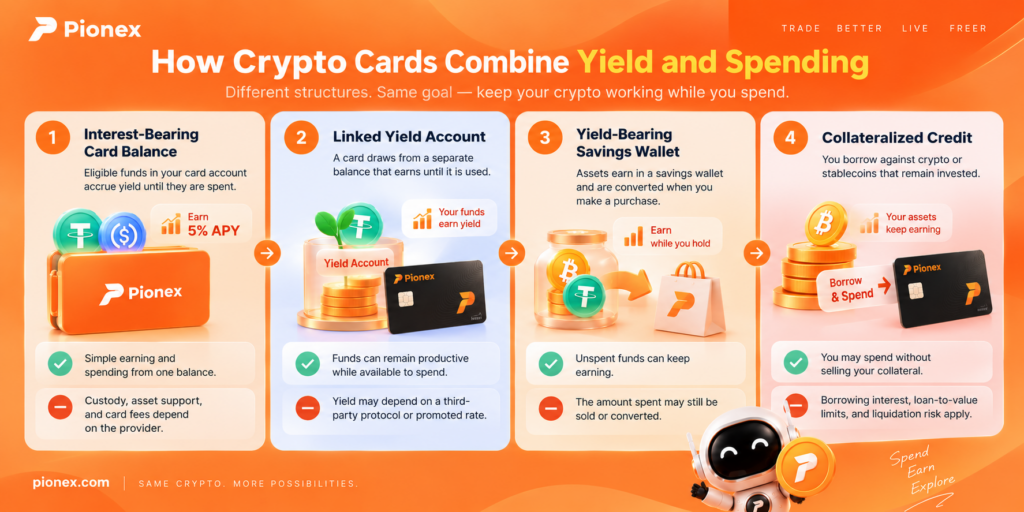
There are four common structures.
| Model | How it works | Main advantage | Main trade-off |
|---|---|---|---|
| Interest-bearing card balance | Eligible funds in the card account accrue interest until they are spent | Simple earning and spending from one balance | Custody, asset support, and card fees depend on the provider |
| Linked yield account | A card draws from a separate balance that earns until it is used | Funds can remain productive while available to spend | Yield may depend on a third-party protocol or promoted rate |
| Yield-bearing savings wallet | Assets earn in a savings wallet and are converted when a debit purchase occurs | Unspent funds can keep earning | The amount spent may still be sold or converted |
| Collateralized credit | You borrow against crypto or stablecoins that remain invested | You may spend without selling the collateral | Borrowing interest, loan-to-value limits, and liquidation risk apply |
A card can support more than one structure. For example, a provider may offer direct spending and borrowing modes in the same product.
Crypto Cards With Yield Compared
The table below covers four current examples whose official documentation explicitly connects earning balances with card spending. It is not a complete list or a ranking.
| Card | Earning arrangement | Advertised return | Spending model | Cashback | Key consideration |
|---|---|---|---|---|---|
| Pionex Card | USDT in the Visa Card Account accrues interest and remains spendable | 5% base APY; current boosted tiers advertise up to 6% when deposit and spending conditions are met | Spend from a custodial card balance | Visa program advertises up to 1% | Visa transactions carry a 1% fee; card type and regional availability vary |
| MetaMask Card + Money Account | mUSD in a self-custodial Money Account accrues yield and can be linked to the card | Standard rate advertised at up to 4%; a limited promotion advertises about 6% through September 30, 2026 | Spend mUSD from the linked account | 1% with the virtual card; 3% with the Metal card | Yield is variable and funds may be deployed through third-party DeFi platforms |
| Nexo Card | Eligible assets in a Savings Wallet can earn until a debit purchase is made; Credit Mode uses assets as collateral | Official card guidance advertises up to 13% on eligible savings balances, depending on asset, tier, settings, and jurisdiction | Debit conversion or crypto-backed credit | Credit Mode advertises up to 2% in NEXO or 0.5% in BTC | Credit Mode introduces borrowing costs and collateral risk |
| ether.fi Cash | Assets can earn through lending or automated DeFi strategies; Borrow Mode uses them as collateral | Variable market or vault yield; no single fixed card APY | Direct Pay or collateralized borrowing | Progressive ETHFI cashback; rate falls as monthly spending crosses thresholds | Borrow Mode accrues interest immediately and can be liquidated |
Sources: Pionex Card Ultimate Guide, MetaMask Money Account, Nexo Card explainer, and ether.fi Cash modes.
The highest advertised rate is not automatically the best deal. A meaningful comparison must also account for:
- Which assets earn the advertised rate
- Whether the rate is fixed, variable, tiered, or promotional
- How much must be deposited or spent to qualify
- Card, conversion, network, foreign-exchange, and borrowing fees
- Whether funds are custodial or self-custodial
- Whether spending sells assets or creates debt
- Where the card is available
Where Does the Yield Come From?
Yield is not created by the plastic or virtual card. It comes from an underlying financial activity.
Pionex: Market-Neutral Arbitrage Funding
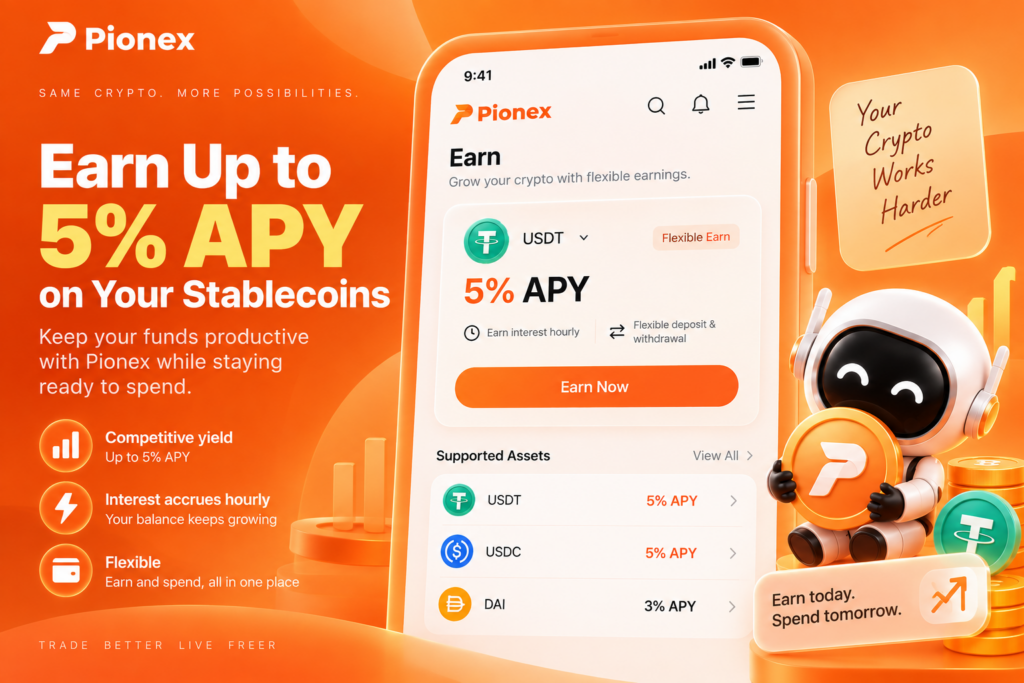
Pionex standard Visa Card Account pays 5% APY on USDT without requiring a separate staking subscription. Interest is calculated hourly, and the eligible balance remains available for spending. Its yield mechanism is similar to its arbitrage strategy: it uses offsetting spot and futures positions and primarily targets perpetual-futures funding fees.
Pionex also has boosted monthly tiers of 5.4%, 5.7%, and 6% when users meet stated net-deposit and card-spending thresholds. These are conditional rates, not a permanent return for every user. The Pionex Visa card currently lists a 1% transaction fee and up to 1% cashback. That makes spending volume important when calculating net value.
For a more product-specific walkthrough, see how the Pionex Card works and the full Pionex Card review.
MetaMask: Yield on mUSD
MetaMask’s Money Account is a self-custodial account built around mUSD on Monad. Its documentation says mUSD earns variable yield automatically, with daily accrual and no lockup or withdrawal penalty.
The standard rate is advertised at up to 4% APY. MetaMask currently advertises a limited promotional rate of approximately 6% through September 30, 2026.
The account can be linked to MetaMask Card, allowing the mUSD balance to remain available for spending. MetaMask says funds may be deployed through third-party DeFi platforms, so the APY is variable and not guaranteed.
Nexo: Savings Yield or Crypto-Backed Credit
Nexo Card offers Debit Mode and Credit Mode.
In Debit Mode, eligible assets in the Savings Wallet can continue earning interest until the moment they are spent. A purchase then uses or converts part of the balance.
In Credit Mode, the user borrows against crypto collateral. The underlying assets are not sold to fund the purchase, but the loan can accrue interest and is subject to collateral requirements.
Nexo’s card explainer advertises up to 13% annual interest on eligible savings balances and up to 2% cashback in NEXO tokens in Credit Mode. Actual terms depend on the asset, Loyalty Tier, settings, balance, and jurisdiction.
ether.fi: Lending and DeFi Vault Yield
ether.fi Cash supports Direct Pay and Borrow Mode.
Direct Pay uses an eligible stablecoin balance, such as USDC or LiquidUSD, to cover transactions. Borrow Mode supplies eligible assets to an onchain lending market and uses them as collateral for spending.
The supplied assets can earn a variable return while backing the loan. But borrowing interest starts immediately, and a falling collateral value can raise the loan-to-value ratio or lead to liquidation.
ether.fi’s Liquid product also allocates funds across automated DeFi strategies. Its displayed APY is a weighted estimate rather than a fixed or guaranteed card rate.
APY, Cashback, and Fees: Calculate the Net Value
To estimate a card’s value, compare all three components:
Estimated net benefit = yield earned + qualifying cashback − card and borrowing costs
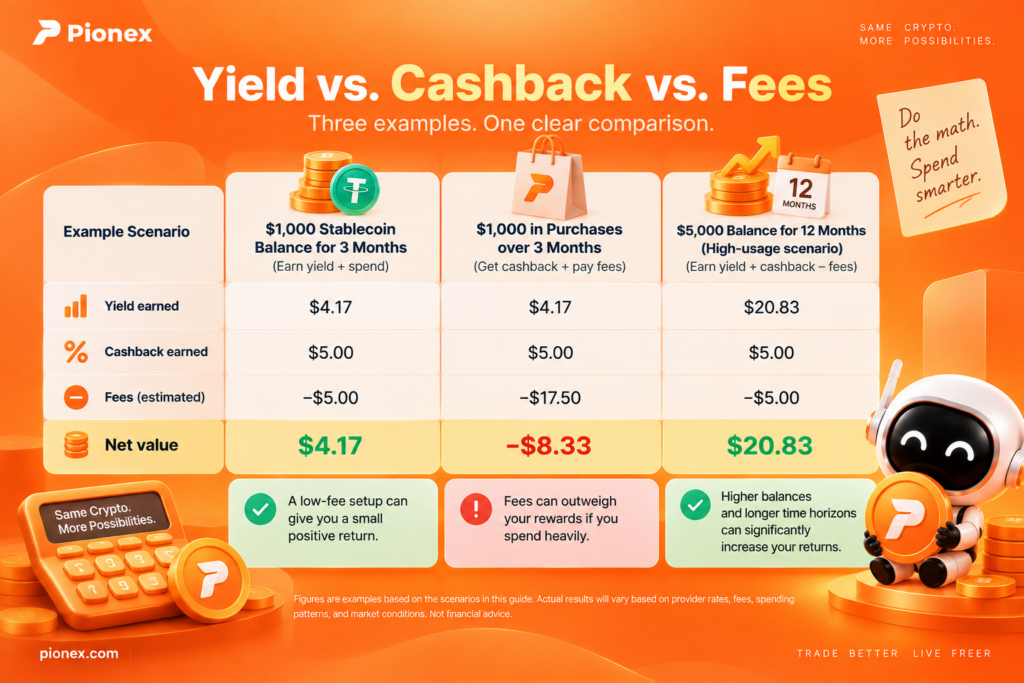
Suppose a cardholder keeps a 1,000 USDT average balance, earns 5% APY, and spends 500 USDT during a 30-day month.
For a simple illustration:
- Estimated monthly yield: 1,000 × 5% ÷ 12 = 4.17 USDT
- Cashback at 1% on 500 USDT of qualifying spending: 5 USDT
- Transaction fee at 1% on 500 USDT: 5 USDT
- Estimated net benefit before other costs: 4.17 USDT
This example assumes the full spend qualifies for cashback and ignores compounding, foreign exchange, ATM charges, network costs, taxes, excluded merchants, and changes to the balance during the month.
The same APY can produce a negative result when spending fees are higher. A 3.5% fee on 500 USDT would equal 17.50 USDT before cashback—more than four times the estimated monthly yield in this example.
| Monthly scenario | Yield | Cashback | Transaction cost | Estimated net benefit |
|---|---|---|---|---|
| 1,000 balance at 5% APY; 500 spend; 1% cashback; 1% fee | 4.17 | 5.00 | 5.00 | 4.17 |
| Same balance and spend; 1% cashback; 3.5% fee | 4.17 | 5.00 | 17.50 | −8.33 |
| 5,000 balance at 5% APY; 500 spend; 1% cashback; 1% fee | 20.83 | 5.00 | 5.00 | 20.83 |
These are illustrations, not forecasts. The actual result depends on the provider’s calculation method and your average eligible balance.
Can You Spend Crypto Without Selling It?
Sometimes—but the answer depends on the spending model.
With a debit or direct-pay model, the provider generally uses, converts, or deducts assets to settle the purchase. You may avoid manually selling crypto first, but the transaction can still economically amount to a disposal.
With a collateralized credit model, the provider lends against your assets. This can let the collateral remain invested instead of being sold at checkout.
However, spending without selling does not mean spending without cost. You may face:
- Borrowing interest
- Variable loan rates
- Collateral or loan-to-value requirements
- Liquidation if collateral falls too far
- Repayment obligations
- Tax consequences that differ by jurisdiction
Nexo Credit Mode and ether.fi Borrow Mode are examples of collateralized spending. Pionex Card’s standard flow is funded from a separate USDT Card Account, while MetaMask lets users spend mUSD from the linked Money Account.
If the goal is international use, check settlement currencies, foreign-exchange charges, and regional restrictions separately. Our guide to crypto cards for international spending covers those factors in more detail.
What Are the Risks?
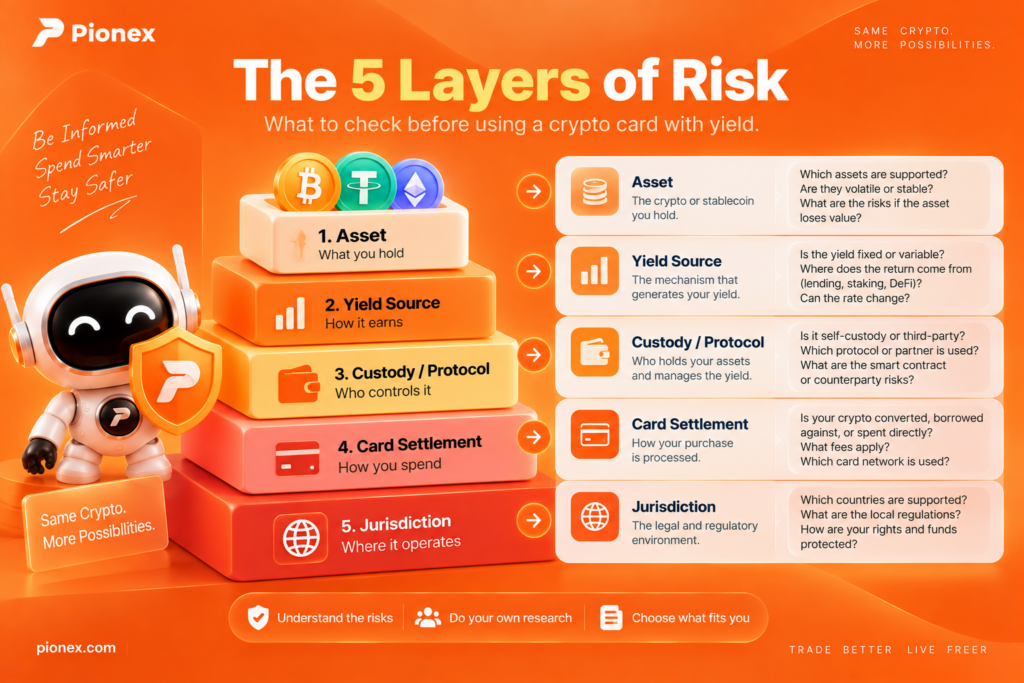
Crypto cards with yield combine payment, digital-asset, and financial-product risks. Review each layer before depositing funds.
1. The APY Can Change
Many rates are variable, promotional, tiered, or conditional. “Up to” is a maximum under stated conditions, not the return every balance will receive.
2. Stablecoins Can Lose Their Peg
A stablecoin is designed to track a reference currency, but it can trade below that value. The card balance can therefore lose value even while its unit count increases.
3. Custodial and Smart-Contract Risks Differ
A custodial card requires the provider to hold or control the spending balance. A self-custodial or DeFi-connected product may reduce that form of custody but introduce smart-contract, protocol, bridge, or blockchain risks.
Self-custody does not remove risk; it changes who controls the wallet and which systems can fail.
4. Borrowing Can Trigger Liquidation
Collateralized cards add debt. If the collateral falls, the user may need to repay, add collateral, or face liquidation.
ether.fi, for example, publishes asset-specific loan-to-value limits for Borrow Mode. Its protection program also states that it is not insurance or deposit insurance and excludes market losses, stablecoin depegs, and yield shortfalls.
5. Cashback May Have Exclusions
Cash withdrawals, peer-to-peer payments, gambling, money transfers, taxes, gift cards, rent, or financial-service merchants may not qualify. Rewards can also be locked, paid in a volatile token, or subject to a minimum claim amount.
6. Access Depends on Your Account and Location
Cards can require identity verification, minimum assets, a paid tier, or residence in an eligible country. A Visa or Mastercard logo does not mean every provider can issue a card in every market.
Check the provider’s live eligibility screen before funding an account. For Pionex-specific coverage, see where Pionex Card works.
How to Compare Crypto Cards With Yield
Use this checklist before choosing a card:
- Identify the earning asset. Is it USDT, USDC, mUSD, another stablecoin, or a volatile crypto asset?
- Find the normal rate. Separate the standard APY from temporary promotions and “up to” tiers.
- Locate the yield source. Is the return generated through lending, staking, futures funding, a DeFi vault, or another activity?
- Confirm when earning stops. Does the balance earn until authorization, settlement, conversion, or repayment?
- Separate APY from cashback. Record both rates and the conditions for receiving them.
- Calculate your likely fees. Include transaction, conversion, network, foreign-exchange, subscription, borrowing, and ATM costs.
- Check what happens at checkout. Are assets sold, converted, transferred, or used as collateral?
- Review custody and liquidation. Know who controls the funds and whether borrowing can trigger a forced sale.
- Check eligibility before depositing. Verify your country, identity level, minimum balance, supported card type, and physical-card availability.
- Read the latest terms. Rates and card programs can change faster than evergreen reviews.
The best fit is not necessarily the card with the largest advertised APY. It is the one whose supported asset, earning model, fees, risks, and availability match how you actually plan to hold and spend funds.
If you are evaluating Pionex specifically, start with the Pionex Card review for a closer look at its setup, earning balance, and spending flow.
Sources
We reviewed official product and support documentation available on September 14, 2026. This is a documentation-based comparison, not a hands-on transaction test. Providers can change rates, fees, eligibility, and reward rules after publication.
Primary sources:
- Pionex Card Ultimate Guide
- Pionex Visa Card Fee Schedule
- Pionex Card Feature Overview
- MetaMask Money Account
- MetaMask Card Limits and Fees
- Nexo Card: Spend Crypto Without Selling
- ether.fi Cash: Borrow Mode vs. Direct Pay Mode
- ether.fi Cash: How Borrow Works
- ether.fi Cash: How Cashback Works
- ether.fi Cash Protection Program
