
Last reviewed: September 9, 2026.

Choose a Grid Bot when you expect a liquid asset to move repeatedly inside a realistic price range. Choose the Pionex DCA Bot when you deliberately want to buy in stages after price declines and have enough capital for the complete safety-order plan. Neither bot predicts the market, guarantees profit or protects you from a sustained decline. The right choice depends on the price path you expect, how you want profits to be taken, how much capital you can reserve and what would invalidate your plan.
A Grid Bot and DCA Bot can both buy after price falls, but they are not doing the same job.
A Grid Bot divides a range into multiple buy and sell levels. Its objective is to complete repeated trades as price moves between those levels.
The Pionex DCA Bot, also called the DCA (Martingale) Bot, builds one combined position through an initial order and subsequent safety orders. It then seeks to close that position when the configured take-profit condition is reached.
Contents
- 1 First, which kind of DCA do you mean?
- 2 Grid Bot vs DCA Bot
- 3 The real decision is the price path
- 4 Price path 1: price repeatedly moves inside a range
- 5 Price path 2: price falls in stages and then rebounds
- 6 Price path 3: price rises without meaningful pullbacks
- 7 Price path 4: price keeps falling
- 8 How capital behaves differently
- 9 The settings that matter
- 10 Grid profit and DCA profit should not be read the same way
- 11 Is Grid Bot or DCA Bot easier for beginners?
- 12 When should you choose neither bot?
- 13 How to use the Pionex Trading Bot Finder for this decision
- 14 A final Grid Bot vs DCA Bot checklist
- 15 Frequently asked questions
- 16 Disclaimer
First, which kind of DCA do you mean?
Traditional dollar-cost averaging means investing a set amount at regular intervals, regardless of the current price. A DCA trading bot can follow a different rule. The Pionex DCA (Martingale) Bot discussed here adds purchases after configured price declines and seeks a combined exit when its take-profit condition is met.
| What you want to do | Approach to investigate | What triggers the next action? |
|---|---|---|
| Buy a fixed amount every week or month and accumulate over time | Scheduled recurring purchases | The next scheduled purchase date |
| Buy and sell repeatedly as price moves inside a range | Spot Grid Bot | Price reaching the configured grid levels |
| Add to one position after declines and seek an exit after a rebound | DCA (Martingale) Bot | The configured safety-order and exit conditions |
For example, buying 25 USDT of an asset every Friday is a schedule-based plan. Reserving money to buy more only after specified price declines is a price-based plan. Several price-triggered orders could fill before the next Friday, so those plans can commit money at very different speeds. The amount is illustrative, not a suggested investment.
If your goal is recurring accumulation, do not select a Martingale-style bot merely because it is called DCA. If your goal is trading, compare the price paths below and check the full capital requirement and exit plan. Scheduled buying also carries market risk; none of these approaches guarantees a profit.
Grid Bot vs DCA Bot
| Decision | Pionex Grid Bot | Pionex DCA Bot |
| Main job | Trade repeated movements inside a range | Build a position in stages after price falls |
| Market assumption | Price will revisit several levels inside the selected range | Price may decline after entry but will eventually rebound sufficiently |
| Profit-taking approach | Multiple smaller buy-and-sell cycles | One combined exit when the position reaches its target |
| Capital structure | Capital is distributed across grid orders | Capital must cover the initial order and planned safety orders |
| Main settings | Lower price, upper price, grid count, investment, stop loss | First order, safety orders, price scale, volume scale, take profit |
| Main failure condition | Price leaves the selected range | Price continues falling after the safety orders are filled |
| Strong rally risk | The bot may sell portions and capture less upside than holding | The position may close at its target before the rally is finished |
| Sustained decline risk | The bot may hold more of the falling asset below the range | The bot may keep adding exposure during the decline |
| Leverage | Standard Spot Grid does not use leverage | Standard Spot DCA does not use leverage |
| Pionex Trading Bot Finder risk label | Moderate | Moderate |
A moderate-risk label does not mean either bot is safe or unable to lose money.

The real decision is the price path
A feature list cannot tell you which bot fits. For a broader comparison beyond Grid and DCA, see how to choose the right crypto trading bot. The same bot can behave very differently in a range, a rally or a prolonged decline. These four price paths explain the difference more clearly.
Price path 1: price repeatedly moves inside a range
Imagine an asset moving from $100 to $90, back to $100, up to $110 and then back to $100.
A Grid Bot can place buy orders below the starting price and sell orders above it. Each repeated crossing may complete another grid trade, depending on the configured range and grid spacing.
A DCA Bot may place a safety order during the fall from $100 to $90. If the subsequent rebound reaches its combined take-profit condition, it may close the entire position. After closing, another cycle would depend on the selected restart conditions.
| Question | Grid Bot | DCA Bot |
| Can it act during several swings? | Yes, through repeated grid levels | Possibly, but usually within a combined position cycle |
| Does it need a fixed range? | Yes | No fixed trading range in the same sense |
| Does it add after a decline? | Yes, at grid levels | Yes, through configured safety orders |
| Does it sell the whole position together? | Not normally | Yes, when the combined take-profit condition is reached |
| Clearer structural fit | Repeated range trading | Buying a dip and exiting after a rebound |
For a liquid, range-bound market, Grid Bot is generally the more direct match.
The important qualification is that the range must continue to contain price. Volatility alone is not enough. A market can be volatile because it is breaking down or rallying sharply in one direction.
Pionex Trading Bot Finder recommends Spot Grid for repeated price swings in a sideways market.
On the Pionex Trading Bot Finder, Spot Grid ranks first when you describe repeated price swings, a sideways market, moderate risk and no leverage.
Price path 2: price falls in stages and then rebounds
Now imagine price moving from $100 to $90, then $80, before recovering to $95.
A DCA Bot may fit this plan if you intentionally want to add at lower prices. Each safety order changes the total position size and average entry price. A sufficient rebound may then allow the combined position to reach its take-profit condition.
A Grid Bot could also trade parts of this movement if the entire path remains inside its configured range. However, its objective is different. It is trying to complete repeated trades at multiple levels, not build one combined dip-buying position for a single exit.
The DCA Bot is the clearer match only when all of the following are true:
- You intentionally want to add after price declines.
- The asset remains worth holding if the decline becomes deeper.
- The complete safety-order ladder has been reviewed.
- The full capital requirement is affordable.
- You have an invalidation or stop-loss plan.
- The rebound thesis is based on more than the fact that price has fallen.
Lowering the average entry price does not remove the loss. It changes the price required for the combined position to recover.
Price path 3: price rises without meaningful pullbacks
Imagine price moving from $100 to $110, then $125 and $140 without returning to the earlier levels.
A Grid Bot may sell portions of the asset as price passes through its upper grid levels. If price continues beyond the upper limit, the bot may stop completing new grid cycles. You can end up holding more of the quote currency and less of the asset than someone who simply held it.
A DCA Bot may never need its lower safety orders. If the position reaches the take-profit target, it may close before the full rally is over.
In this price path, both bots can lag holding. That does not mean either bot malfunctioned. It means a range strategy or rebound-exit strategy was used during a strong one-way trend.
| Your real thesis | More relevant approach to research |
| Price will oscillate inside a range | Grid Bot |
| Price may dip and then recover | DCA Bot |
| Price will rise strongly and I want continued exposure | Holding or a trend-oriented strategy |
| I do not know what price behaviour to expect | Wait, reduce complexity or use the Pionex Trading Bot Finder |
A trading bot should not be forced into a market thesis it was not designed to express.
Price path 4: price keeps falling
Imagine price falling from $100 to $90, $75, $60 and then $45 without a lasting rebound.
This is the most important stress test because both strategies can lose.
A Grid Bot may complete trades during smaller bounces early in the decline. Once price falls below its lower range, new grid activity can pause while the bot holds more of the base asset. Completed grid profit can remain positive while the unrealized loss on the held asset makes total profit negative.
A DCA Bot may place its initial order and successive safety orders as price falls. This reduces the average entry price, but it also increases the total amount exposed. Once every planned safety order is filled, the bot has no remaining staged purchases. It can be left waiting for a rebound that may not arrive.
| Failure question | Grid Bot | DCA Bot |
| What failed? | The selected range | The rebound assumption |
| What happens to exposure? | The bot may hold more base asset below the range | The position grows as safety orders fill |
| Can displayed profits be misleading? | Positive grid profit can coexist with negative total profit | A lower average entry can hide how much capital is now exposed |
| What must be planned first? | Lower-range response and stop loss | Full safety-order capital and final invalidation point |
Neither strategy turns a weak asset into a strong one.
How capital behaves differently
The first order does not reveal the DCA Bot’s complete capital requirement.
Consider a purely illustrative plan:
| Order | Amount | Cumulative capital |
| Initial order | $100 | $100 |
| Safety order 1 | $100 | $200 |
| Safety order 2 | $150 | $350 |
| Safety order 3 | $225 | $575 |
In this example, someone who looks only at the $100 initial order may think the bot requires $100. The complete plan actually allocates up to $575.
This is not a recommended Pionex configuration. It demonstrates why the volume scale, safety-order count and total planned investment must be reviewed together.
A Grid Bot handles capital differently. Part of the allocation is used for the base asset while the remainder supports buy orders at lower grid levels. The required amount depends on the pair, range, number of grids, order-size rules and other current settings.
Pionex displays the applicable minimum investment before confirmation. Do not copy someone else’s minimum or use one from another pair or an old article because the amount can change with the configuration.
The settings that matter
| Grid Bot setting | Why it matters |
| Lower price | Defines where the intended trading range ends on the downside |
| Upper price | Defines where the range ends on the upside |
| Number of grids | Controls the number and spacing of order levels |
| Grid mode | Determines how the levels are distributed |
| Investment | Determines the capital distributed through the setup |
| Take profit | Defines a planned profitable exit condition |
| Stop loss | Defines when the range thesis should be abandoned |
| Liquidity | Affects fills, spreads and slippage |
| Estimated profit per grid | Needs to remain meaningful after trading costs |
| DCA Bot setting | Why it matters |
| Initial order | Opens the position cycle |
| Safety-order count | Determines how many staged additions are planned |
| Price scale | Determines the price movement that triggers later orders |
| Volume scale | Determines how later order sizes change |
| Maximum investment | Shows the capital required if the full ladder fills |
| Take-profit condition | Defines the combined exit target |
| Stop-loss rule | Defines when the rebound thesis should be abandoned |
| Asset selection | Determines what you may have to hold during a long decline |
More grids do not automatically improve a Grid Bot. More safety orders do not automatically make a DCA Bot more likely to recover. Both changes can increase capital demands and change the strategy’s risk.
Grid profit and DCA profit should not be read the same way
Grid profit usually records profit from completed grid trades. It does not, by itself, describe the current value of the unsold asset held by the bot.
For a Grid Bot, review:
- Grid profit
- Unrealized profit or loss
- Total profit
- Current asset allocation
- Whether price remains inside the range
- Fees and slippage
A DCA Bot is usually evaluated at the combined-position level. The key questions are how much capital has been deployed, how many safety orders remain, the current average entry and the distance to the take-profit or stop-loss condition.
Comparing a Grid Bot’s completed cycle profit with a DCA Bot’s combined-position result can produce a misleading conclusion. The strategies realize gains differently.
Is Grid Bot or DCA Bot easier for beginners?
Neither bot should be described as automatically safe for beginners. The Pionex Trading Bot Finder labels both standard spot products moderate risk, not low risk.
Grid Bot may be easier to understand when you can clearly identify a trading range. However, choosing realistic limits, grid spacing and a range-break response still requires judgment.
DCA Bot may look simpler because it buys in stages, but the capital structure can be less obvious. A beginner needs to understand that Pionex DCA is a price-based Martingale-style strategy, not simply a fixed purchase made every week.
A beginner should be able to answer these questions before choosing:
| Question | If your answer is “no” |
| Can I explain why this asset should remain inside my Grid range? | Do not start the Grid Bot |
| Can I fund every planned DCA safety order? | Do not start the DCA Bot |
| Do I know what would invalidate my market view? | Do not automate the trade yet |
| Can I tolerate holding the asset through a deeper decline? | Reconsider both bots |
| Have I reviewed total profit rather than one profit number? | Learn the P&L display first |
| Can I check the bot if market conditions change? | Reduce complexity or wait |
When should you choose neither bot?
Choose neither when:
- You expect guaranteed or passive income without loss.
- You have no view on why the asset should range or rebound.
- You cannot afford the complete strategy allocation.
- You do not want to hold the selected asset after a decline.
- You expect a strong one-way rally and mainly want continued exposure.
- The market is illiquid or vulnerable to large price gaps.
- You cannot define an exit or invalidation point.
- You cannot monitor whether the original market condition has changed.
Waiting is a valid trading decision. Automation does not create a strategy where none exists.
How to use the Pionex Trading Bot Finder for this decision
The Pionex Trading Bot Finder compares more than the labels “Grid” and “DCA.”
For a useful result:
- Select “Trade price swings” if the job is repeated range trading.
- Select “Build a position” if the job is staged buying.
- Describe the market you actually expect.
- Exclude leverage unless you understand liquidation and margin.
- Answer the risk question using the loss you could tolerate.
- Use your real monitoring availability.
- Treat the result as a research shortlist, not financial advice.
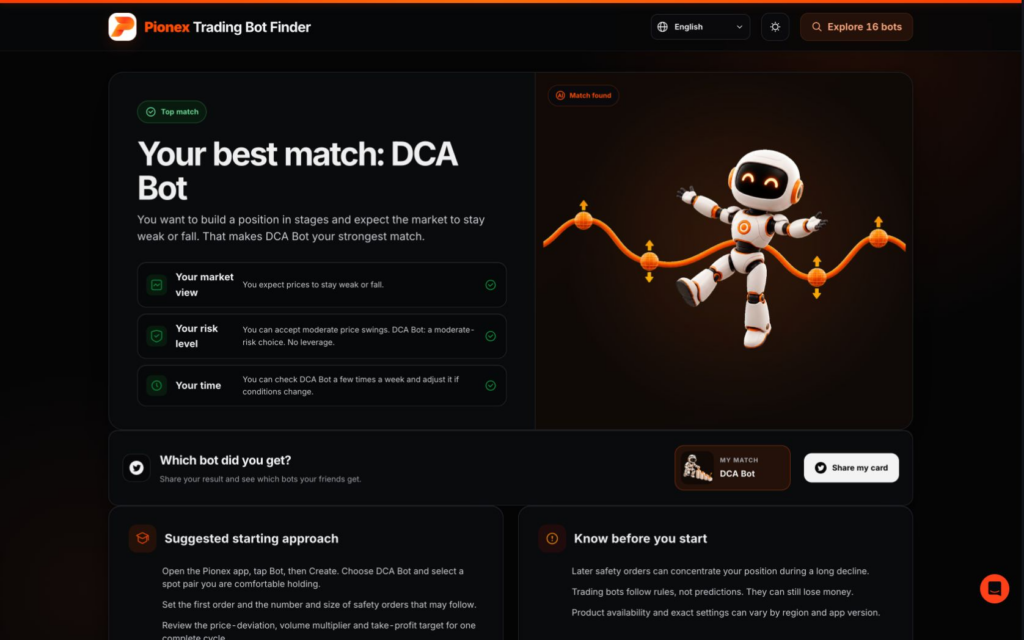
Your market view can change the result. In a live test on August 20, 2026, Spot Grid ranked first for repeated price swings in a sideways market. DCA Bot ranked first when the goal was staged position building during a weak or falling market.
A final Grid Bot vs DCA Bot checklist
| Choose Grid Bot when | Choose DCA Bot when |
| You expect repeated movement inside a defined range | You expect declines followed by a sufficient rebound |
| You want multiple buy-and-sell cycles | You want to build and exit one combined position |
| You can define realistic upper and lower limits | You can fund the complete safety-order ladder |
| You have a plan for an upside or downside range break | You have a plan for a decline beyond the final safety order |
| The pair has enough liquidity for repeated trades | You are comfortable holding the asset if recovery takes time |
Choose neither if you cannot explain the market assumption and failure condition behind the strategy.
Frequently asked questions
Is a DCA Bot better than a Grid Bot?
Not automatically. A Grid Bot is built for repeated movement inside a selected range, while the Pionex DCA Bot builds a combined position through staged purchases. The better fit depends on the expected price path, available capital and exit plan.
Which bot fits a sideways market?
A Grid Bot is generally the more direct fit when a liquid asset repeatedly moves inside a realistic range. It can become unsuitable when price breaks the range or trading costs consume the profit from small grid movements.
Can I use a DCA Bot in a sideways market?
Yes, if the strategy’s staged buys and combined exit match the movement. However, a DCA Bot does not capture every oscillation in the same way as a Grid Bot. Its main objective is to build and exit one combined position.
What happens when a Grid Bot falls below its lower range?
New grid trading can pause while the bot holds more of the base asset. If price continues falling, the unrealized loss can exceed completed grid profit. A lower-range response should be planned before the bot starts.
What happens after every DCA safety order fills?
The full planned capital has been deployed and no additional safety orders remain. The bot may hold the combined position while waiting for its take-profit or stop-loss condition. A continued decline can deepen the loss.
Is Pionex DCA the same as buying crypto every week?
No. The Pionex DCA Bot described here is a price-based, staged-buying strategy that can add safety orders after declines. Fixed-calendar recurring purchases are a different approach.
Can Grid profit be positive while total profit is negative?
Yes. Grid profit measures completed grid trades. Total profit also reflects the current value of the assets held by the bot, unrealized gains or losses and applicable costs.
Which bot needs more capital?
It depends on the pair and settings. A Grid Bot distributes capital across grid orders, while a DCA Bot must reserve enough for the complete safety-order ladder. Check the current minimum and maximum planned investment in the Pionex order panel.
Can either bot lose money?
Yes. A Grid Bot can lose when price leaves its range, the underlying asset falls or costs consume small profits. A DCA Bot can lose when price continues falling after staged orders are filled or the expected rebound does not occur.
How do I choose between them?
Define the job first. Choose Grid Bot for repeated range trading and DCA Bot for deliberate staged buying with a rebound thesis. Then check capital, liquidity, monitoring time and the condition that would invalidate the strategy.
Disclaimer
This article is for informational purposes only and does not constitute financial or investment advice. Crypto trading carries significant risk including total loss of capital. Past performance is not indicative of future results. Always conduct your own research before trading.
Product mechanics and risks were checked against the current Pionex DCA Bot vs Grid Bot page, Pionex Martingale Bot guide, Grid Trading Risks guide, Grid Bot parameter guide, Pionex Grid Bot support guide and Pionex DCA Bot support guide.
Product availability, settings and minimum investment can vary by region, pair and app version. Check the current Pionex order panel before committing funds
