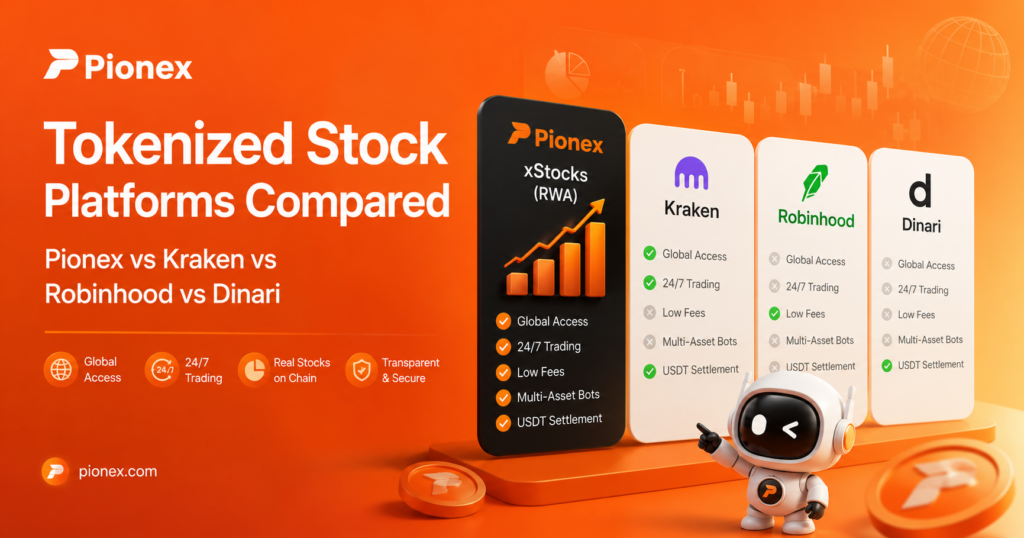

Five platforms now sell some version of “trade Tesla or Apple without a brokerage account.” None of them sell the same thing. The legal wrapper, the custody chain, the rights you get, and the countries you can use it from all differ, sometimes sharply, between Pionex, Kraken, Robinhood, Ondo, and Dinari. This guide lines them up side by side so you know exactly what you are buying before you buy it.
If you want price exposure to US stocks, funded in USDT, with bots that automate entries and exits, Pionex is built for that specific workflow. If you want the widest reach with a household brokerage name behind it, Robinhood’s new global Stock Tokens just launched in 120+ countries. If you want the closest thing to actual shareholder rights available in token form, Dinari’s dShares are the benchmark, though they run mostly through partner apps rather than a retail exchange. Kraken sits in the middle: broad self-custody support, a maker-taker fee schedule, and the same underlying xStocks tokens you will also find on Pionex.
None of these five platforms hand you a normal brokerage account. All of them are distributing, wrapping, or issuing a token that tracks a stock price. The differences are in how close that token gets to owning the real thing.
If you are new to this category, start with the Pionex xStocks hub. It gives the main overview of tokenized-stock trading on Pionex before you compare individual platforms below.
Contents
What each platform actually is
| Platform | What it is | Who issues the token | Chain |
| Pionex | Crypto exchange that aggregates xStocks and Ondo Stocks liquidity, with built-in trading bots | Backed Assets (JE) Limited (xStocks) and Ondo Global Markets (BVI) Limited (Ondo Stocks) | Solana, Ethereum, BNB Chain |
| Kraken | Crypto exchange distributing the same xStocks tokens | Backed Assets (JE) Limited | Solana (withdrawable to Ethereum, TON, Ink) |
| Robinhood | Brokerage offering two separate products: Classic Stock Tokens (EU-only) and new global Stock Tokens | Robinhood Assets (Jersey) Limited (new Stock Tokens) | Robinhood Chain, an Arbitrum Layer 2, launched July 1, 2026 |
| Ondo Stocks | Issuer selling structured notes tied to stocks and ETFs, distributed through venues like Pionex | Ondo Global Markets (BVI) Limited | Ethereum, BNB Chain |
| Dinari | Tokenization infrastructure provider working through partner apps, not a consumer exchange | Dinari Securities LLC, custody at Alpaca Securities LLC | Multiple chains, including Avalanche via the Dinari Financial Network |
Pionex is the only platform on this list that aggregates both xStocks and Ondo Stocks liquidity in one venue rather than distributing a single issuer’s product.
Do you own the stock? Rights comparison
This is the question every one of these platforms gets asked most, and the answer varies by wrapper, not by brand.
| Platform | Legal wrapper | Voting rights | Dividend handling | Self-custody / withdrawal |
| Pionex (xStocks) | Tracker certificate, bearer debt instrument | None | Auto-reinvested via rebasing multiplier | Not the focus; product is designed for trading and bots on-platform |
| Pionex (Ondo Stocks) | Structured note secured by underlying assets | None, and no information rights either | Passed through net of applicable adjustments | Not the focus; product is designed for trading and bots on-platform |
| Kraken (xStocks) | Same tracker certificate as Pionex’s xStocks | None | Auto-reinvested via rebasing multiplier | Yes, to Solana, Ethereum, TON, or Ink wallets |
| Robinhood Classic Stock Tokens (EU) | MiFID II derivative between the user and Robinhood Europe | None | Cash pass-through possible, not treated as a normal dividend | No, cannot be withdrawn to a wallet |
| Robinhood Stock Tokens (global, new) | Debt security issued by Robinhood Assets (Jersey) Limited | None, per the SEC’s January 2026 guidance on tokenized securities, this structure falls in the category facing closer scrutiny | Not yet fully detailed at launch | Yes, via Robinhood Wallet, and usable as DeFi collateral |
| Dinari dShares | Custodial tokenized security, share held at a US broker-dealer | Positioned closest to real ownership among these five, though voting access depends on the specific arrangement and is not guaranteed across all tickers | Paid in stablecoin on the issuer’s dividend schedule | Yes, redeemable back to the underlying share’s market value |
The pattern holds across every platform except Dinari: what you are buying is economic exposure to a stock price, not a claim on the company itself. Pionex says this plainly in its own materials, and so do Kraken, Robinhood, and Ondo. Dinari is the outlier because its custodial model keeps the underlying share on a real broker-dealer ledger rather than inside a debt-instrument wrapper, which is why its rights profile reads closer to ordinary share ownership.
Fees
| Platform | Trading fee | Notes |
| Pionex | 0.05% spot, per fill | No bot subscription fee, no monthly charge |
| Kraken | 0% with USDG or USD, 1% instant buy/sell with other assets, 0.25%/0.40% maker/taker on the orderbook | EEA clients can only use the fiat convert flow, not the full orderbook |
| Robinhood | Not fee-free; commission structure varies by product and is still being finalized for the new global Stock Tokens | Classic Stock Tokens carry an FX-related fee around 0.1% |
| Ondo Stocks | Fee is embedded in the note structure rather than charged as a separate line item on Pionex | Depends on the distributing venue |
| Dinari | Fee model set by the partner platform distributing dShares, not a fixed public rate | Dinari itself is B2B infrastructure, not a consumer-facing fee schedule |
On a pure cost basis for USDT-funded, bot-driven trading, Pionex’s flat 0.05% is difficult to beat among this group. Kraken’s fee-free path only applies if you are funding with USD or USDG specifically, and Robinhood’s newest product had not published a finalized retail fee schedule at the time this article was written.
Where you can actually use each one
| Platform | Broadly available | Explicitly restricted |
| Pionex | Non-restricted global markets | United States, United Kingdom, Singapore, Hong Kong, Canada, the Netherlands, Spain, France, among others |
| Kraken (xStocks) | 110+ countries | United States, Canada, United Kingdom, Australia |
| Robinhood Classic Stock Tokens | EU/EEA | Outside the EU/EEA, not accessible |
| Robinhood Stock Tokens (global) | 120+ countries via Robinhood Wallet | United States |
| Ondo Stocks | Distributed under Regulation S outside the US | United States persons excluded |
| Dinari dShares | 85+ jurisdictions outside the US, through partner apps | United States retail is largely excluded from direct dShares access |
Every platform on this list blocks the United States for retail tokenized-stock trading, and most block a similar cluster of jurisdictions with stricter securities regimes. If you are checking eligibility, check the venue’s list and the issuer’s list separately. Pionex’s restricted countries are not identical to xStocks’ or Ondo’s own restrictions, and the stricter of the two applies.
Trading hours and weekend access
| Platform | Hours |
| Pionex | 24/7 on tokenized instruments once listed |
| Kraken | 10 xStocks trade 24/7 (including TSLAx, AAPLx, NVDAx, QQQx, SPYx), the rest trade 24/5 |
| Robinhood Classic Stock Tokens | 24/5 |
| Robinhood Stock Tokens (global) | 24/7 on-chain, since the product is designed for DeFi composability |
| Dinari dShares | 24/5 on most partner venues, with some partnerships extending toward 24/7 |
Weekend and after-hours pricing on any of these products is an approximation, not a live feed from the primary exchange. During US market hours, prices track the real order book closely. Outside those hours, market makers price off index futures, other venues, and internal models, which is why gaps and wider spreads are more common on Saturday and Sunday than on a Tuesday afternoon.
Funding and how you actually pay
Pionex’s clearest structural advantage is funding. Trading tokenized stocks on Pionex runs through USDT, the same stablecoin most of its crypto pairs already use, so a user does not need to convert into a different asset just to buy a stock token. Kraken’s fee-free path requires USD or USDG specifically, and USDT has to be converted first. Robinhood’s global Stock Tokens are funded through Robinhood Wallet’s supported assets. Dinari settles in stablecoin or fiat depending on which partner app is used.
For a trader who already holds USDT for crypto trading and wants to add tokenized-stock exposure without moving funds between stablecoins, Pionex removes a step the other platforms do not.
Bots: the feature none of the others have
This is where Pionex’s design diverges from every other platform on this list. Kraken, Robinhood, Ondo, and Dinari are all built around manual buy-and-hold or manual trade execution. Pionex layers its existing Spot Grid Bot and Futures Grid Bot infrastructure directly onto tokenized stock pairs like TSLAX/USDT, AAPLX/USDT, and NVDAX/USDT, letting a bot capture range-bound volatility automatically rather than requiring the user to time entries and exits by hand.
No competitor reviewed here offers the same combination of tokenized equity exposure, USDT-native funding, and no-code automated trading. That is a genuine product gap, not a marketing claim.
Which platform fits which trader
| If you want… | Best fit |
| USDT-funded exposure with automated bots | Pionex |
| The widest self-custody and DEX withdrawal support | Kraken |
| A household brokerage brand with the broadest country reach | Robinhood (new global Stock Tokens) |
| The rights profile closest to real share ownership | Dinari, through a partner app |
| Simple EU-only access inside an existing Robinhood account | Robinhood Classic Stock Tokens |
In Conclusion,
None of these five platforms currently offers retail users direct equity ownership with full shareholder rights in token form. Dinari comes closest because its custodial structure keeps a real broker-dealer between the user and the underlying share. Pionex, Kraken, Robinhood, and Ondo all sell price exposure through tracker certificates, structured notes, or debt securities, and every one of them says so in their own disclosures.
What separates Pionex from the rest of that group is not the legal wrapper, since it uses the same xStocks and Ondo Stocks tokens available elsewhere. It is the combination of USDT-native funding, a 0.05% flat spot fee, and bot automation that no other platform in this comparison currently replicates.
FAQ
Is Pionex a licensed stockbroker? No. Pionex is a crypto exchange that distributes tokenized stock products issued by third parties, xStocks and Ondo Stocks. It is not licensed in any jurisdiction as a broker, financial advisor, investment advisor, portfolio manager, or tax advisor.
Do xStocks give me voting rights? No. Whether accessed through Pionex or Kraken, xStocks are tracker certificates that provide price exposure only, with no voting rights and no shareholder rights over the underlying company.
Which platform has the lowest fees for tokenized stocks? Pionex charges a flat 0.05% per fill with no subscription or bot fee. Kraken can match that with zero fees, but only when funding with USD or USDG specifically.
Can I withdraw my tokenized stock to a personal wallet? On Kraken and the new global version of Robinhood’s Stock Tokens, yes. Robinhood’s earlier Classic Stock Tokens cannot be withdrawn. Pionex’s tokenized stock products are designed around on-platform trading and bot automation rather than wallet withdrawal.
Is Dinari available on Pionex? No. Dinari operates through its own partner network and is not one of the liquidity sources Pionex aggregates. Pionex sources tokenized stock liquidity from xStocks and Ondo Stocks.
This article is for informational purposes only and does not constitute financial, legal, or tax advice. Tokenized stocks provide price exposure to an underlying equity and do not confer direct ownership or shareholder rights unless explicitly stated by the issuer. Availability varies by jurisdiction and is subject to change. Always confirm current terms, fees, and restricted countries directly with each platform before trading.
