
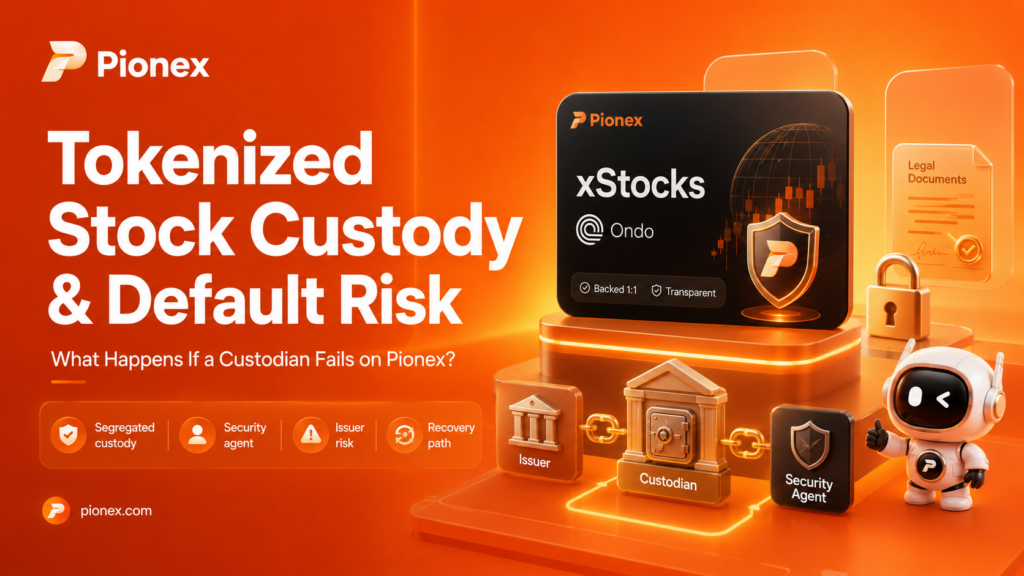
A tokenized stock on Pionex is not a claim against Pionex. It is a claim against a chain of entities you never interact with directly: an issuer, a custodian bank, and a security agent, most of whom you have probably never heard of. Understanding that chain matters more than the price chart, because it determines what actually happens to your position if something upstream breaks. This article walks through exactly who holds what, in what order, and what your realistic path to recovery looks like if a custodian or issuer runs into trouble.
For more context, read the Pionex xStocks guide for tokenized stock trading, custody, trading hours, and platform comparisons.
Pionex does not custody the underlying shares behind xStocks or Ondo Stocks. That job belongs to regulated banks and broker-dealers upstream of Pionex, appointed by the issuers, Backed Assets (JE) Limited for xStocks and Ondo Global Markets (BVI) Limited for Ondo Stocks. Both structures use bankruptcy-remote special purpose vehicles, segregated collateral accounts, and an independent security agent whose entire job is to step in and protect token holders if the issuer defaults. That is a real protection layer. It is not the same as owning the stock outright, and it does not eliminate custodian risk, it relocates it.
Contents
- 1 Who actually holds the shares
- 2 What “bankruptcy-remote” actually protects you from, and what it doesn’t
- 3 A structural detail worth knowing: Kraken now owns Backed Finance
- 4 Some independent sources have flagged a collateral question worth watching
- 5 Ondo’s collateralization buffer, explained
- 6 What Pionex says about this risk directly
- 7 If Pionex delists a tokenized stock, here is what actually happens
- 8 A practical due diligence checklist
- 9 FAQ
| xStocks | Ondo Stocks | |
| Issuer | Backed Assets (JE) Limited, a Jersey SPV | Ondo Global Markets (BVI) Limited, a BVI SPV |
| Underlying share custody | Alpaca Securities LLC (US), with InCore Bank AG and Maerki Baumann & Co. AG (Switzerland) | Alpaca Securities LLC (US) |
| Cash and stablecoin custody | Held within the same custodial structure | BitGo Bank & Trust, National Association |
| Independent security agent | A Swiss Security Agent under a three-party Account Control Agreement | Ankura Trust Company, holding a first-priority perfected security interest |
| Collateralization level | 1:1, segregated per product, no commingling | 1:1 plus buffer collateral, required to stay at or above 100.5% of outstanding token value |
| Verification | Proof of reserves published weekly on-chain, quarterly ISAE 3000 assurance audits | Daily attestations by Ankura Trust, publicly viewable |
| Supplemental coverage | Lloyd’s of London coverage up to $175M aggregate, disclosed by Kraken | Not publicly disclosed at the same level of detail |
Both structures land on the same basic design: real shares, sitting with a regulated custodian, ring-fenced inside a bankruptcy-remote SPV, with an independent third party whose entire job is watching the collateral rather than running the business.
What “bankruptcy-remote” actually protects you from, and what it doesn’t
A bankruptcy-remote SPV means that if the parent company behind the issuer, Backed Finance or Ondo Finance, gets into financial trouble, the SPV’s assets are legally separated and should not become available to the parent’s general creditors. That is a real structural protection, and it is the same design principle used across most institutional structured products.
It does not protect you from every failure mode. Three scenarios sit outside what bankruptcy-remoteness solves for:
Custodian failure. If Alpaca Securities, InCore Bank, Maerki Baumann, or BitGo itself became insolvent or faced regulatory seizure, the SPV structure does not automatically make that problem disappear, it just determines who has the legal standing to act on your behalf when it happens. This is why both structures deliberately use regulated, audited custodians rather than unregulated ones, and why xStocks explicitly discloses Lloyd’s of London supplemental coverage as an added layer.
Issuer default. This is the scenario the security agent exists for. For xStocks, the Security Agent can take control of the collateral accounts, liquidate the underlying assets, and distribute proceeds to token holders according to the prospectus terms. For Ondo Stocks, token holders can direct Ankura Trust to take possession of the collateral, convert it to cash, and distribute proceeds if the issuer cannot service redemptions or maintain full collateralization. Neither process is instant, and neither guarantees you receive full value if liquidation happens during a market dislocation.
Venue-level risk. Pionex, like Kraken, Bybit, or any other exchange distributing these tokens, sits between you and the issuer. If Pionex itself faced an operational or solvency issue, that is a separate risk layer from the custody chain described above, governed by Pionex’s own terms of service and reserve practices rather than the issuer’s prospectus.
A structural detail worth knowing: Kraken now owns Backed Finance
Kraken acquired Backed Finance, the company behind xStocks, in a deal completed in late 2025 and early 2026. Kraken has since named Alpaca Securities as its preferred partner for sourcing and custodying the equities behind xStocks.
This matters for a specific reason: it changes the independence picture. When xStocks launched, Backed Finance was a separate Swiss company distributing through Kraken as one venue among several, including Pionex, Bybit, and others. With Backed now owned by Kraken, the entity issuing the token and the largest venue distributing it sit under common ownership. That does not affect the legal separation between the SPV and the custodians, but it is a relevant fact for anyone assessing how independent the different layers of this structure actually are from one another.
Some independent sources have flagged a collateral question worth watching
Most official documentation from Backed Finance and Kraken describes xStocks collateral as consisting of the actual underlying shares, held 1:1. At least one independent analytics source has published a more cautious read, suggesting the collateral backing xStocks may not always consist strictly of the underlying shares themselves, which would mean holders carry some exposure to Backed’s own credit rather than a pure pass-through claim on the stock. This is not the consensus position and is not confirmed by the issuer’s own disclosures, but it is the kind of claim worth watching for updated attestation data rather than dismissing outright, given how central the 1:1 backing claim is to the entire product’s credibility.
Ondo’s collateralization buffer, explained
Ondo Global Markets is required to maintain collateral, cash, and additional collateral together worth at least 100.5% of the value of outstanding tokens at all times, verified through daily attestations from Ankura Trust. That half a percentage point of buffer exists specifically to absorb small valuation gaps before they become a shortfall, and the daily cadence of verification, rather than weekly or quarterly, is one of the more conservative disclosure practices among the platforms reviewed for the comparison guide on this blog.
What Pionex says about this risk directly
Pionex’s own risk disclosure for tokenized stocks lists reserve and operational anomalies explicitly as one of the causes of potential depegging: technical or risk-control incidents involving issuers, custodians, cross-chain bridges, or settlement channels. That is Pionex naming the same custody chain described above as a real, disclosed risk factor, not a hypothetical one.
If Pionex delists a tokenized stock, here is what actually happens
This is a different scenario from custodian or issuer default, but it is the one most likely to actually affect a Pionex user in practice, and Pionex has a documented delisting process for it. When Pionex delists a tokenized stock:
- The trading pair stops, and any open bot orders and manual orders on that pair are cancelled.
- If the position sits inside a rebalancing bot, the bot itself is not cancelled, only the position in the delisted asset is released from it.
- The position is sold at the best available price after delisting, and the resulting USDT is credited back to your account.
- Pionex explicitly recommends closing the bot in advance or selling manually if you are concerned about price movement during this process.
This is a Pionex-level decision, driven by factors like liquidity, trading volume, and the ongoing quality review Pionex runs on listed assets, not necessarily a sign that the underlying issuer has defaulted. But it is worth knowing that “best available price after delisting” is not the same as choosing your own exit price, so watching delisting announcements for tickers you hold is worth the five minutes it takes.
A practical due diligence checklist
| Question | Where to check |
| Is this ticker sourced from xStocks or Ondo Stocks? | Pionex’s tokenized stock listing pages typically note the source |
| What is the current proof-of-reserves or attestation status? | xStocks publishes weekly on-chain, Ondo publishes daily via Ankura Trust |
| Has Pionex issued any delisting notices for this ticker? | Pionex’s Token Delisting announcements collection |
| Am I holding this inside a multi-asset bot? | Check your bot’s holdings before a known volatile event or earnings date |
| Do I understand this is a claim on an issuer, not the company itself? | Neither xStocks nor Ondo Stocks confer voting rights, traditional stock dividends, or a legal claim on the underlying company; eligible Pionex holders may instead receive USDT holding rewards reflecting corporate equity adjustments |
FAQ
Does Pionex hold the actual stocks behind tokenized stock trading? No. Pionex distributes tokenized stock liquidity sourced from xStocks and Ondo Stocks. The underlying shares are held by regulated custodians appointed by those issuers, not by Pionex.
What happens to my tokens if the custodian bank fails? The bankruptcy-remote SPV structure and independent security agent, InCore Bank and Maerki Baumann alongside Alpaca for xStocks, Alpaca and BitGo for Ondo, are designed to let token holders recover value through liquidation of segregated collateral. This process is not instant and is not guaranteed to return full value during a market dislocation.
Is my tokenized stock position insured? xStocks discloses supplemental coverage from Lloyd’s of London up to $175M in aggregate. This is not the same as deposit insurance and has coverage limits. Ondo has not published equivalent public disclosure at the same level of detail.
What is the difference between issuer default and Pionex delisting a token? Issuer default is a failure upstream, at the custody or SPV level, addressed through the security agent process described in the issuer’s prospectus. Delisting is a Pionex decision to stop offering a trading pair, typically for liquidity or quality reasons, which results in your position being sold at the best available price and credited back in USDT.
Does Kraken owning Backed Finance change what backs my xStocks on Pionex? The collateral and custody structure described in Backed’s prospectus and legal documentation has not changed as a result of the acquisition. It is a relevant fact to know because it changes the independence relationship between the xStocks issuer and one of the exchanges distributing the token, which is worth factoring into how you weigh disclosures going forward.
This article is for informational purposes only and does not constitute financial or legal advice. Custody structures, collateralization requirements, and issuer disclosures are subject to change. Tokenized stocks provide price exposure to an underlying equity and do not confer direct ownership or shareholder rights. Always review the current prospectus, attestation reports, and risk disclosures published by the relevant issuer before trading.
