
Pionex Market Data | May 27, 2026
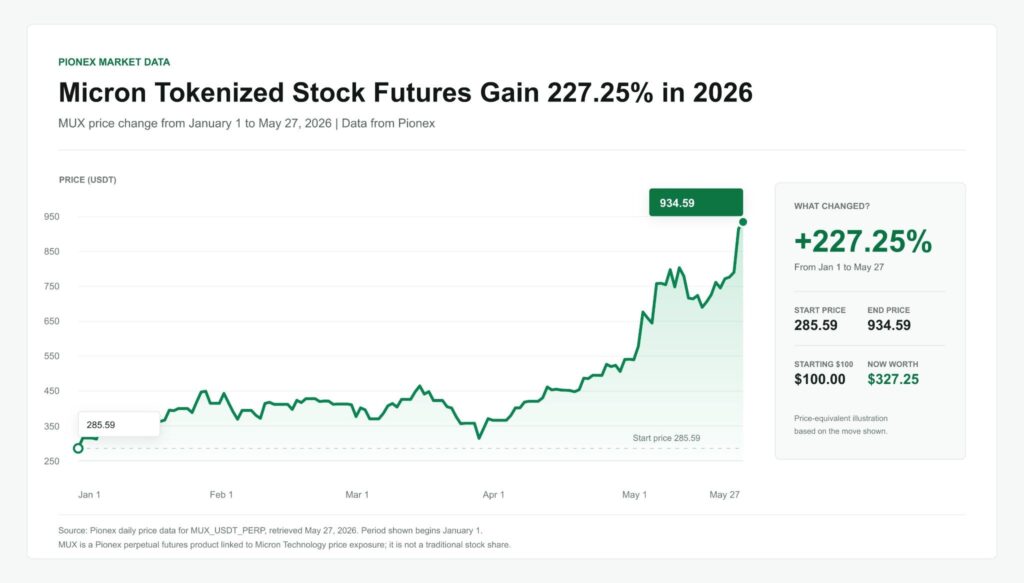
Micron Technology ($MU) is having one of the most talked-about runs in the market right now. President Trump praised it by name at a public rally. His own trade disclosures show he bought the stock six times earlier this year at an average of ~$407 : it’s now trading near $900. A mystery trader turned $60 million in call options into $1.3 billion in under two months. And on Pionex, MUX the platform’s tokenized Micron stock futures product is up 227.25% year-to-date.
If you’ve been watching the $MU story and wondering how to get automated, crypto-native exposure to it, here’s the complete breakdown.
Contents
- 1 Why Everyone Is Talking About Micron Right Now
- 2 What Is MUX on Pionex?
- 3 MUX Price Performance: Year-to-Date 2026
- 4 Which Bots Can You Use to Trade MUX on Pionex?
- 5 The AI Memory Thesis: Why Micron Keeps Coming Up
- 6 Has Micron Moved Like This Before? Historical Context
- 7 What Could Push MUX Lower? Risks to Watch
- 8 How to Monitor MUX on Pionex
- 9 Frequently Asked Questions
Why Everyone Is Talking About Micron Right Now
Trump named Micron at a public rally
At a rally in Suffern, NY on May 23, 2026, President Donald Trump made an unprompted remark about Micron: “Big company Micron, boy, Micron is great.” The clip went viral, accumulating over 1 million views on a single post. Presidential endorsements even casual ones drive immediate retail search and trading interest.
Trump’s own trade disclosures show six $MU purchases
A report flagged a detail that made the story significantly more complex: Trump’s disclosed trades show he purchased $MU six times earlier this year on 3/2, 3/11, 3/12, 3/17, 3/23, and 3/25. His average buy price was approximately $407. $MU is now trading near $900. A sitting president publicly praising a stock in which he holds a disclosed, profitable position has generated sustained attention across finance media and retail trading communities.
Someone turned $60 million into $1.3 billion
On March 31, 2026, an anonymous trader spent approximately $60 million on $MU call options at a $400 strike price with a 6/18 expiration date. At the time, $MU was trading at $337 — the bet looked aggressive. By late May, $MU hit a new all-time high of $916. Those $22 calls are now worth $500 each. The position grew from $60 million to approximately $1.3 billion in less than two months.
The AI memory thesis
Micron is the world’s third-largest producer of DRAM and NAND memory chips. As AI infrastructure buildout accelerates — data centers, edge devices, autonomous systems : demand for high-bandwidth memory is compounding. Micron’s HBM (High Bandwidth Memory) chips are used directly in NVIDIA’s AI accelerators. The AI memory trade, which also drove the historic growth of the Roundhill Memory ETF ($DRAM), has Micron at its center.
What Is MUX on Pionex?
MUX is a Pionex tokenized stock futures product that tracks Micron Technology ($MU) price exposure. It is not a traditional Micron share.
The product is available as a perpetual futures contract (MUX_USDT_PERP) denominated in USDT. It allows crypto traders to gain exposure to Micron’s price movements 24/7, with USDT settlement and bot automation support.
MUX is available in two forms on Pionex:
- MUX/USDT Spot — direct tokenized exposure, no leverage
- MUX/USDT Perpetual Futures (MUX_USDT_PERP) — leveraged automated futures trading
MUX Price Performance: Year-to-Date 2026
Pionex has MUX data available from before January 1, making this an accurate 2026 year-to-date performance chart:
| Metric | Value |
| Start price (January 1, 2026) | 285.59 USDT |
| Current price (May 27, 2026) | 934.59 USDT |
| 24-hour change | +20.32% (776.90 → 934.77 USDT) |
| YTD total change | +227.25% |
| $100 invested January 1 | $327.25 today |
The 24-hour move alone — +20.32% — reflects the velocity of the current $MU narrative. The YTD figure of +227.25% is one of the strongest performances among tokenized stock products on Pionex in 2026.
Source: Pionex MCP data for MUX_USDT_PERP, retrieved May 27, 2026.
Which Bots Can You Use to Trade MUX on Pionex?

1. Spot Grid Bot (MUX/USDT Spot)
What it does: Automatically buys lower and sells higher within a price range you define. Captures the spread repeatedly as price oscillates within the band — without manual input.
Best for: Traders who want MUX exposure without leverage, who expect short-term price swings within a defined range and want to automate the trading.
Minimum investment: Calculated by Pionex in the interface based on your chosen price range and number of grids. Configure your range to see the required amount.
2. DCA Bot (MUX/USDT Spot)
What it does: Executes gradual, scheduled purchases of MUX to average your cost basis over time rather than entering in a single transaction.
Best for: Traders who believe in the long-term AI memory thesis behind Micron and want consistent automated accumulation of MUX exposure without timing the market.
Minimum investment: Set in the bot interface based on your configuration. No fixed MUX-specific minimum published by Pionex.
3. Futures Grid Bot (MUX/USDT Perpetual Futures)
What it does: Automates grid trading on MUX perpetual futures in Long, Short, or Neutral mode. Places buy and sell orders within a selected price range automatically, executing on movement in either direction.
Best for: Experienced traders who want automated leveraged exposure to MUX futures and understand perpetual contracts, funding rates, and liquidation mechanics.
Minimum investment: 10 USDT
⚠️ Futures trading involves leverage. Losses can exceed your initial investment. Only use the Futures Grid Bot if you fully understand perpetual futures and liquidation risk.
Quick Reference: MUX Bot Options
| Pionex Product | Bot | Starting Amount |
| MUX/USDT Spot | Spot Grid Bot | Based on range + grid count |
| MUX/USDT Spot | DCA Bot | Set in bot interface |
| MUX/USDT Perpetual Futures | Futures Grid Bot | 10 USDT |
The AI Memory Thesis: Why Micron Keeps Coming Up
The $MU story isn’t just about political trade disclosures or mystery options traders. There’s a structural reason this stock keeps appearing in AI infrastructure conversations.
Every major AI training run and inference deployment requires massive amounts of high-bandwidth memory. Micron’s HBM3E chips ship inside NVIDIA’s H100 and H200 AI accelerators ; the same chips driving the data center buildout. As AI compute demand scales, Micron’s addressable market scales with it.
The Roundhill Memory ETF ($DRAM) which became the fastest-growing ETF in history, surpassing BlackRock’s Bitcoin ETF is built around exactly this thesis. Micron is one of its core holdings. For crypto traders on Pionex, MUX offers a 24/7 automated way to participate in the same trade.
Has Micron Moved Like This Before? Historical Context
The current $MU run is exceptional in speed but not without precedent in pattern.
In the 2023 memory cycle, Micron stock recovered from a trough of ~$48 to over $150 within 18 months as DRAM oversupply corrected and AI-related demand projections began pricing in. That move roughly 3x from trough to peak set the template for how institutional capital enters the memory trade: slowly through the bottoming phase, then rapidly once a macro catalyst confirms the cycle has turned.
The current cycle has a more compressed timeline, driven by the HBM supercycle. HBM (High Bandwidth Memory) is a premium DRAM variant used exclusively in AI accelerators. Micron is one of only three companies in the world capable of producing it — alongside Samsung and SK Hynix. Supply is constrained by design. The $DRAM ETF reaching $10 billion in AUM faster than any ETF in history reflects how decisively institutional capital has moved into this thesis in 2026.
For MUX traders on Pionex: the historical pattern suggests that memory cycles, once in momentum, tend to overshoot before correcting. The 2023 cycle peaked when DRAM spot prices plateaued and AI capex commentary from hyperscalers softened. Watching for the same signals — Micron earnings guidance, NVIDIA data center revenue commentary, HBM allocation announcements gives traders context for when the current MUX move may be approaching exhaustion.
What Could Push MUX Lower? Risks to Watch
A +227% YTD move demands a clear-eyed look at what reverses it. Three conditions could push MUX significantly lower from current levels:
1. AI capex slowdown from hyperscalers Micron’s HBM demand is almost entirely dependent on continued spending by Microsoft, Google, Amazon, and Meta on AI infrastructure. If any major hyperscaler signals a pause, delay, or reduction in GPU cluster buildout — through earnings guidance or public commentary — HBM demand projections reprice immediately. $MU dropped 15–20% intraday on a single cautious Microsoft capex comment in late 2024. MUX would mirror that move.
2. Samsung or SK Hynix HBM yield improvement Micron’s premium pricing depends on supply being tight across all three HBM producers. If Samsung — which has historically struggled with HBM3E yields — resolves its production issues and comes to market at scale, the supply-demand balance shifts. More HBM supply means lower prices, lower margins, and lower $MU valuation. This is the risk that most institutional holders of Micron track most closely.
3. Political catalyst reversal The Trump trade disclosure and rally mention added fuel to a move already driven by fundamentals. Political catalysts are asymmetric: they can accelerate a move but they cannot sustain one if the underlying thesis weakens. If Trump’s disclosed $MU positions become a political liability through STOCK Act scrutiny or congressional attention the narrative turns negative quickly, even if Micron’s business hasn’t changed.
For MUX traders specifically: futures trading means liquidation risk at leverage. Even a 20–30% pullback in $MU entirely normal in a high-momentum stock can liquidate a leveraged MUX position if the range isn’t set wide enough.
How to Monitor MUX on Pionex
On Pionex directly:
- Navigate to the Markets tab and search MUXUSDT or MUX_USDT_PERP to see live price, volume, and funding rate
- Set a price alert from the asset page to get notified at key levels
- The funding rate on MUX_USDT_PERP updates every 8 hours — positive funding means longs are paying shorts, signalling strong demand; negative funding signals the opposite
For $MU underlying price:
- Micron reports quarterly earnings — next report dates are published on investor.micron.com. Earnings are the single biggest volatility event for MUX
- NVIDIA earnings are a secondary signal: if NVIDIA raises AI accelerator guidance, HBM demand expectations rise with it, and $MU typically rallies within 24 hours
- HBM allocation announcements from Micron’s investor relations page are the highest-signal fundamental update to watch
For the broader narrative:
- The Roundhill Memory ETF ($DRAM) daily price and inflow data tracks the institutional memory thesis in real time
- Congressional trade disclosures for $MU are searchable at efts.sec.gov — any new filings from Trump or related political figures will surface there first
Frequently Asked Questions
What is MUX on Pionex? MUX is a Pionex tokenized stock futures product that tracks the price of Micron Technology ($MU). It is denominated in USDT and is not a traditional Micron share. It is available as both a spot pair (MUX/USDT) and a perpetual futures contract (MUX_USDT_PERP).
Can I use a trading bot with MUX on Pionex? Yes. Pionex supports three bots for MUX: the Spot Grid Bot and DCA Bot for spot trading (MUX/USDT), and the Futures Grid Bot for perpetual futures (MUX_USDT_PERP). The Futures Grid Bot starts from 10 USDT.
What is the minimum amount to trade MUX futures on Pionex? The Futures Grid Bot for MUX perpetual futures starts at 10 USDT. For spot trading, the Spot Grid Bot minimum is calculated by Pionex based on your selected price range and number of grids.
How has MUX performed on Pionex in 2026? From January 1 to May 27, 2026, MUX gained 227.25% on Pionex — rising from 285.59 USDT to 934.59 USDT. A $100 investment on January 1 would be worth $327.25 today. In the latest 24-hour period, MUX gained an additional 20.32%.
Which Pionex bot suits MUX given the current strong uptrend? Given MUX’s near-unidirectional move of +227% YTD, a neutral grid bot would have underperformed significantly — it is designed to profit from oscillation, not sustained directional moves. For the current market condition, the DCA Bot suits traders who want to build exposure gradually without timing the top. For experienced futures traders, a long-biased Futures Grid Bot — with the upper range set wide to accommodate continued upside — captures directional momentum while automating entries. A neutral Futures Grid Bot is not recommended while the trend remains this strong.
Why is Micron ($MU) in the news right now? Three events converged in May 2026: President Trump praised Micron by name at a public rally; his trade disclosures revealed he had purchased $MU six times between March 2 and March 25 at an average of ~$407 (now near $900); and an anonymous trader’s $60 million call option position grew to approximately $1.3 billion in under two months after $MU hit a new all-time high of $916.
Is MUX the same as buying Micron stock? No. MUX is a Pionex tokenized product that tracks Micron price exposure. It is a crypto derivative settled in USDT, not an equity instrument. It does not represent ownership in Micron Technology and is subject to crypto market conditions in addition to the underlying stock’s price movements.
What are the main risks of trading MUX on Pionex? Three conditions could push MUX lower: a hyperscaler AI capex slowdown (which directly reduces HBM demand), improved HBM supply from Samsung or SK Hynix breaking the current supply constraint, or a reversal of the political narrative around Trump’s disclosed $MU positions. For futures traders, leverage amplifies all of these risks — a 20–30% pullback in $MU, which is normal in high-momentum stocks, can liquidate a leveraged MUX position if the price range is not set wide enough.
Disclaimer: This article is for informational purposes only and does not constitute financial or investment advice. Crypto and tokenized product trading carries significant risk including total loss of capital. Past performance is not indicative of future results. Always conduct your own research before trading.
Data source: Pionex MCP data for MUX_USDT_PERP, retrieved May 27, 2026.
