
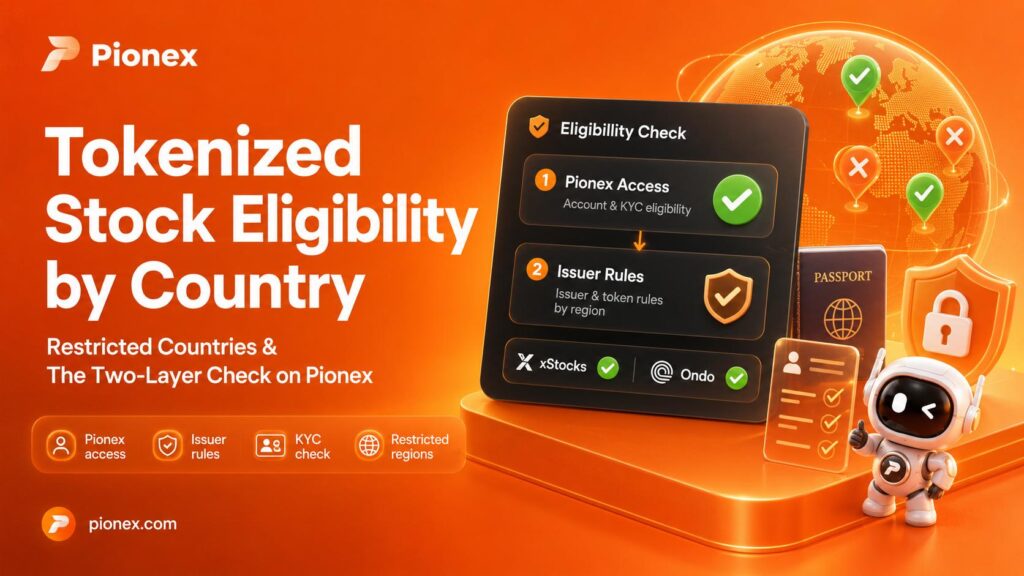
“Is Pionex available in my country” and “can I actually trade TSLAX from my country” are two different questions with two different answers.
Tokenized stock eligibility runs through two separate restriction layers stacked on top of each other: whether Pionex itself will serve you, and whether the issuer behind the specific token you want, xStocks or Ondo Stocks, will serve you. Passing one does not automatically mean you pass the other. This guide walks through both layers so you can check your own eligibility properly instead of guessing.
For more context, read the Pionex xStocks guide for tokenized stock trading, custody, trading hours, and platform comparisons.
Contents
- 1 The two layers, explained
- 2 Layer one: Pionex’s Restricted Jurisdictions
- 3 Layer two: what the issuers themselves restrict
- 4 Why this actually matters: a worked example
- 5 If your country becomes restricted after you already hold a position
- 6 KYC and phone verification: a narrower, separate list
- 7 A note on VPNs
- 8 Eligibility checklist
- 9 FAQ
The two layers, explained
Layer one: Pionex’s own Restricted Jurisdictions. This is set out in Pionex’s Terms of Service and applies to the platform as a whole, not just tokenized stocks. If your country is on this list, you cannot open a Pionex account or use any Pionex service, tokenized stocks included.
Layer two: issuer-level restrictions. xStocks and Ondo Stocks are separate products issued by separate companies, each with their own jurisdictional restrictions written into their own prospectus or offering terms. These restrictions exist independently of Pionex’s own rules, and they are not always identical to Pionex’s list.
You need to clear both layers to trade a given tokenized stock. Clearing Pionex’s account-level check does not automatically mean every tokenized stock ticker is available to you, and the two lists diverge in specific, easy-to-miss ways.
Layer one: Pionex’s Restricted Jurisdictions
Per Pionex’s Terms of Service, to use any Pionex service you must not be a national or resident of, or under the control of, any of the following:
| Category | Jurisdictions |
| Major restricted markets | Mainland China, Hong Kong, United States, Singapore, United Kingdom, Canada, Netherlands, Spain, France |
| Sanctioned jurisdictions | Afghanistan, Cuba, Iran, North Korea, Syria |
Pionex also restricts anyone appearing on applicable economic sanctions lists, regardless of country of residence. This list applies platform-wide. It is not specific to tokenized stocks, and it is the same list that governs whether you can open a Pionex account at all.
Layer two: what the issuers themselves restrict
This is the layer most eligibility guides skip, and it is the one that actually determines whether a specific ticker works for you even after you have a Pionex account.
| Issuer | Stated restrictions |
| xStocks (Backed Assets, JE Limited) | Not accessible to US persons, and per its primary distribution partner, also excluded in Canada, the United Kingdom, and Australia |
| Ondo Stocks (Ondo Global Markets, BVI Limited) | Distributed under Regulation S, which excludes US persons from participating regardless of where they are physically located |
Notice what is missing from both issuer lists compared to Pionex’s own list: neither xStocks nor Ondo Stocks specifically names Mainland China, Hong Kong, Singapore, the Netherlands, Spain, or France as restricted in their own public disclosures. Those restrictions come from Pionex’s own compliance posture, not from the token issuers. Conversely, Australia appears on xStocks’ restriction list through its primary distributor but is not one of Pionex’s own Restricted Jurisdictions, which matters if Pionex sources a specific ticker’s liquidity from xStocks specifically.
Why this actually matters: a worked example
Say a trader is based in a country that is not on Pionex’s Restricted Jurisdictions list and not explicitly named in either issuer’s public restrictions. On paper, they clear both layers and can open a Pionex account and trade tokenized stocks normally.
Now say a second trader is a US citizen living outside the United States. Pionex’s Restricted Jurisdictions list is based on nationality and residency, not just physical location, so US nationals are excluded from Pionex regardless of where they currently live. Even if that were not the case, both xStocks and Ondo Stocks independently exclude US persons at the issuer level, which means a US national would fail layer two even in a scenario where layer one somehow did not apply.
The lesson: your nationality, your residency, and your physical location can each trigger a different restriction, and it takes only one to block access.
If your country becomes restricted after you already hold a position
Jurisdictional rules change, and Pionex has a defined process for when a region becomes newly restricted. Affected users are notified by email. After that notice, you can still close existing orders, sell your tokens manually, and withdraw your funds as normal. What you lose is the ability to open new orders. This applies to tokenized stock positions the same way it applies to any other asset on the platform.
If you are notified that your region has become restricted, the priority is managing existing positions deliberately, closing out or transferring what you need to, rather than assuming access will be restored.
KYC and phone verification: a narrower, separate list
Pionex maintains a separate, shorter list of countries where phone number services and KYC verification are not supported, largely overlapping with internationally sanctioned states. This is a narrower list than the Restricted Jurisdictions list and applies specifically to the identity verification step rather than platform access as a whole. If you are unable to complete phone verification during signup, checking whether your country falls on this narrower list is the first thing to rule out.
A note on VPNs
Some traders in restricted jurisdictions consider using a VPN to access Pionex or any other blocked platform. This carries real risk beyond the obvious terms-of-service violation: it can create compliance and legal exposure depending on your local regulations around financial platform access, and it does not change the underlying eligibility determination, since Pionex and the token issuers both determine eligibility using more than just IP address. The straightforward approach, if Pionex is not available in your jurisdiction, is to use a platform that is legally available where you live.
Eligibility checklist
| Check | Where to verify |
| Is your country of nationality or residency on Pionex’s Restricted Jurisdictions list? | Pionex Terms of Service |
| Are you a US national or resident, regardless of current location? | Excludes you from Pionex platform-wide, and from both xStocks and Ondo Stocks independently |
| Does the specific ticker you want source liquidity from xStocks, Ondo Stocks, or both? | Check the individual tokenized stock’s listing details |
| Is your country on the narrower KYC/phone verification unsupported list? | Affects onboarding specifically, separate from trading eligibility |
| Are you on any applicable economic sanctions list? | Restricts you regardless of country of residence |
FAQ
If Pionex is available in my country, can I trade every tokenized stock? Not automatically. Pionex’s own Restricted Jurisdictions list governs platform access. The tokenized stock issuers, xStocks and Ondo Stocks, have their own separate restrictions, and clearing Pionex’s check does not clear theirs.
Is a US citizen living outside the United States eligible? No. Pionex’s Restricted Jurisdictions are based on nationality and residency, not just physical location, and both major tokenized stock issuers separately exclude US persons regardless of where they are physically located.
What happens to my open tokenized stock position if my country becomes restricted? You will be notified by email. You retain the ability to close existing orders, sell manually, and withdraw funds, but you will not be able to open new orders.
Is the United Kingdom restricted on Pionex? Yes, the UK appears on Pionex’s own Restricted Jurisdictions list under its current Terms of Service.
Should I use a VPN if my country is restricted? This is not something we would recommend. It does not resolve the underlying eligibility determination and can create additional compliance risk. If Pionex is unavailable in your jurisdiction, using a platform that is legally accessible in your country is the safer path.
This article is for informational purposes only and does not constitute legal advice. Restricted jurisdictions and eligibility requirements are set by Pionex’s Terms of Service and by third-party issuers independently, and are subject to change without notice. Always confirm current eligibility directly against Pionex’s Terms of Service and the relevant issuer’s own disclosures before trading.
