
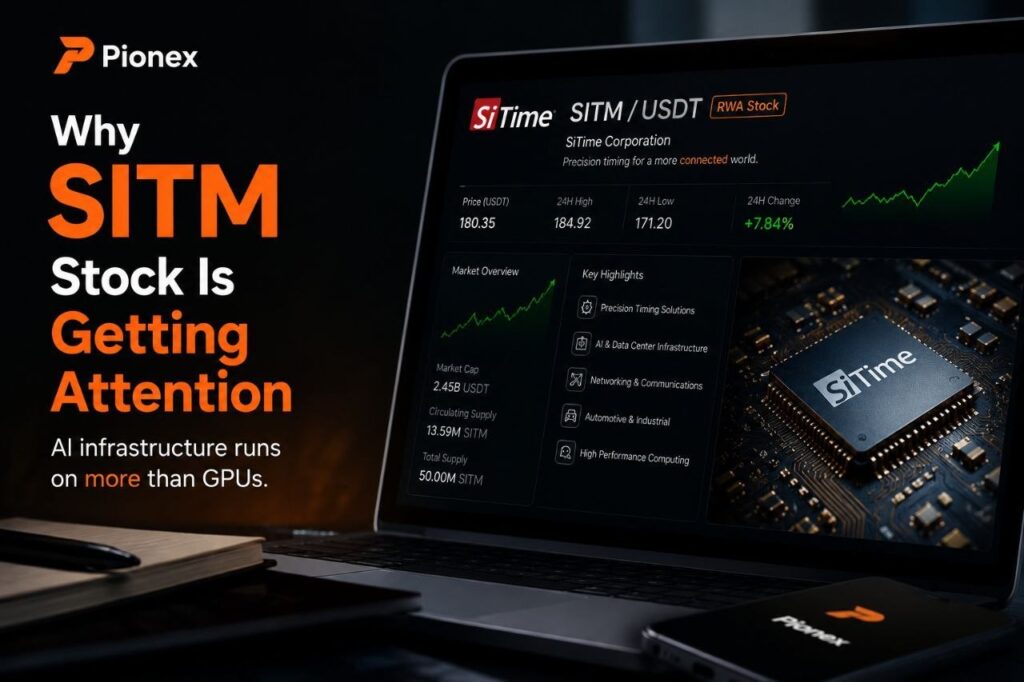
For most investors, the AI trade begins and ends with Nvidia.
But behind every AI model, data center, and high-performance computing system is an entire hardware ecosystem working quietly in the background. GPUs may receive the most attention, but they are only one part of the infrastructure powering modern AI systems.
As AI data centers become larger and more complex, investors are starting to pay attention to the smaller semiconductor companies supplying the components that help those systems stay synchronized, stable, and efficient.
One of the companies benefiting from that shift is SiTime.
SiTime trades under the ticker SITM and specializes in precision timing technology used across data centers, networking infrastructure, telecommunications systems, industrial hardware, and advanced computing environments.
SITM is being prepared for addition to Pionex and is expected to be available shortly. Once live, users may be able to trade SITM-linked exposure with USDT through supported tokenized stock markets.
Contents
- 1 What does SiTime actually do?
- 2 Why the market suddenly cares about timing chips
- 3 Why traders are watching SITM stock
- 4 How SITM differs from Nvidia and other AI chip companies
- 5 Why modern AI data centers require precision synchronization
- 6 What to check before trading SITM with USDT
- 7 Risks to understand before trading SITM
- 8 Frequently asked questions
- 9 In Conclusion,
What does SiTime actually do?
SiTime builds precision timing chips.
That may sound like a small niche inside the semiconductor market, but timing systems are critical to how modern electronic infrastructure operates.
Inside a data center, thousands of components communicate continuously at extremely high speeds. Servers exchange information constantly. Networking systems route enormous volumes of data every second. AI clusters process massive workloads across multiple GPUs simultaneously.
All of those systems rely on accurate synchronization.
Timing chips help electronic systems stay coordinated so that data moves correctly between components. Without precise timing, computing systems become less stable, less efficient, and more prone to errors.
This becomes even more important as AI infrastructure scales.
Training and running large AI models requires enormous coordination across servers, networking hardware, storage systems, and computing clusters. Even tiny timing inconsistencies can affect performance in environments handling huge volumes of real-time data.
That is part of the reason companies like SiTime have started attracting more investor attention.
Why the market suddenly cares about timing chips
The AI infrastructure story has expanded far beyond GPUs.
At first, most of the market focused almost entirely on companies building AI processors. Then attention moved toward servers, cloud infrastructure, memory systems, networking equipment, and data-center construction.
Now investors are gradually moving deeper into the infrastructure stack.
As AI spending accelerates, more people are beginning to realize that modern computing systems depend on a huge network of supporting hardware operating behind the scenes. Timing systems are part of that broader ecosystem.
This does not mean SiTime suddenly becomes an “AI company” in the same way Nvidia is viewed as an AI company.
Instead, SiTime operates inside the infrastructure layer supporting the expansion of AI systems.
That distinction matters because many of the companies benefiting from AI growth over the next few years may not be the most obvious names.
Why traders are watching SITM stock
SITM has started attracting attention because it gives traders exposure to a different side of the AI infrastructure trade.
The company sits inside several growing trends at once, including data-center expansion, networking infrastructure, semiconductor demand, industrial electronics, and advanced communications systems.
Unlike many large semiconductor companies, SiTime operates in a specialized niche that most retail investors rarely discuss. But specialized infrastructure suppliers often become more important as technology systems grow more complex.
This is one reason smaller semiconductor companies sometimes rally during major infrastructure cycles.
When a new technology wave begins, investors initially focus on the largest and most visible companies. Over time, attention spreads outward toward secondary suppliers helping support the broader ecosystem.
That process is now happening across parts of the AI hardware market.
How SITM differs from Nvidia and other AI chip companies
Nvidia builds GPUs used directly to train and run AI models.
SiTime focuses on timing systems that help electronic infrastructure remain synchronized and coordinated.
That means the company participates in a completely different layer of the semiconductor industry.
Its products are not the “brains” of AI systems. They are part of the supporting infrastructure helping modern computing environments operate reliably at scale.
This is why SiTime is better understood as an indirect AI infrastructure play rather than a direct AI software or AI-chip company.
The difference may sound subtle, but it matters.
As AI systems become larger, the infrastructure surrounding those systems also becomes more valuable. Computing performance no longer depends only on processors themselves. It also depends on networking efficiency, synchronization, data transfer reliability, and system coordination.
That broader infrastructure story is where SiTime fits into the conversation.
Why modern AI data centers require precision synchronization
AI systems process enormous amounts of data simultaneously across thousands of servers, GPUs, networking switches, and storage systems.
Those environments operate at extraordinary speed and scale. Small synchronization problems inside those systems can create inefficiencies that become much larger over time.
Precision timing technology helps coordinate how information moves across computing infrastructure.
In practical terms, timing systems help data-center hardware stay aligned so workloads can move efficiently between different parts of the system.
As AI clusters continue scaling upward, synchronization becomes increasingly important.
That does not mean timing chips suddenly become the biggest part of the AI market. But it does explain why investors are paying more attention to semiconductor infrastructure companies operating outside the mainstream spotlight.
What to check before trading SITM with USDT
SITM is being prepared for addition to Pionex and is expected to be available shortly. Once the market opens, users will be able to search SITM on Pionex and trade supported SITM-linked exposure with USDT.
Before placing a trade, users should review the market details carefully inside Pionex, including liquidity, spread, fees, trading hours, regional availability, and product terms linked to the market.
It is also important to understand that semiconductor stocks can be volatile, especially when market sentiment shifts around AI growth, infrastructure spending, or technology-sector momentum.
Risks to understand before trading SITM
SiTime operates in the semiconductor industry, which can experience large swings during periods of changing investor sentiment.
The company may benefit from long-term AI infrastructure growth, but it still faces risks tied to competition, supply chains, customer demand, technology cycles, and broader market conditions.
Smaller semiconductor companies can also experience sharper volatility than larger technology firms because expectations can change quickly during periods of strong momentum.
Like many infrastructure-related technology stocks, SITM may react strongly to earnings reports, macroeconomic conditions, and shifts in sentiment surrounding AI spending.
Frequently asked questions
What is SiTime?
SiTime is a semiconductor company focused on precision timing technology used across data centers, networking systems, industrial electronics, and communications infrastructure.
What is the ticker for SiTime?
SiTime trades under the ticker SITM.
Why is SITM stock getting attention?
SITM is getting attention because investors are increasingly exploring the broader semiconductor infrastructure supporting AI systems and data centers.
Is SiTime an AI company?
No. SiTime is not an AI software company or GPU manufacturer. It is a semiconductor infrastructure company focused on timing systems.
Why are timing chips important?
Timing chips help electronic systems remain synchronized. They are important across servers, networking infrastructure, telecommunications systems, and advanced computing environments.
Can I trade SITM with USDT?
SITM is being prepared for addition to Pionex and is expected to be available shortly. Once available, users may be able to trade SITM-linked exposure with USDT through supported tokenized stock markets.
In Conclusion,
The AI infrastructure trade is becoming much broader than GPUs alone.
As data centers expand and computing systems become more complex, investors are beginning to pay more attention to the semiconductor companies supporting the infrastructure behind those systems.
SiTime operates in one of those specialized areas through its focus on precision timing technology used across advanced computing environments.
While the company may not receive the same attention as the largest AI chip names, it sits inside a part of the infrastructure stack that becomes increasingly important as AI systems continue scaling globally.
SITM is being prepared for addition to Pionex and is expected to be available shortly. Once live, users may be able to trade SITM-linked exposure with USDT through supported tokenized stock markets.
Start Trading Your Favorite Stocks on Pionex
