
Contents
- 1 Find a bot that fits your plan in 2 minutes
- 2 “Free” can mean four different things
- 3 Free AI trading bot options compared
- 4 Pionex: built-in bots without a separate subscription
- 5 OctoBot: an open-source option with AI connectors
- 6 Freqtrade and FreqAI: free machine learning for technical traders
- 7 Hummingbot Condor: open-source AI agents for advanced deployments
- 8 Some “free” accounts do not include free live bots
- 9 A free bot can still cost money
- 10 Is it really an AI trading bot?
- 11 How to choose a free option
- 12 Security checks before connecting a free bot
- 13 Frequently asked questions
Find a bot that fits your plan in 2 minutes
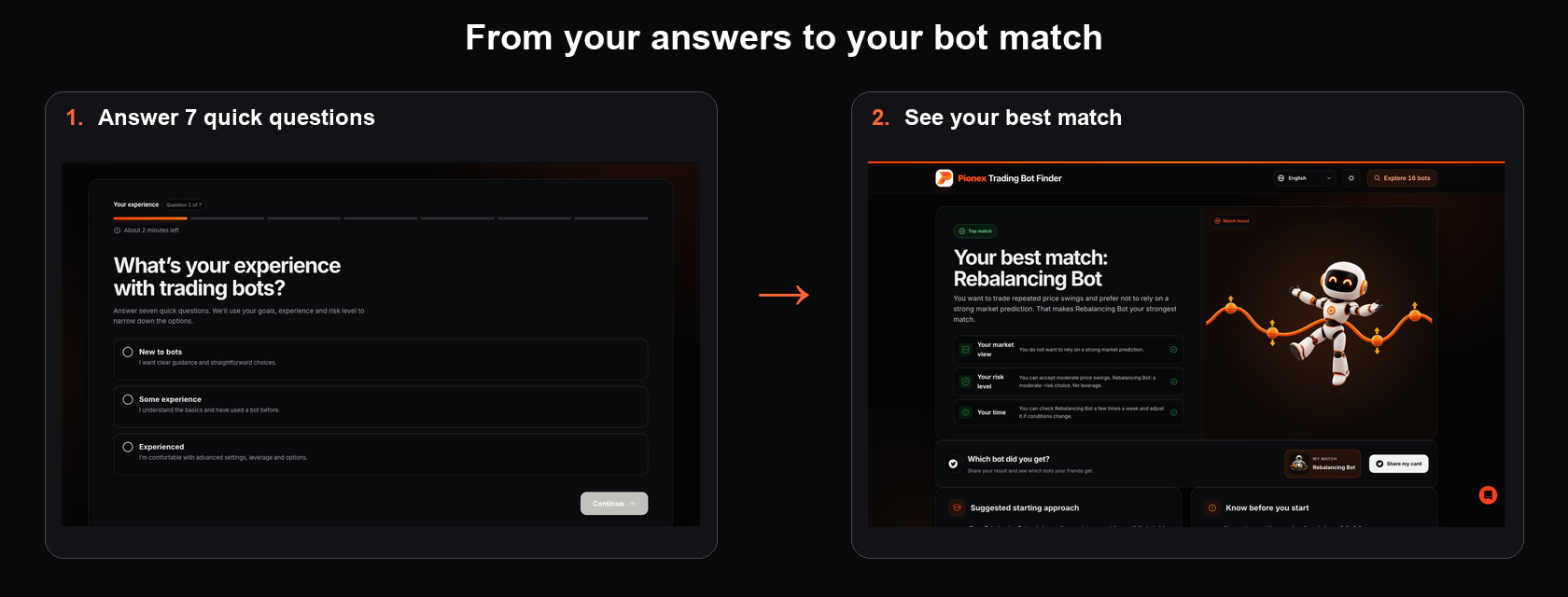
The Pionex Trading Bot Finder helps you find the right bot in 2 minutes. Answer seven questions about your experience, goal, market view, risk tolerance and available time. You will receive a bot match, an explanation and other options to compare.
The result is educational. It does not predict the market, guarantee a profit or replace your own risk assessment.
Yes, you can use an AI-assisted trading bot without paying a monthly subscription. The catch is that “free” rarely means you can trade without any cost, setup work or risk.
Some platforms provide bots inside an exchange without a separate bot fee. Others give you free open-source software that you must install and secure yourself. Some advertise a free account but do not allow live automated trading until you pay. AI can also mean anything from suggested parameters to machine-learning forecasts or an LLM agent that helps build a strategy.
This guide compares those models so you can see what is genuinely free, what still costs money and which option matches your technical experience.
“Free” can mean four different things
Before comparing platforms, identify which version of free you actually need.
| Free-access model | What you receive | What you may still pay for |
|---|---|---|
| Built-in exchange bot | Automated trading without a separate bot subscription | Trading fees, spreads, funding and withdrawal fees |
| Open-source bot | Free software you install and control | Hosting, AI model usage, exchange fees and your setup time |
| Restricted free tier | Limited tools, analysis or portfolio tracking | A subscription before live automation becomes available |
| Free trial | Temporary access to paid bot features | The full subscription when the trial ends |
A platform can therefore advertise a free account without providing a free live trading bot. It can also provide free bot software while leaving you responsible for servers, API keys and external AI costs.
Free AI trading bot options compared
| Option | What is free? | Where AI appears | Main catch | Experience level |
|---|---|---|---|---|
| Pionex | Built-in trading bots without a separate activation or subscription fee | AI-assisted research, strategy guidance and parameter planning | Trading fees and product-specific costs still apply | Beginner to experienced |
| OctoBot | Open-source software that can run on your computer | AI model connectors, strategy automation and analysis | Installation, exchange connection and possible AI-model costs | Intermediate |
| Freqtrade with FreqAI | Open-source bot and machine-learning framework | Predictive models, feature engineering and retraining | Requires Python, testing, hosting and model oversight | Advanced |
| Hummingbot with Condor | Open-source trading framework and AI-agent harness | LLM agents connected to deterministic execution | Technical deployment, LLM costs and security work | Advanced |
| 3Commas Free | Free account and limited AI Assistant credits | Analysis and assistance | Live automated trading is unavailable on the free plan | Evaluation only |
| Cryptohopper | No permanent free automation tier as of September 2026 | Paid strategy and automation tools | The former free Pioneer plan was retired | Paid option |
Pionex: built-in bots without a separate subscription
Pionex currently presents 16 built-in trading bots, including Grid, DCA and Rebalancing Bot options. The bots are integrated into the exchange, so you do not need to install software or connect Pionex to a third-party service through an external API key. Pionex’s current product page describes the available built-in automation.
Pionex does not charge a separate subscription or activation fee for its built-in bots. Orders placed by a bot still incur the applicable trading fee. Futures funding, spreads and other product-specific costs may also apply. The detailed Pionex bot fee guide explains those differences.
Pionex.AI can help you research strategies, compare bot behaviour and review parameters before launch. Core access includes Pi and Support, while Coder and Quant are premium PRO tools. AI guidance should still be checked against the live market, current settings and your own risk limits. See the Pionex.AI agents and pricing guide for the current distinction.
OctoBot: an open-source option with AI connectors
OctoBot is a free, open-source crypto trading bot with a visual interface. Its official repository describes support for Grid, DCA, TradingView and AI-connected strategies across multiple exchanges.
You can run it on your own computer, server or Raspberry Pi. Its AI connectors can use OpenAI, Ollama or another supported model. That flexibility also creates additional responsibilities: you must install and update the software, secure exchange credentials and understand whether the AI model or hosting provider charges separately.
OctoBot can suit you when you want more control than an exchange-built bot but do not want to build an entire interface yourself. Its own documentation recommends starting in simulation mode and understanding the strategy before risking money. Review the official OctoBot repository.
Freqtrade and FreqAI: free machine learning for technical traders
Freqtrade is an open-source crypto trading framework. FreqAI adds machine-learning tools for feature engineering, predictive models and automatic retraining.
This is closer to genuine machine-learning experimentation than a bot that simply copies AI-suggested settings. It is also substantially more technical. You are responsible for data quality, model selection, backtesting, deployment and monitoring.
The software is free, but the complete workflow may not be. A live setup can require server resources, exchange trading fees and considerable development time. FreqAI’s documentation also warns that live machine-learning deployment and data handling can be logistically difficult and expensive. Read the official FreqAI documentation.
FreqAI is most relevant when you can review Python code and understand why a model is producing a signal. It is not a one-click source of reliable market predictions.
Hummingbot Condor: open-source AI agents for advanced deployments
Hummingbot is an open-source Python framework for automated crypto strategies. Condor is its newer harness for deploying AI trading agents.
Condor connects LLM-based decision-making to deterministic trade execution. This means an AI agent can observe and reason about a market while a separate execution layer follows defined trading routines. The software is free and open source, according to the official Condor documentation.
Running the framework can still involve server costs, model-provider charges, exchange fees and security work. It is designed for traders or developers who are comfortable managing infrastructure, accounts and execution logic.
The separation between AI reasoning and deterministic execution is useful, but it does not eliminate bad signals, software defects or market risk.
Some “free” accounts do not include free live bots
3Commas currently allows you to create a free account and use limited AI Assistant credits. However, its official help centre states that real trading, Signal Bots and futures trading are unavailable on the free plan. Live bot trading requires a paid plan or temporary trial. Check the current 3Commas plan details.
Cryptohopper previously offered a free Pioneer tier. The company discontinued that tier on June 18, 2026, and moved its features into the paid Explorer plan. Existing free bots could no longer remain active without upgrading. Cryptohopper announced the change here.
These examples show why you should check what a free account can actually do instead of relying on a comparison article written before a pricing change.
A free bot can still cost money
| Possible cost | When it applies |
|---|---|
| Trading fees | Every time an order fills |
| Spread or price impact | When the execution price differs from the quoted market price |
| Futures funding | When a perpetual position remains open at a funding settlement |
| Hosting | When you run an open-source bot on a cloud server |
| AI model usage | When an agent calls a paid LLM or inference service |
| Data services | When a strategy requires premium market or alternative data |
| Withdrawal fees | When assets are moved away from an exchange |
| Tax and reporting | When automated trades create reportable transactions |
A free bot may place many orders, which makes trading frequency important. Calculate costs using the complete strategy rather than looking only at whether the software has a subscription.
Is it really an AI trading bot?
Many products called AI trading bots are rule-based bots with AI-assisted setup.
A Grid Bot that places orders at predefined price levels is executing rules. AI may help suggest the range, explain the parameters or compare historical configurations, but the order logic itself can remain deterministic.
A machine-learning bot such as a FreqAI strategy may train a predictive model using market features. An LLM-based agent may interpret text, select tools or help construct a strategy. These systems use AI differently and carry different failure modes.
Before selecting an option, ask:
- Does AI generate a suggestion, or can it execute trades?
- Which data does the model use?
- Can you inspect or override its decision?
- Has the strategy been tested using realistic fees and slippage?
- What happens if the model, server or data feed fails?
- Can you stop the bot and close or retain the remaining assets?
If the platform cannot explain what AI controls, treat “AI” as a marketing label rather than evidence of a better strategy.
How to choose a free option
Choose based on the work you are prepared to do, not the number of AI features advertised.
- If you want built-in automation without installing software, compare Pionex bot families and their product costs.
- If you want an open-source interface with AI connectors, investigate OctoBot and begin in simulation mode.
- If you want to build and test predictive machine-learning strategies, FreqAI provides a more technical research framework.
- If you want to experiment with LLM-based agents and can manage infrastructure, review Hummingbot Condor.
- If a platform only provides analysis or portfolio tracking on its free plan, do not count it as a free live trading bot.
Whichever route you choose, start with a small test, define your exit conditions and monitor total profit and loss rather than isolated winning trades.
Security checks before connecting a free bot
Free software should not receive weaker security review just because it does not charge a subscription.
- Download open-source software only from its official repository.
- Review the permissions requested by any exchange connection.
- Do not share your exchange password, recovery phrase or private wallet key.
- Use the minimum account and API permissions required for the strategy.
- Test with simulation, demo trading or a small controlled balance.
- Keep software, dependencies and servers updated.
- Confirm how to stop the bot before allowing live execution.
- Monitor unexpected orders, failed connections and changes in behaviour.
Open-source code can be audited, but that does not automatically make every release, plugin or strategy safe.
Frequently asked questions
Are there completely free AI trading bots?
Yes, but the meaning of free varies. Pionex provides built-in bots without a separate bot subscription, while OctoBot, FreqAI and Hummingbot provide free open-source software. Live trading can still involve exchange fees, funding, hosting or AI-model costs.
Is the Pionex AI trading bot free?
Pionex does not charge a separate subscription or activation fee for its built-in trading bots. Applicable trading fees and product-specific costs still apply. Core Pionex.AI access and its premium PRO agents should be treated separately from the bot fee structure.
Can I use a free trading bot without coding?
Yes. An exchange-integrated option such as Pionex does not require you to install or program a bot. Open-source options usually require more technical setup, even when they provide a visual interface.
Does a free AI trading bot guarantee profit?
No. Automation and AI do not remove market, execution, fee, funding, software or model risk. A bot can follow its rules correctly and still lose money.
Do free trading bots need API keys?
Exchange-integrated bots normally operate inside the same platform and do not require an external API connection. Third-party and self-hosted bots commonly need an exchange API or another authenticated connection.
Is an open-source trading bot safer?
Open-source code can be inspected, which improves transparency. It is not automatically safe because security also depends on installation, dependencies, API permissions, strategy code, server configuration and ongoing maintenance.
This article is for informational purposes only and does not constitute financial or investment advice. Crypto trading carries significant risk including total loss of capital. Past performance is not indicative of future results. Always conduct your own research before trading.
