
A year ago, SanDisk was the boring half of a corporate divorce. When Western Digital spun off its flash memory business in early 2025, most analysts treated the new standalone company as the slower, less exciting sibling, a maker of SD cards and USB drives with a shrinking role in a commoditized market. Nobody wrote headlines about it. Nobody expected it to become one of the defining AI trades of 2026.
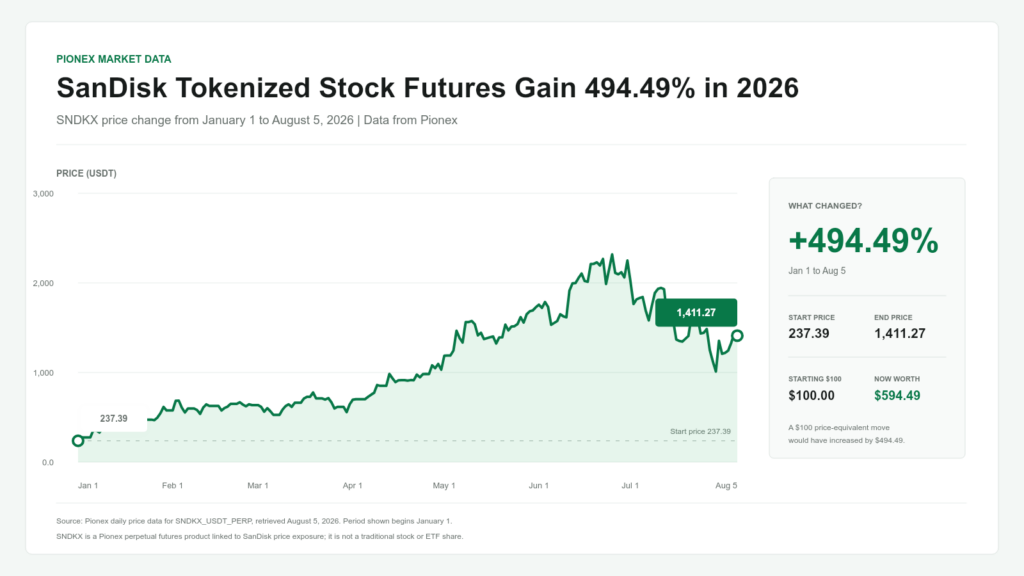
That story has flipped entirely. Real SanDisk shares have posted one of the sharpest rallies of any major stock during the measured period, and the tokenized version of that stock on Pionex, SNDKX, has moved almost exactly in step. Between January 1 and August 5, 2026, SNDKX perpetual futures climbed from 237.39 USDT to 1,411.27 USDT, a gain of 494.49%. A trader who put in $100 on the first trading day of the year would be looking at $594.49 at the snapshot endpoint, before accounting for funding costs, leverage, or fees. Among every tokenized stock available on Pionex across both spot and perpetuals, SanDisk finished the period as the single best performer, ahead of fellow chipmakers Micron, Intel, and AMD.
This piece walks through what actually drove SanDisk’s real-world surge, how the tokenized futures product tracks that move, how SNDKX stacks up against other chip names on the platform, and what anyone considering the trade should understand about the risks before putting money into it.
Contents
Why SanDisk’s Real Stock Took Off in 2026
The short version is that the world ran out of memory chips at the exact moment AI data centers needed more of them than ever. NAND flash, the type of memory SanDisk manufactures for solid state drives, USB sticks, and enterprise storage, went from an oversupplied, commodity market to one of the tightest supply chains in tech within about eighteen months.
The demand side of that story is AI infrastructure. Hyperscalers building data centers for large language model training and inference need large amounts of fast storage. SanDisk introduced a 256-terabyte enterprise SSD designed for AI data lakes. In July 2026, TrendForce reported that servers accounted for more than 40% of NAND flash bit demand and estimated a 4% to 5% NAND supply deficit for 2026.
The supply side made things worse for buyers and better for SanDisk’s margins. TrendForce reported that existing fab space remained constrained as manufacturers prioritized DRAM capacity expansion. Gartner estimated that annual NAND flash prices would rise 234% in 2026, with meaningful pricing relief not expected until late 2027. This combination of rising demand and limited supply supported stronger pricing for NAND producers.
The company’s results support the supply-and-demand narrative. SanDisk reported fiscal third-quarter revenue of $5.95 billion, up 97% sequentially, with a 78.4% non-GAAP gross margin and non-GAAP diluted earnings of $23.41 per share. Nasdaq announced that SanDisk would join the Nasdaq-100 before market open on April 20, 2026. Index inclusion can create passive-fund demand, but it does not guarantee that the rally will continue.
What SNDKX Actually Is
SNDKX is available on Pionex in two markets: SNDKX_USDT spot and SNDKX_USDT_PERP futures. Both provide SanDisk-linked price exposure without direct ownership of the underlying shares. The perpetual contract is denominated in USDT and has no fixed expiry.
Neither SNDKX market provides shareholder rights, dividends, or a legal claim on SanDisk. For a deeper explanation, see what xStocks ownership actually gives you. The spot market does not use perpetual funding payments. The perpetual market can use leverage and involves periodic funding payments between long and short positions, so it adds funding and liquidation risks that do not apply in the same way to spot exposure. Traders can compare the broader tokenized stock fees and spreads before choosing a market.
For broader product context, read the Pionex tokenized stocks guide and the guide to tokenized stock perpetuals and futures bots. The guide to tokenized stock trading hours and weekend closures explains the schedule differences traders should check.
The SNDKX Numbers, January to August 2026
| Metric | Value |
|---|---|
| Start price (Jan 1, 2026) | 237.39 USDT |
| Price as of Aug 5, 2026 | 1,411.27 USDT |
| Percentage change | +494.49% |
| Hypothetical $100 invested | Now worth $594.49 |
| Markets | Spot (SNDKX_USDT) and perpetual futures (SNDKX_USDT_PERP) |
The climb wasn’t a straight line. The chart shows a steady grind through the first quarter, an acceleration starting in April around the Nasdaq-100 inclusion news, a sharp peak in late June near 2,400 USDT, and then a pullback into July before stabilizing above 1,400 USDT heading into August. That pattern, a strong fundamental run followed by a partial retracement, is common in stocks that have moved this fast, and it’s worth remembering that the 494.49% figure reflects the full period rather than a smooth or guaranteed path.
How SNDKX Compares to Other Tokenized Chip Stocks
SanDisk wasn’t the only chip name having a strong year, but it was in a category of its own. Here’s how the top tokenized semiconductor perpetuals on Pionex performed over the same January 1 to August 5 window.
| Rank | Tokenized asset | Jan 1 price | Aug 5 price | Return |
|---|---|---|---|---|
| 1 | SanDisk (SNDKX) | $237.39 | $1,411.27 | +494.49% |
| 2 | Micron (MUX) | $285.59 | $877.61 | +207.30% |
| 3 | Intel (INTCX) | $36.87 | $99.03 | +168.59% |
| 4 | AMD (AMDX) | $214.12 | $476.09 | +122.35% |
| 5 | SOXX Semiconductor ETF (SOXXX) | $301.16 | $535.68 | +77.87% |
The pattern across the whole list points to the same story: memory and storage names outperformed logic chipmakers during the measured period, because the AI bottleneck in 2026 has increasingly been about where to store data rather than only how fast to compute it. Micron, which makes DRAM and NAND like SanDisk, posted the second-best return on the list for largely the same reasons. Intel and AMD gained on general AI enthusiasm but without the same direct exposure to the memory shortage, which is a meaningful part of why their tokenized futures lagged SanDisk’s by a wide margin. Readers comparing the two memory names can also see how to trade Micron (MUX) on Pionex using bots.
How to Trade SanDisk on Pionex
Traders can use the SNDKX_USDT spot market for non-leveraged tokenized exposure or the SNDKX_USDT_PERP market for perpetual futures exposure. Both markets support manual orders. The futures market also supports automated strategies, but leverage, funding, and liquidation risk must be considered before opening a position.
The Futures Grid Bot places orders across a price range selected by the user and can run in Long, Short, or Neutral mode. The Futures DCA Bot can build a long or short futures position through scheduled entries. Pionex currently documents the Futures DCA Bot as available in the app rather than on the web. Neither bot removes funding, leverage, liquidation, or out-of-range risk.
None of this removes the underlying risk of trading a leveraged perpetual on a stock that’s already moved this much. A grid bot narrows the range of outcomes and removes some of the guesswork around entries, but it doesn’t protect against a sustained move outside the grid’s range, and a poorly sized DCA schedule can still leave you overexposed if SanDisk’s rally stalls. Automation manages the mechanics of trading, not the risk itself, so position sizing and a clear view of your own risk tolerance still matter more than which bot you pick.
What Could Go Wrong From Here
A rally this size deserves a clear-eyed look at the downside, not just the headline number. SanDisk’s stock, and by extension SNDKX, is now priced for a lot of good news to keep arriving. Several analysts covering the real stock have pointed out that a company trading at several multiples of its price a year ago has less room for error if NAND pricing growth slows or if hyperscalers pull back on capital spending, and a stock that has run this hard can also fall hard on a single disappointing earnings report or a shift in AI infrastructure sentiment.
There’s a second layer of risk specific to trading SNDKX rather than the real shares. As a leveraged perpetual product, funding rates can turn against a position during periods of high volatility, and a sharp reversal like the one visible on the chart between late June and mid-July can trigger liquidations for traders using leverage even if they were directionally right over the full year. Anyone considering this trade should size positions with that volatility in mind and treat leverage as something that amplifies both outcomes, not just the favorable one.
Regulatory treatment of tokenized equities also varies by jurisdiction, and traders should confirm that products like SNDKX are permitted where they live before opening a position, since availability and legal status differ from country to country.
Key Takeaways
- SNDKX, Pionex’s tokenized SanDisk perpetual futures product, gained 494.49% between January 1 and August 5, 2026, making it the top-performing tokenized stock on the platform over that stretch.
- The rally is rooted in a real NAND flash memory shortage driven by AI data center demand outpacing manufacturing capacity, not speculative trading alone.
- SanDisk’s Nasdaq-100 inclusion in April 2026 added a wave of passive index buying on top of the fundamental story.
- Memory-focused names like SanDisk and Micron outperformed logic chipmakers like Intel and AMD, reflecting where the actual AI infrastructure bottleneck has been in 2026.
- SNDKX is a leveraged perpetual future, not a share of stock, and carries funding costs and liquidation risk that a real brokerage account holding SanDisk shares would not.
- Pionex’s Futures Grid Bot and Futures DCA Bot can automate entries and exits on SNDKX, but neither one removes the underlying risk of trading a leveraged position on a stock that’s already up sharply for the year.
Frequently Asked Questions
Is SNDKX the same as owning SanDisk stock? No. SNDKX is a tokenized perpetual futures contract that tracks SanDisk’s share price, but holding it doesn’t give you shareholder rights, dividends, or legal ownership of the company. It’s price exposure delivered through a derivative, settled in USDT.
Why did SanDisk stock rise so much in 2026? The core driver is a global NAND flash memory shortage caused by AI data centers consuming far more storage capacity than manufacturers had planned for, combined with years of underinvestment in new production capacity across the industry. That squeeze pushed memory prices sharply higher and lifted SanDisk’s revenue and margins along with it.
Is it too late to trade SNDKX after a 494.49% move? Nobody can answer that with certainty, and anyone telling you otherwise is guessing. What’s worth knowing is that the underlying rally has been driven by real earnings growth and a genuine supply shortage rather than pure hype, but the stock has also already priced in a substantial amount of future good news, so the risk of a sharp pullback is real and has already shown up once in the June to July stretch.
What’s the difference between trading SNDKX spot and perpetual futures? Pionex lists both SNDKX_USDT spot and SNDKX_USDT_PERP futures. Spot provides tokenized price exposure without perpetual funding payments, while the futures market can use leverage and involves funding and liquidation risk.
Can I use a trading bot for SNDKX instead of trading manually? Yes. On the SNDKX_USDT_PERP market, Pionex offers the Futures Grid Bot and Futures DCA Bot. The Futures DCA Bot is currently documented as app-only. Bots do not guarantee profit, and funding, leverage, and liquidation risks still apply.
How is this data sourced? The performance figures come from Pionex’s own daily price data for SNDKX_USDT_PERP, retrieved on August 5, 2026, with the period beginning January 1, 2026.
